
When a woman receives rape threats online, has her personal information published or is targeted by a sustained campaign of abuse, who pays the price?
Usually, she does.
She pays in lost work, damaged career opportunities, medical bills, psychological distress and countless hours trying to protect herself and her family.
Meanwhile, the multibillion-dollar technology companies whose platforms facilitate this abuse keep making money.
I’ve spent years investigating cyberhate, interviewing perpetrators and victims, and documenting its devastating consequences. My book Troll Hunting exposed organised networks that deliberately terrorise people online.
I’ve experienced serious cyberhate myself.
One thing my research made clear is that online abuse is profoundly gendered. In research I commissioned from The Australia Institute for Troll Hunting, 44 per cent of women reported experiencing online harassment, compared with 34 per cent of men.
But those figures tell only part of the story. Women reported higher rates of abuse across nearly every category surveyed, including rape and death threats, unwanted sexual material, stalking threats and publication of personal information.
This isn’t simply about hurt feelings. Cyberhate can silence women, destroy livelihoods and drive them from public life.
The Australia Institute estimated that online harassment and cyberhate cost the Australian economy $3.7 billion in lost income and medical expenses in 2019. (The price tag would have surely increased since then.)
Now Australia has an opportunity to change the rules.
The federal government’s proposed Digital Duty of Care legislation would require technology companies to take greater responsibility for online harms.

It’s an important step. But the proposed laws have serious shortcomings, particularly for women.
A joint submission from Wesnet, Australia’s peak national advocacy body for specialist women’s domestic and family violence services, and the Working with Women Alliance identifies serious gaps.
For starters, the legislation doesn’t explicitly recognise gender-based violence as an overarching systemic risk that technology companies must assess and address.
In a Wesnet survey, 99.7 per cent of specialist domestic and family violence practitioners reported supporting clients who had experienced technology-facilitated gender-based violence.
We’re talking about perpetrators using location sharing, read receipts, account settings and ordinary messaging functions to monitor, intimidate and control women.
The proposed legislation also provides broader protections against certain misogynistic content for children than for adults.
However, misogyny doesn’t stop being dangerous when a woman turns 18.
The submission also identifies something I’ve witnessed repeatedly in my investigations: cumulative, relentless harm. One comment might *seem* innocuous. But what happens when someone receives 50 or more such comments daily, or coordinated trolls attack across multiple platforms?
This means legislation focused on individual incidents risks missing the bigger picture.
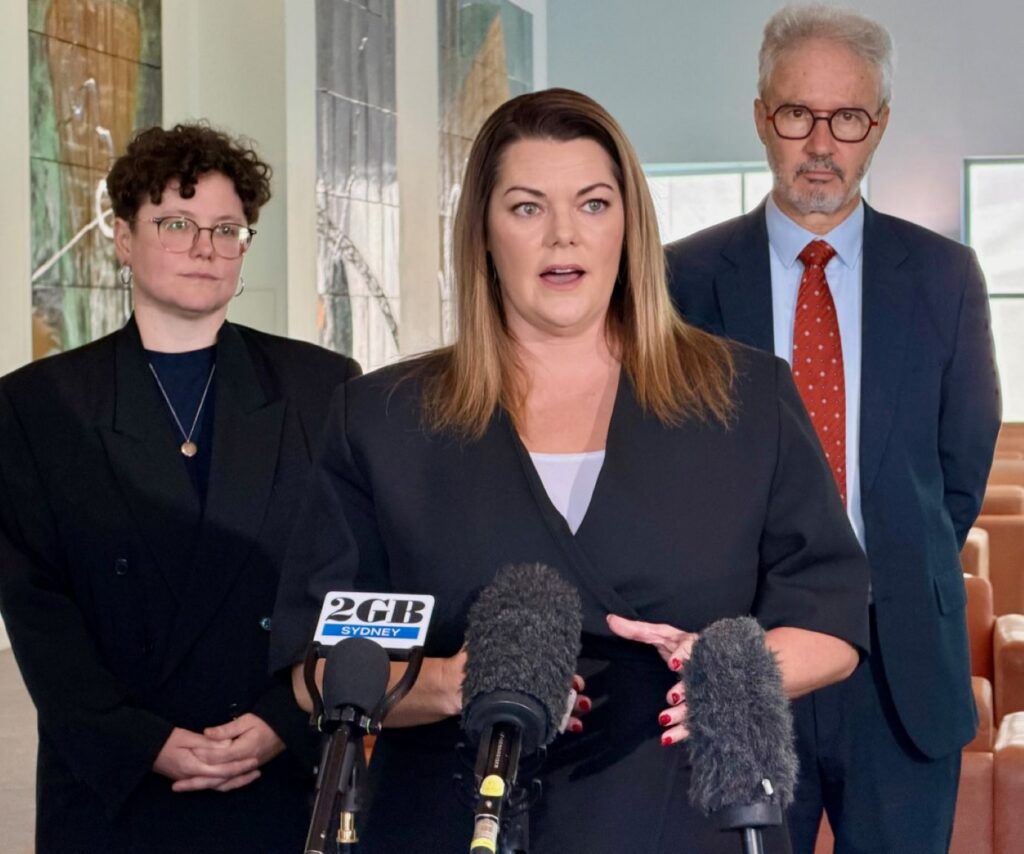
At a recent press conference at Parliament House in Canberra, I asked Dr Gemma Killen, executive director of the Working with Women Alliance, about the consequences for women’s safety and participation in public life.
“Having harmful content taken down doesn’t necessarily address the harms that they’ve experienced or help support them through the trauma, the long tail of trauma that comes afterwards,” she explained.

And that brings us to perhaps the biggest omission.
Under the proposed Digital Duty of Care, individuals would not have a direct right to sue technology companies for breaching that duty.
Enforcement would largely rest with the eSafety Commissioner.
Lawyer Josh Bornstein, now Director of Corporate Regulation at The Australia Institute, is campaigning to change this.
As Bornstein said: “No regulator can police online safety on its own. Australians who are harmed by Big Tech should also be allowed to seek redress for a breach of the Digital Duty of Care.”
Senator Sarah Hanson-Young was equally clear: “Australians should have the right to take big tech to court and to seek remedy – that is, compensation – for the harm that their online experience has done to them.”
The public appears to agree. New YouGov polling commissioned by The Australia Institute found 95 per cent of women believe platforms should be legally required to provide a safe environment and address illegal and harmful content. Among women supporting that obligation, 91 per cent believe it should protect everyone, not just children.
And 72 per cent of women believe people who suffer physical or mental health harm from online content should be able to seek compensation from the platform.
Of course, the right to sue won’t end cyberhate. Legal proceedings can be expensive, exhausting and inaccessible, particularly for traumatised victims.
But financial liability changes the equation for corporations.
As speakers at the press conference pointed out, we’ve already seen this in the United States, where lawsuits against major technology companies have put financial pressure on platforms to address the harms their products cause.
“Once the companies get the hint that it’s going to cost them and hit their bottom line, they will start investing very heavily in making sure they don’t have to pay lots of compensation,” Bornstein told gathered members of the media.
We already accept that companies can be held accountable when their products or practices cause harm in the physical world.
Why should the digital world be different?
For women who’ve been threatened, stalked, humiliated or driven from public life, the consequences of cyberhate are anything but virtual.
They’re painfully real.
It’s time Big Tech started paying a price too.
Sign the petition here: https://nb.australiainstitute.org.au/big-tech