
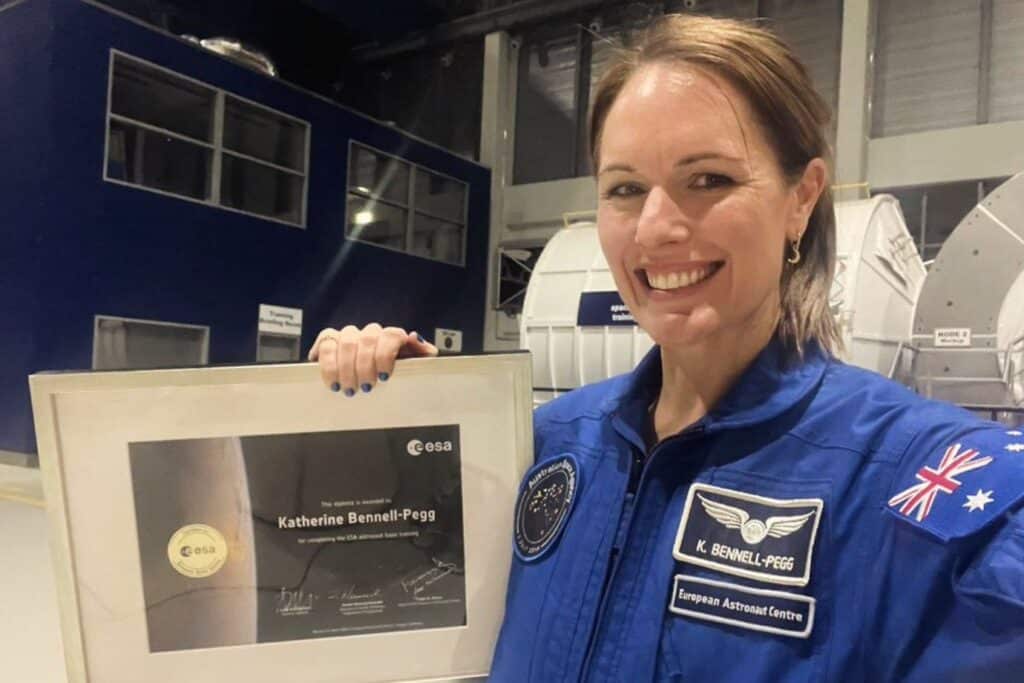
In 2024, Adelaide space engineer Katherine Bennell-Pegg made history by becoming the first person to qualify as “an astronaut under the Australian flag”.
From a candidate pool of over 22,000 applicants, Katherine Bennell-Pegg graduated from the European Space Agency (ESA) astronaut program, and invited to take part in the agency’s mission to the International Space Station (ISS) in a proposed partnership with the Australian Government.
Two years later, the ESA is still waiting for the Australian government to provide the funding needed to send Katherine Bennell-Pegg into space.
Despite efforts to secure alternative funding through crowdfunding and industry backing, the Albanese Government must still cover the cost of the launch — projected to be in 2028, and estimated to be more than $100 million.
Speaking to The West Australian this week, Bennell-Pegg said: “It’s not just about a ticket to space, it’s about a program of research, science, education, diplomacy and supply chain access, and the astronaut is the piece that enables such a program.”
“The Australian Space Agency’s exploration programme is returning $7 for every $1 that’s been invested in it, so it’s an investment in the future.”
Last November, the 41-year old was named South Australia’s 2026 Australian of the Year. Since then, she has toured the country as part of her commitments, speaking at schools to highlight the significance of the mission and what it could mean for Australia as a nation.
“The ISS is coming to the end of its life in 2030 or thereabouts … and space agencies around the world are putting their astronauts on all the remaining seats,” she told the ABC.
“There are very few seats left.”
The International Space Centre at the University of Western Australia has been spearheading a grassroots campaign to convince the Albanese Government of the value of the proposed mission.
It has already secured backing from leading figures in the space industry and former chief scientists, and raised over $1 million through a co-contribution fund.
Astrophysicist and director of the University of Western Australia’s International Space Centre, Danail Obreschkow, warned that if the funding effort fails, Australia may not see another opportunity of this kind for decades.

“We don’t know which space mission, we don’t know the volume of the offer, but typically such partnerships can be in the range of a hundred million dollar investment,” he said.
“Through such a space mission, you join a worldwide economy … that global space economy which is worth a trillion dollars this year. Put it all in the bucket, you get this huge return on investment factors … people working in space, new jobs.”
Another industry-led campaign launched earlier this year urged the Government to view the ESA mission as “a chance to forge a unifying narrative of ambition, innovation, and partnership.”
“This is a moment when evidence and persuasion should replace the assumption that human spaceflight is a luxury for a few and instead recognise it as an opportunity for all,” the statement read.
“The risk to Australia is not in acting; it is in not acting. Rejecting an ESA offer would forfeit a once-in-a-generation chance to strengthen a major alliance, catalyse a STEM recovery, and build sovereign capability with high national returns; supporting rather than competing with urgent priorities such as cost of living.”
This week, Bennell-Pegg is in Western Australia, touring the Goldfields and speaking to young Australians.
“I hope that through representing Australia, I can unlock the opportunity for Australia to be part of human space flight, to be able to put payloads in space, to do research up there,” she told ABC.
“It’s been a privilege to help foster that and help them to dream big for themselves and know that future is in reach from right here.”
The government has yet to make any public commitment to financial support. But a spokesperson for Federal Science Minister Tim Ayres said of Bennell-Pegg: “Her determination to become the first astronaut qualified under the Australian flag to travel into space is an inspiration to us all, particularly young Australians.”