
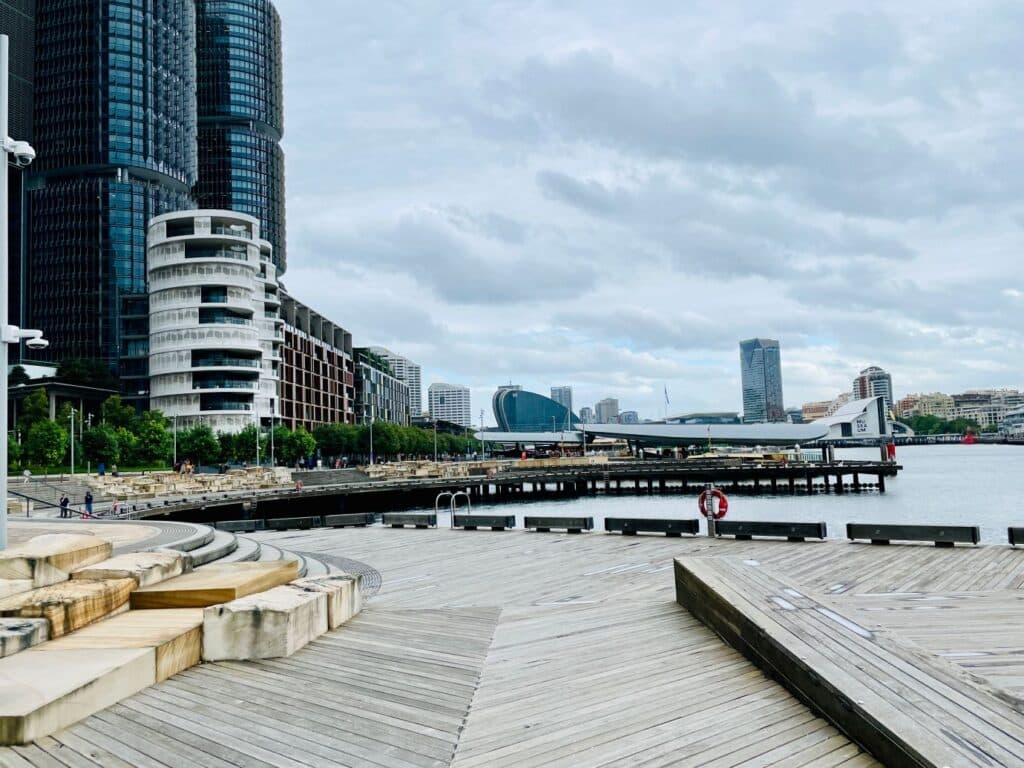
Affordable housing tenants at a Barangaroo apartment complex are required to use a separate entrance. Dr Gemma Killen and Katherine Berney share this piece on what this says about who we believe deserves access to housing.
This week, reports emerged of an apartment complex in central Sydney requiring affordable housing tenants to enter the building from a separate entrance.
The tenants at Watermans Residences at Barangaroo have also being denied access to the building’s pool, spa, sauna and gym. For the privilege of segregation, these tenants are offered a 25 per cent discount on the market rate for rent. Looking at the publicly available floor plans from 2020 this appears to be segregation by design.
A quick google suggests a one-bedroom apartment in the “good” part of the complex costs $1,400 per week, meaning an “affordable” rental could cost $1,000 a week, or more than $50,000 annually.
Imagine Lucy, a teacher – the affordable rentals are reserved for essential workers – who makes $100,000 a year working at a local high school. After paying tax, her HECS repayment, and her rent at this so-called affordable property, she is left with about $385 a week to afford food, transport and medicine, and to pay her bills. The rent amounts to almost three quarters of her post-tax salary. In what world are developers and property owners allowed to call that affordable housing?
Now imagine Lucy coming home from an exhausting (and underpaid) day at work and having to enter her home from a different door to the students she has spent all day teaching. Where is the dignity or the fairness in that?
And if that is how we treat renters who can afford $1,000 a week, how should people who need more support expect to be treated?
This is not just a story about one building in Barangaroo. It is a declaration of who we think deserves to be seen. A “poor door” is not an architectural quirk. It is a deliberate act of exclusion. It says: you may live near us, but you will not live with us. It says that belonging is something you must earn. It teaches everyone who walks past it that wealth equals worth, and anyone who cannot keep up should feel grateful simply to be allowed inside at all. You can segregate people and still charge them a premium for it.
If this is how we treat essential workers, what does that say about how we view women and children escaping violence, or single mothers living in poverty, or young people leaving state care with nowhere safe to go? The federal government has committed to building 4,000 homes through the Housing Australia Future Fund for women and children fleeing violence. That is vital. It will save lives. But housing is not just bricks and keys. If these homes are delivered into systems that shame, isolate or visibly separate people, then all we are doing is moving women from one set of controlled conditions into another. Safety must come with dignity. A locked front door means little if you still have to enter your own home through the side-gate, so others do not have to look at you.
Meanwhile, in Broome, a single mother of two continues to live in homelessness because the public housing property she was offered after years of couch surfing was littered with used syringes, rubbish and dead frogs. And in the ACT, young people are ageing out of the foster care system into homelessness because the eligibility criteria for public housing includes a rental history – which these young people do not have. It sounds like tragic satire, but it is the reality for many women across the country.
What connects each of these stories is a disregard for human dignity. People who struggle to afford ever increasing rents deserve empathy and respect rather than stigma and exclusion.
In 2025, more than 1.2 million low-income households are experiencing housing stress. Of all household types, single parents and their children are the most likely to experience housing stress, with almost two in five spending more than a third of their income on housing costs.
And yet, Australian housing prices are rising at their fastest rate in four years.
We need to do better than policy that allows rich people to pretend there is no housing crisis by making poor people stay hidden behind separate doors, lifts and hallways.
Housing is not just for the rich, it should be a fundamental right.
This is what we are really talking about: the deep cultural belief that some people deserve privacy, care, rest and ease, and others do not. A belief that poverty is a personal failing. A belief that people experiencing violence should be grateful for whatever crumbs they receive rather than a fundamental right to safety. A belief that if you cannot afford a mortgage in a capital city, your life is simply worth less.
These beliefs sit underneath our planning laws, our tenancy systems, our funding rules and our casual public conversations.
They show up in every “poor door,” in every headline about “housing unaffordability,” in every shrug that quietly accepts this as the natural order of things. It is not natural. It is built into the system.
We need coordinated action led by the federal government, and that starts with the release of the National Housing and Homelessness Plan.
About the authors:
Dr Gemma Killen is the Director of the National Women’s Equality Alliance.
Katherine Berney is the Executive Director Working with Women Alliance.