
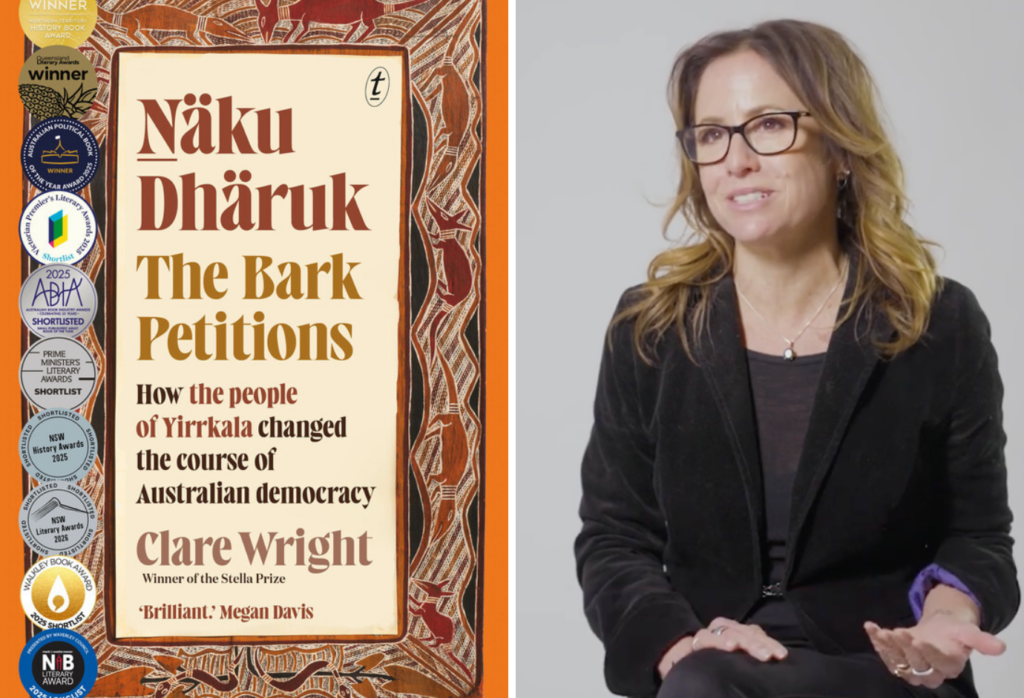
Historian Clare Wright OAM has won Book of the Year at the NSW literary awards for her 640-page tome on the 1963 Yolngu Petitions, “Näku Dhäruk: The Bark Petitions”.
The book follows the story of the petitions on bark created by the Yirrkala community in Arnhem Land and the protesting of bauxite mining on traditional lands. In 1963, Yolŋu elders presented a series of painted bark petitions to the Australian Parliament, asking for federal intervention after part of the Arnhem Land Reserve had been opened to a French mining company.
The documents — at once legal appeals and works of cultural expression — would become a watershed moment in the country’s Indigenous rights movement.
While the petitions failed to stop mining operations, they helped lay the groundwork for Australia’s first land rights legislation, the Aboriginal Land Rights (Northern Territory) Act of 1976.
Wright’s book is the third and final title in her volume on Australian democracy. Previous works include “The Forgotten Rebels of Eureka” which told the story of the women and men behind the Eureka flag, and “You Daughters of Freedom”, an account of the Australian suffragists and their legacy.
“The revolutionary set of books recalibrates Australia’s history to illuminate the lived experience of unrepresented and systematically silenced people during the Eureka stockade (1854), the campaign for women’s voting rights (1880s), and the Yolŋu petition for land rights (1963),” Monique Grbec described in the Sydney Review of Books. “Read together, the books establish a historical, political, and cultural sequence that constitutes Australia’s founding documents.”
The book, which judges described as “highly original” also won the Douglas Stewart prize for nonfiction, worth $40,000.
The judges described the book as “a work of national significance,” praising its deeply researched scholarship and the way its personal histories emerge from the page with striking immediacy.
“It is a book that should be read by all Australians,” judges said.
The book has already won multiple awards since its publication in October 2024, including the 2025 Australian Political Book of the Year, the Queensland Literary Awards Non-Fiction Book Award, and the Northern Territory History Award.
Accepting her latest awards on Monday night, Wright described the wins as “extraordinary”.
“It caps off an extraordinary year,” she said. “[I am] gratified to have that breadth of recognition for a history book, a 640-page history book written by an academic historian that is in its fourth print, which means people are actually reading it”.
“That’s probably the most special thing of all: knowing this story is reaching audiences and they’re consuming it, learning from it, having their hearts broken open by it,” she continued.
“It means a lot to people in north-east Arnhem Land, that the story of their Old People, their Elders and ancestors, is being told and being heard by all Australians and people around the world.”
In a previous interview with Guardian Australia, the La Trobe University professor said she spent ten years working on the book, collaborating with the Yirrkala community.
“The Yolŋu people wanted me to tell it because they wanted Australia to know their story,” she said.
“Readers who have spent time in north-east Arnhem Land with Yolŋu people tell me that [reading the book] felt like going home, it felt like being … in that very special remarkable part of the world.”
Senior Judge James Bradley OAM said this year’s judges were deeply impressed by the strength and variety of the works submitted — over 780 entries across twelve categories.
“Their works explore topics ranging from Indigenous history and the often-painful legacies of Australia’s past to migration and displacement, love, ageing and mortality,” he said. “Time and again, the winning authors demonstrate not just the power and vitality of Australian writing, but also the capacity of great literature to help us understand the past, and think differently about the future.”
Other winners on Monday night include Adelaide poet Jill Jones for her collection “How to Emerge”, which took home the Kenneth Slessor prize for poetry, worth $30,000; Narungga woman and poet Natalie Harkin, who won the Indigenous Writers’ prize for her poetry collection “Apron-Sorrow / Sovereign-Tea”’; Sydney novelist Emily Maguire, who won the University of Sydney’s people’s choice award for her celebrated historical novel “Rapture”; and Australian–Palestinian writer Micaela Sahhar, who won the UTS Glenda Adams award for her critically acclaimed memoir, “Find Me at the Jaffa Gate: An Encyclopaedia of a Palestinian Family”. The book also won the Victorian Premier’s Literary Awards 2026 for Non-Fiction.
Melbourne writer Moreno Giovannoni won the $40,000 Christina Stead prize for fiction for his second novel The Immigrants, while the Multicultural NSW award, worth $30,000, went to Sri Lankan-Australian playwright S Shakthidharan, for his powerful and moving memoir, “Gather Up Your World in One Long Breath.”