
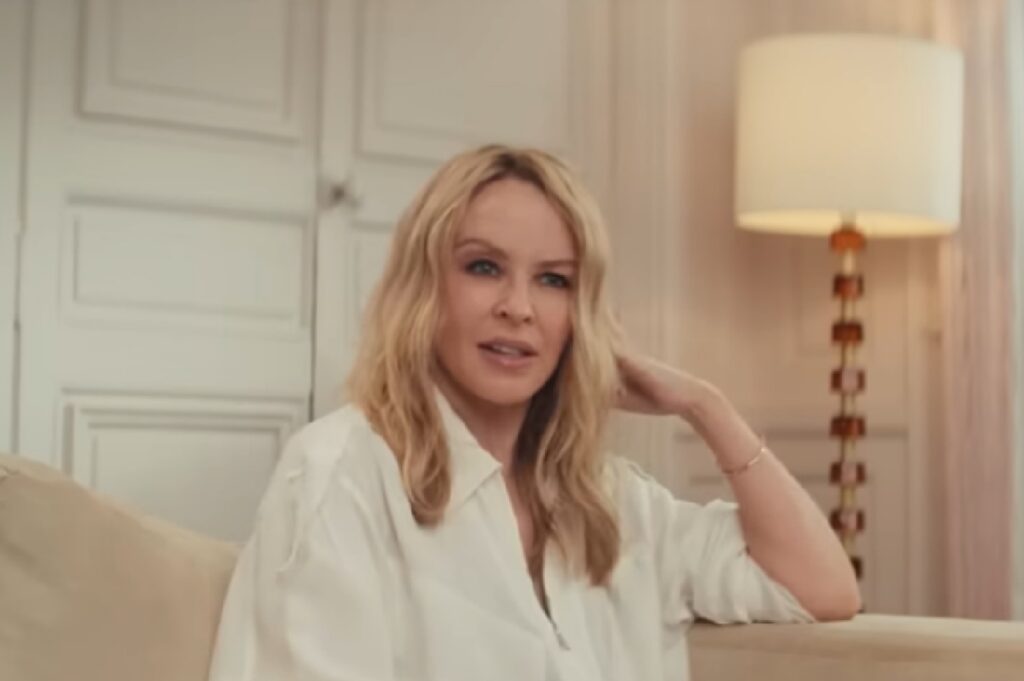
It’s 2003. Michael Parkinson, one of Britain’s most celebrated interviewers, is sitting across from one of the world’s most successful pop artists, Kylie Minogue. She has sold tens of millions of records. She has reinvented herself multiple times over. And what does he ask her?
“Do you want children? You’re 35 now, isn’t that a bit late?”
No eyebrows were raised or angry comments slung at Parkinson. In 2003, the question was fair game.
But what’s our excuse today? It’s 2026, and I can’t help but feel that we’re still subjecting women in the public eye to the same brand of reductive sexism.
The KYLIE documentary, landed on Netflix in three parts, and it’s an unexpectedly moving piece of work. For those of us who grew up with Kylie and did the Locomotion in a layered skirt and wide elastic belt and watched Scott and Charlene’s wedding through blurry eyes, it triggers a flood of memories.
But it also conjures a more uncomfortable feeling; a reckoning with what we accepted.
Minogue was dismissed as “talentless” before she had a chance to prove otherwise. She was labelled “the singing budgie”, a sneer designed to minimise and ridicule. Interviewers grilled her repeatedly about her “raunchy” image, her relationships, and whether her father approved of her choices.
When she was diagnosed with breast cancer in 2005 and forced to cancel her world tour and a coveted Glastonbury headline slot, even her illness became something the public felt entitled to weigh in on.
She has spoken openly about how the “nastiness” cut deep and how behind the sequins and the smile, she was absorbing blow after blow.
None of it was accidental. Women in the public eye have always been assessed on a different set of criteria to men. Closely judged on their appearance, their relationships, their bodies and their biology. Their talent, where it is acknowledged at all, comes second to questions about who they are sleeping with, what they are wearing, and whether they have fulfilled their perceived social obligations as women.
The examples are not hard to find.
Scarlett Johansson, one of the highest-paid actors in Hollywood, spent years fielding questions about her diet and her underwear choices in press junkets.
Mindy Kaling, promoting Ocean’s 8, was asked by a male journalist how she could possibly play a jeweller given that she had never been engaged.
Anne Hathaway sat through an interview in which a reporter repeatedly pressed her about a wardrobe malfunction, refusing to move on, as though her humiliation were the real story worth telling.
Taylor Swift, who has broken more records than most artists alive, spent years being publicly mocked for writing songs about her relationships, a critique that was never levelled at Ed Sheeran or Harry Styles, who source the same emotional territory without consequence.
Billie Eilish began wearing deliberately oversized clothing as a teenager specifically to deprive the media of the opportunity to comment on her body. When a photo of her in a tank top went viral, the commentary was immediate and vicious. She later created a short film addressing body shaming directly, asking the question that no young woman in the public eye should ever have had to ask: why do you care? The answer, of course, is that we have been conditioned to care, to believe that a woman’s body is public property subject to public verdict.
When Meghan Markle declined to be photographed with her newborn son, a British columnist accused her of breaking a contract with the public. The contract, apparently, was her body. Her child. Her private life. All of it, owed.
We ask women to be simultaneously modest and exciting, maternal and youthful, grateful and never demanding, successful but not threatening. We ask them to age gracefully while punishing the very fact of their ageing. We ask them about children and clocks. We ask them to justify their image, their relationships and their ambitions.
And when they push back, as Hannah Waddingham did at the 2024 Olivier Awards, firing back “you’d never say that to a man”, we applaud it as exceptional, rather than recognising it as the bare minimum.
What Kylie Minogue’s documentary makes impossible to ignore is how much energy women in the public eye have always had to spend simply defending their right to exist on their own terms. The documentary’s most affecting thread is not the glittering costumes or the number ones. It is the quiet revelation of how much it cost her and how she kept going anyway.
The questions haven’t changed. Only the names of the women being asked them, have.