
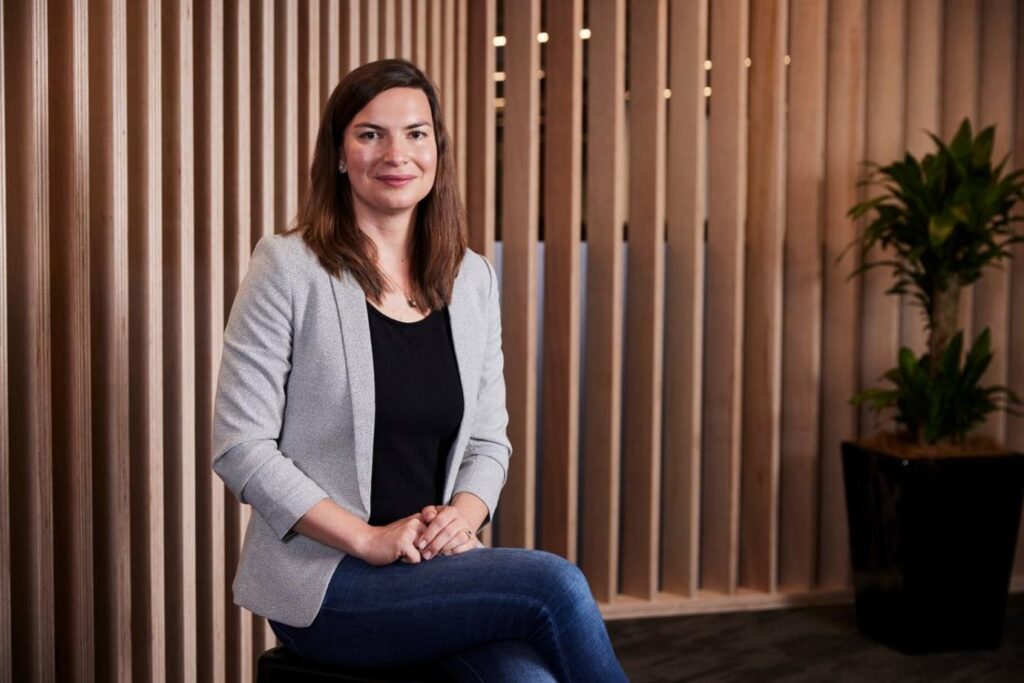
When Nicole Kuepper-Russell was eight, she was given a solar car kit for Christmas. There was no battery as it was powered by the sun. Nicole was baffled. Then hooked. And ever since, her fascination with solar has never wavered.
Nicole joined a recent episode of There Will Be Dancing, a podcast produced by Women’s Environmental Leadership Australia (WELA) in partnership with Women’s Agenda, to talk about what it takes to build a clean energy future designed for everyone.
Her early curiosity was shaped by a childhood spent between two very different worlds. Nicole’s parents are German and the family spent summers or winters with relatives there. Flying into Germany, she would look out the window and wonder, “What are all those solar panels doing on those houses?” despite the cold and the snow. Flying back into Australia, a land bathed in sunshine, she would see almost none. Her grandparents sorted their rubbish into seven separate streams and reused their water multiple times over. Australia was only just getting used to the idea of recycling.
“It was a really interesting juxtaposition of two societies,” she says. That contrast pointed her toward a life in energy.
Nicole’s credentials are formidable: a PhD in solar cell devices from UNSW completed by 25, a decade at Bain & Co and nearly six years at 5B, the Australian clean energy company where she now serves as Chief Strategy Officer. Throughout her career she has watched the cost of solar fall from around $8 a watt to roughly 10 cents, a shift she still finds astonishing.
However the pace of that advancement is only half the story. According to Nicole, solar has been technically and economically competitive for at least a decade, yet the rollout still lags well behind what the technology allows. The gap lies in political will.
“It’s government policy that turns proven technology into adopted infrastructure,” says Nicole. “Australia’s opportunity lies less in competing with global manufacturing giants and more in driving towards ultra-low cost, large-scale solar deployment.”
She’s frank that while the Australian government is doing a great deal, it isn’t yet enough to meet the scale of what the climate crisis demands.
The ambition to meet the moment the climate crisis demands is as much cultural as economic. Nicole points to the Burj Khalifa, and the napkin sketch that preceded it by six years, as an example of a society choosing to build the seemingly impossible rather than dismiss it. She wants Australia to bring the same energy to its own transition, resisting the national habit of tall poppy syndrome and reflexive doubt.
As the executive responsible for HR at 5B, Nicole has made equity part of the transition.
She redesigned the company’s production line to remove physical exertion requirements and lifted female representation on its factory floor to 40 per cent. Flexible shift structures opened roles to people with all kinds of caregiving responsibilities. A gender-neutral parental leave policy has seen full uptake and the gender pay gap sits at just 5 per cent.
Her own career has required its own negotiations. She and her husband keep “a very dedicated teapot,” brought out only for their most significant conversations. It was over that teapot, early in their relationship, that they struck a deal: “For three years, your job will be the focus… and then from then on, pretty much bang on, every three years we have moved somewhere for someone’s career, and that person’s career has taken precedent.” The arrangement has taken them from Canberra to Sydney, London and Abu Dhabi, each move dictated by whoever’s career was in its three-year window.

Nicole is candid that when she was starting out in solar, she struggled to find women in the industry she could look to. That absence has shaped how she now shows up for the next generation, whether speaking to a high school class over Zoom or telling her own story publicly. “Without those stories, you don’t build excitement,” she says. “It’s that excitement, as much as any technology, that will draw the next generation in.”
Looking ahead, Nicole’s vision is unapologetically big: an Australia that leads in green industries rather than watching them build elsewhere, backed by a clear national plan and the courage to pursue projects before every risk has been resolved. Getting there, she insists, will take more than falling costs and better technology. It will take the stories and role models that convince the next generation this is a future worth building.
Listen to the full conversation with Dr Nicole Kuepper-Russell on There Will Be Dancing, available now on Spotify, Apple Podcasts and all major platforms.