
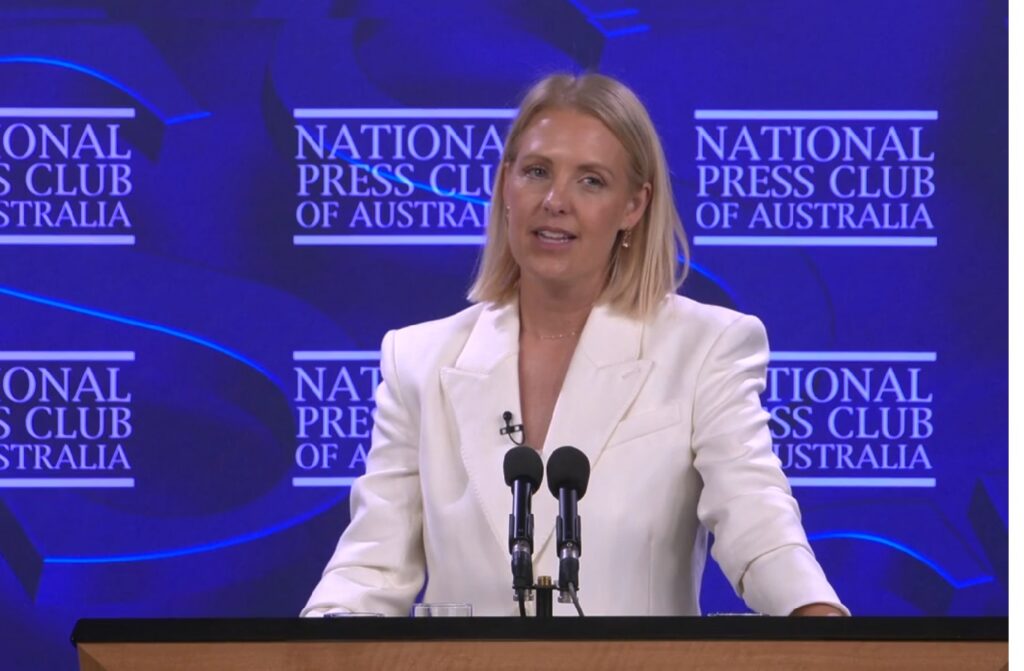
On Wednesday, I sat in the audience at the National Press Club listening to my extraordinary friend and former Women’s Agenda colleague Georgie Dent deliver a speech aptly called The Mother and Father of all Problems.
Now CEO of NFP The Parenthood, Georgie’s address looked at the ways families’ lives and work have shifted dramatically over the past couple of decades, while so much of the infrastructure designed to support them still seems built for a bygone era.
She made a compelling case for better paid parental leave, genuinely universal early childhood education and care (a pledge outstanding from the government), and workplaces that recognise caring as part of ordinary life rather than an inconvenience to be begrudgingly accommodated.
She also made the point that “every failure” of the system “lands on single parents and their children first, and hardest”, because there is no second adult available to absorb any of the fallout.
As these words were spoken, I felt my eyes prick.
I have been a solo mum for nearly two years, with a four-year-old daughter and six-year-old son, and increasingly I think this is the part of the family policy conversation we don’t talk about nearly enough.
The problem with being a solo parent is not simply that everything costs more, although obviously it does. It’s that so much of everyday life is built around the assumption that there are two adults available to make it work.
Our system currently fails all parents. But at least, at least, with a partner, there’s some a modicum of relief.
I have written on this issue before, and always start out by underscoring my enormous privilege.
I have a good job, run a business, have flexibility and earn a salary that puts me in a very different position from a single parent struggling to pay the rent and put food on the table at the same time. Too many single parents are struggling in this way.
In fact, nearly one in three single-parent households in Australia (approximately 31.3 per cent) live below the poverty line. That is a glaring indictment on Australia and the “lucky country” we’re promised.
But even with the strong advantages I have, I find the practical business of making work and family life fit together extremely difficult.
I live in regional NSW, in a childcare desert where options are more constrained than they would be in a major city. When I need to travel for work, arranging care for two children can involve what feels like 17 different conversations, favours, contingencies and calculations.
I have an amazing network, family, resources and can usually find a way through it. But that is another lucky break, that a lot of single parents don’t have.
The government relies on the lucky breaks of single parents too much.
In days when I’m home and not travelling, I’m still hamstrung. As noted by Georgie, school finishes before most full-time working days do, meaning that as a single parent, I’m forever playing catch-up in a bid to retrieve lost income from lost hours.
Through guilt, I often make up the deficit early in the morning or on weekends. Then I’m plagued with additional guilt of not being there enough for my kids.
School holidays stretch far beyond my annual leave entitlements. Kids get sick at exactly the wrong moment, childcare centres close (and more so when they’re impacted by climate events commonly occurring in the Northern Rivers, where I live), and work sometimes requires you to be somewhere other than your home.
Georgie cited an ABC analysis finding that two full-time working parents with primary-school-aged children can need more than 800 hours of additional care. Those hours can’t be divided in a single-parent household.
When millions of parents are encountering the same structural obstacles, we surely need to zero out and then zero back in. As Georgie put it, parents can’t meditate their way out of a childcare desert or time-manage their way into a 25th hour.
Of course, the economic gain should be the clincher.
Treasury research found that having children reduces women’s earnings by an average of 55 per cent over the first five years, while there is little discernible earnings effect for men.
Meanwhile, The Grattan Institute estimated that a 95 per cent universal childcare subsidy would cost about $12 billion a year while boosting Australia’s GDP by $27 billion annually.
The economic modelling is there, yet if caring remains something primarily associated with women’s careers, the motherhood penalty will continue to be baked into the system.
Then there is the compounding issue of loneliness and isolation as seen in Women’s Agenda’s own research with Medibank. Our Motherhood Index showed mums reporting significant pressures around the mental load, support, connection and the sheer amount of responsibility they carry, with single/solo mothers facing significantly elevated risks of chronic isolation, anxiety, and mental health challenges.
This is a sleeping giant of an issue that needs significant attention.
In fairness, we’re seeing some progress in certain policy areas which are making a profound difference.
When I had my son close to seven years ago, the government paid 18 weeks of parental leave at the minimum wage; today the entitlement is 26 weeks, with superannuation and four weeks reserved for partners. This is a good step.
But there is an obvious difference between being entitled to leave and being able to afford to take it, particularly when the payment remains tied to the minimum wage rather than replacing a person’s actual income.
Georgie’s proposal for a pathway towards a full year of paid parental leave, progressively moving towards wage replacement and including appropriate provisions for single parents, is worth taking seriously.
So too is the bigger question of whether our tax and welfare settings adequately account for households with the same combined income but very different numbers of adults available to earn and care.
A household where two adults each earn $75,000 is not necessarily living the same financial reality as one where a single adult earns $150,000 and is solely responsible for two children. The second household has one income taxed at a higher margin. It’s one career and one person carrying the risk of losing that income, while also doing the unpaid work of raising a family.
None of this is an argument that single and solo parents should be treated as a special category to whom every problem must be individually solved. I think the opposite is true. We just need to build family infrastructure that recognises how people actually live now.
Paid parental leave, accessible early education and care, and workplaces that recognise caring responsibilities should be treated as baseline infrastructure rather than generous extras.
We’re all tired of a system that depends on us muddling and struggling through.