
Anthony Albanese spoke at length about AI and jobs at the University of Sydney on Wednesday. He didn’t mention the finding in his own department’s report about which jobs go first.
Released last week, that report found that seven in ten jobs in the “least exposed” quintile are held by men, compared with women dominating four in ten jobs in the “most exposed” quintile – which should concern any government that claims to be concerned with women’s workforce participation.
Instead, Albanese said the report indicated software jobs are increasing and that the disruptions feared haven’t eventuated.
He also incorrectly stated that Australia has “real-time, data-driven analysis of AI’s impact on the labour market.”
This report is not “real time”. The report released just a week ago covered a period from the end of 2022 to February 2026 – thereby failing to account for significant advancements in AI development, including Claude models that have disrupted the software industry globally. In the months since February 2026, Australia has already seen a number of high-profile examples of companies announcing extensive layoffs as a result of AI, including WiseTech Global (announcing 2,000 jobs will be cut), Atlassian (announcing 1,600 jobs, including 500 locally), and the local Australian offices of larger multinationals.
Here’s what he did announce.
Albanese promised faster approvals for AI projects, including data centres, during his major, urgent speech on AI delivered at the University of Sydney. As of Wednesday, Australia now has an Office of AI within the Department of the Prime Minister and Cabinet, which will take immediate effect to coordinate cross-government work and design new Australian AI standards.
He said Australia’s “agency” in embracing and shaping AI comes from building the capability to do so right here. We have a geographic advantage, he said, and plenty of space to build data centres. This capacity is our leverage with the big AI firms, he added. It’s our opportunity to negotiate the terms of engagement and, in turn, determine AI’s impact on jobs and the economy.”
“We have more than enough room for new data centres, without them competing with new housing,” Albanese said.
Our leverage against big tech, in other words, lies in ensuring it operates in our social interest or within our geographic footprint.
I’m not convinced.
There is more at stake than Albanese indicated during his overly optimistic speech on the issue on Wednesday. This isn’t a matter of being left behind – we’re far too late for that. Rather, it’s a matter of acknowledging some of the real risks of the future, including threats to democracy posed by deceptive deepfakes and misinformation, as well as those associated with AI-related job displacement.

Albanese suggested that opening more opportunities for AI firms to invest in Australia will be key to ensuring AI creates jobs, but he doesn’t explain how such investments will create jobs in the long term, beyond offering some optimistic statements that they will.
Sure, there might be some limited work in constructing data centres and in adjacent technical roles, but these buildings essentially become ghost towns. There’s some limited opportunity in AI innovation and for entrepreneurs and startups to leverage AI to build new solutions. This doesn’t create jobs at scale.
It’s unclear how employers will improve conditions for workers through more of us embracing AI – where there are productivity gains, why would employers bother to keep the full workforce capacity or to replace those who leave?
Meanwhile, just a day before Albanese’s speech, leading AI researchers and economists from around the world issued an open letter sounding the alarm about job losses from AI and urging policymakers and tech leaders to better prepare the economy for what’s ahead. They declare AI could “drive an unprecedented transformation of our economy, larger than the Industrial Revolution.
Albanese curiously took a much softer approach, comparing the AI transformation to the advent of aviation in industry in the 1920s and genetics in the 1990s. Such comparisons were either designed to downplay concerns about the current and upcoming disruption or made because the PM’s own office lacks awareness of just how much will change.
To his credit, Albanese promised that, “Our Australian standards will also set clear rules for large data centres: where they are built – and the power and water they use.”
Albanese promised that, “Our Australian standards will also set clear rules for large data centres: where they are built – and the power and water they use.”
He said there will be a legal obligation for the next generation of large-scale data centres to underwrite new power supply. To pay their full share of grid connection, so no costs are passed on to homes or businesses.
And on the copyright issue, Albanese made some big statements about protecting the copyrights of musicians, artists, journalists, and other creators, promising new laws to do so.
He said “our laws will spell that out, plain as day” – in terms of Australian writers, musicians, artists, and journalists retaining ownership and control of their work.
“No company should use Australian books, music, art or news to build or train AI without the artist’s control.”
But that doesn’t account for the generations of work already stolen.
As for the value of good work, Albanese touched on it in a light at the end of his speech. he said, “the value and importance of secure and fulfilling work” will never change, and that “we should not treat AI as a threat to good jobs — we must use it as an instrument to help create them.”
These are all good hopes for the future, but they all require far more detail and work ahead.
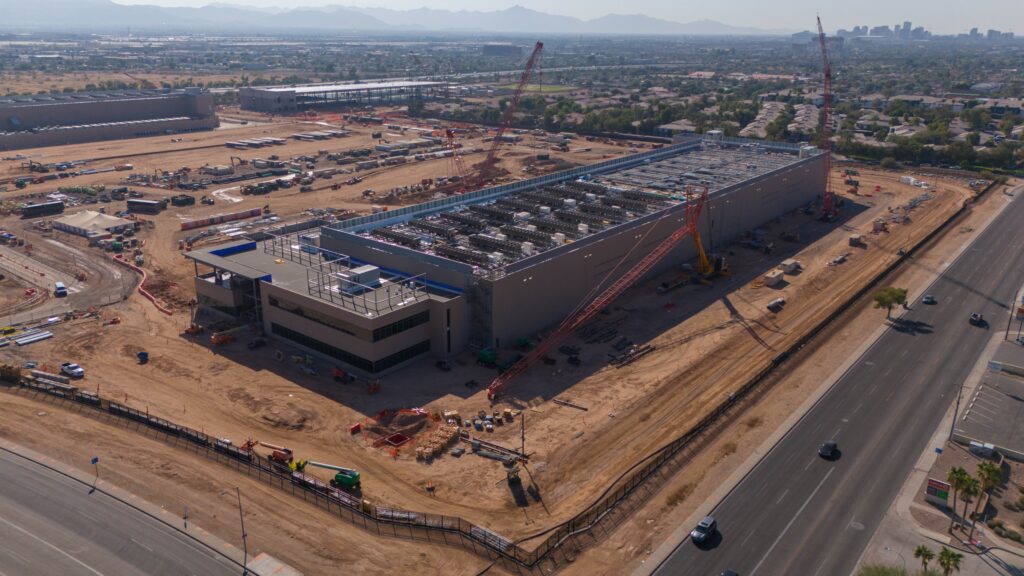
Pictured above: A data centre under construction in Phoenix, Arizona.