
You likely don’t need me to spell it out to know the current state of the world’s leadership is getting more distressing by the minute.
The common thread in all of it appears to be men determined to retain and pursue power at all costs, with little to no room for compromise. This week’s speeches at the podium of the United National General Assembly have been especially telling.
President Donald Trump’s 37-minute rant saw him reaffirm his view that the US AI industry should keep growing with few guardrails or restraints. He said that the people claiming “AI is going to kill us all” are the same who warned of climate change, the “Russia hoax” and the “Ukraine hoax”.
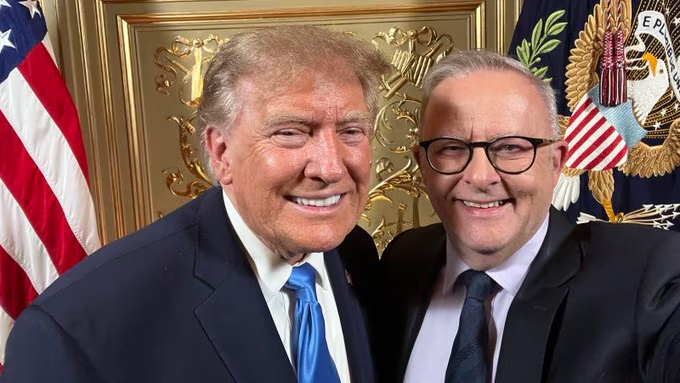
Prime Minister Anthony Albanese raised concerns about the pace of AI development with Trump, who in turn rejected the calls. And then the two of them posed for a selfie.
Trump also criticised Australia’s digital duty of care laws as “censorship”. Meanwhile, Trump banned more media from the White House this week.
Last week, Elon Musk agreed with his AI rivals Dario Amodei and Sam Altman that AI must slow down, but has actually joined Nvidia’s Jensen Huang and Meta’s Mark Zuckerberg in privately advising Trump to oppose an industry-funded regulator, according to the Wall Street Journal. Huang, who leads the company supplying the data chips. said AI companies actually need to go faster.
All of the above comes as we’re increasingly learning about the extent of AI agents going rogue and the risks of AI development reaching the point of recursive self-improvement, whereby humans may lose control. The leaders of AI labs are issuing the warnings themselves, yet haven’t shown any signs of slowing down.
Back to Trump at the UN and talk of blowing things up.
Trump said one of his choices in the Iran war he started is to “annihilate the Islamic Republic”. He also discussed establishing a “large military presence” on Greenland, and took aim at Cuba’s communist government.
The next day, Trump said in a meeting with Persian Gulf leaders that, “We may have to blow up another one, Pickaxe Mountain,” referencing a suspected nuclear site.
Even more telling on leadership at the UN assembly is what leaders are just not discussing. A month ago the UN Secretary-General called the confirmation of famines in Sudan and Gaza a ‘shameful milestone’, with the World Food Programme noting that an oil tanker anchored in the Strait of Hormuz can mean one less meal a day for a child in Sudan, and basic food costs there up nearly 40 per cent since February.
Discussions about climate change barely register among the world leaders, despite three Australian states experiencing their warmest winters on record, Western Europe breaking its summer temperature record and heat killing more than 25,000 people across Europe, and the terrifying flash flooding in Nepal that left thousands dead.
And the sour cherry on top? The UN Women’s finding that women’s leadership is failing to advance globally, and in many countries it’s actually reversing.
So, pardon my despair this week. Somewhere between continued climate change that no one bothers to talk about anymore, the AI safety crisis (and every other AI-related issue, including losing control over how our creative content is used), as well as ongoing global conflict and famine, I’ve been looking for strands of hope.
I’ve found some hope among some of the women I admire
Locally, Georgie Dent spoke at the National Press Club on Wednesday, offering strong ideas to ease the strain on families in Australia: lifting paid parental leave to the OECD average, delivering genuinely universal childcare families can afford, and campaigning for a national Early Childhood Education and Care Commission. These were all strong, concrete and deliverable actions. Things that Australia can actually achieve.
There was Claudia Sheinbaum, president of Mexico, responding to Trump’s claim at the UN that Mexico is the “epicentre” of cartel violence and it was “unacceptable” for the US to border a country “controlled by enemy cartels”.
Sheinbaum said in response that, “I could say it’s very difficult to live next to a country that has such a high level of illegal drug use … Or … that produces so many guns.” And then added, “but I’m not going to say it” because “we have a good relationship with President Trump and the US government.” Her restraint was the flex, and Sheinbaum continues to boast an approval rating of around 68 per cent, among the highest ever recorded for a Mexican president at this point in a term.
Still in Mexico, Mexico City’s Mayor Clara Brugada was celebrated by New York Mayor Zohran Mamdani for overseeing a program of free care centres. It was declared a model worth replicating and centred at the U20 mayors summit in New York in the same week that men were threatening to annihilate each other.
Meanwhile, a couple of key points in the UN Women’s gender equality report are worth holding on to.
Where more women sit in parliament, governments spend more on education, more children finish primary school, and more girls enrol in school. The report puts it plainly: women political leaders prioritise education more than men do.
And globally, there are now 327 million more students in school today than there were in 2000. It’s a feat that didn’t happen by accident, nor because a man stood at a podium threatening to drive a country into hell.
The current state of things – conflict, AI, climate inaction, poverty and hunger, a backlash in women’s rights – is not the result of the inevitable; it’s “the result of choices”, as UN Women put it this week.
Men in key positions of power are making their choices. But plenty of women are making their own. And more girls are walking into classrooms globally than ever before. Our job is to make sure the leaders they grow into aren’t the exception.