


I’m the editor of an online publication for intelligent women, there’s nothing about my job I don’t love.
Well, actually, no, that’s not quite true. There’s one thing about my job I don’t love, and I don’t love it to the point that it has me hurling profanities at my screen every day.
Images. Or, to be more precise, stock images I can use for stories about women.
Most stock images of women fit into a few narrow categories:
- Blandly pretty, young white women doing blandly pretty things – babies, flowers, cupcakes, tea.
- Blandly pretty, young white women gazing adoringly at blandly handsome young white men being blandly powerful
- Age appropriately dressed “mature” white women doing grandmotherly things
- Oooh, cute! A secretary!
- And the obligatory single image of a coloured person, with a bunch of blandly pretty white people. Look at how not racist they are being!
The only other alternative for women: scantily clad, perfectly shaped, gazing seductively into the camera.
I think there is one stock image I found of a young woman and an older woman together that didn’t involve babies.
One.
Women, apparently don’t spend time with other women unless they are all the same age and level of bland prettiness. Women are not tall, short, round, old, coloured or less than perfectly contoured. They are not wrinkly, saggy, chubby or variable in any shape, size, activity or ambition.
Nor are they powerful, interesting, engaged, strong, independent or anything of the myriad things that most women actually are.
It’s infuriating. Stock images are background noise, they are deliberately beige and grey, meant to illustrate but not detract from the written content. They are the (very) white noise of the internet and often, until you really start looking at it, you don’t notice how subtly they reinforce the idea that women, unless they are highly sexualised, are meant to be young pretty, submissive and unobtrusive; or motherly/grandmotherly, submissive and unobtrusive.
And that’s just when you’re looking for images to accompany articles about women at work.
Women’s Agenda also publishes about male violence against women. The only stock image options are pictures of bruised, broken women, usually with a clenched male fist or indistinct looming male figure posing threateningly above them.
For those of us who publish responsibly on such topics, images like that are just not an option. You can warn people about content so they don’t accidently click into an article and find themselves in the middle of a graphic description of violence, which can and does trigger painful memories or flashbacks in survivors of such violence. But you can’t warn them about the images that flow through their Facebook feed, or jangle on the front page of news sites.
A domestic violence survivor once told me she was told by a well-meaning friend to “just stay off Facebook”, because the images that are forced upon her were inducing panic attacks and terror.
Just stay off Facebook. Sounds like a non-problem, doesn’t it? Except that it isn’t. Women who are in abusive relationships, or have just escaped them, are frequently isolated by the abuse they suffered. Social media is a way of connecting to the world, to people and services who can help them, to stories that can reassure them and information that can slowly help unwind the twisted ideas their abuser has enforced on their understanding of their experiences. Just stay off Facebook is the worst thing you can say to those women.
I got a PR email from Getty images last week about their new “Lean In” collection. Obviously I am far from the only person in media struggling with this problem. Some, but not all, image services have recognised that women do not want to see themselves rejected by blandly pretty submissive images, they want to see themselves reflected in the full variety of female experiences. They want short, tall, round, off centre, strong, hawkish, old, hilarious photos of women. They want images that look like the world they recognise, not the world they know is not their space.
This is a Getty image from 2007. She is naked, seductive, perfect looking. And she is lying down, powerless, but for her sexual appeal. She has nothing to do but gaze into the camera and wait.

This one is from 2015, attractive, but not bland, fully dressed, occupied, thinking about something, going somewhere. The full range of new images includes women of all colours, ages, interests and sizes.
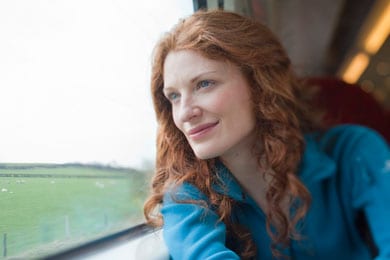
Here, here and here are links to other stock images that are some improvement on the standard services. Although the women are still almost entirely white and young, they are at least engaged and interested.
In the huge range of issues that affect women, stock images are not high on the list, but they are the background to public discussion of the issues that really matter. Every time we read an article about the real issues of violence, economic disparity and power imbalance, and the intersection of race, religion, gender identity and sexual orientation that complicate those issues even further, there is almost always an image that accompanies the article. And it insidiously colours our view of those issues, who they affect and how they affect them. It’s a small, but subtle indicator of how women are viewed and how much we still need to change.
What do we want? To see women as they really are, not what they are told they should be.
When do we want it? Well, a couple of decades ago actually, but now will do.
Now.
Please.