
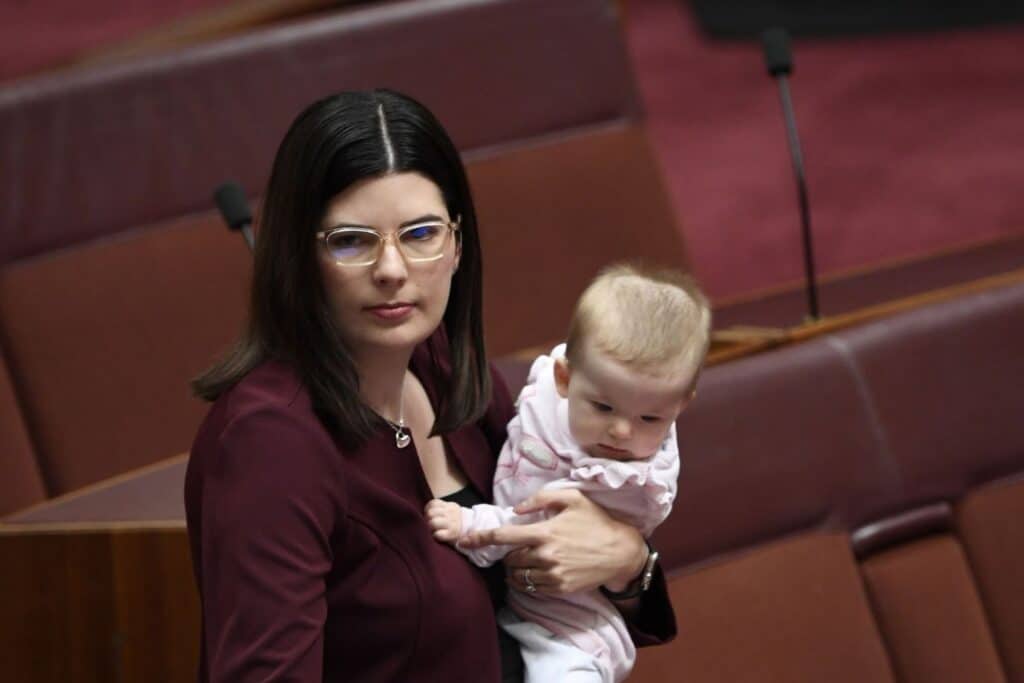
Having a newborn left Labor Senator Marielle Smith feeling helpless and with postnatal anxiety. She wants more women to share their story.
There isn’t a moment in my life where I have felt more powerful than when I first held my baby son Benjamin in my arms. I remember so vividly the sense of relief, the explosion of love and the feeling that I could do absolutely anything.
But that sense of power didn’t last for long. In the days and weeks that followed, I felt the most helpless I had ever felt.
Breastfeeding was extremely difficult for me. The pain was agonising. Holding my baby in my arms, so desperate to feed and nourish him, I felt like such a failure. It’s not surprising that I ended up with post-natal anxiety as a result.
Yet I was one of the lucky ones. I found a wonderful lactation consultant, Robyn, who literally held my hand until I got breastfeeding back on track, and as a result I was able to go on to feed my baby for a year. But I am extremely cognisant that I was able to access this support because I lived in a capital city like Adelaide, and because I could afford to pay for it privately, something I know isn’t accessible to many women.
Good postpartum health care should never be a matter of luck. It should not depend on where you live or whether you can afford the care you need. Yet for many women, that is the reality.
Eight years on from the birth of my first child, I now hold a seat in the Senate. And I’m determined to use it to drive change here for women and their families.
That’s why in August, I moved a motion in the Senate to establish a new Select Committee to inquire into postpartum care in Australia, as well as a number of other very important women’s health issues including fertility and women’s pain. Since then, I have been overwhelmed by the number of women, clinicians and experts who have reached out asking to be involved.
It is painfully clear to me that too many women have been suffering and have failed to receive the care and support they need.
Now is the time for them to have their say.
Submissions are open until 9 October, and they do not need to be overly long or formal. It could look like a letter to the Committee, sharing a personal story. It might address a woman’s experiences of pain, fertility care or the postpartum period. We’re interested in learning more about the barriers to affordable, timely and appropriate care, what is working, and what needs to change. We want to hear about the gaps, and fresh ideas for how things could be better.
I know sharing a personal story can be difficult. It was hard for me to share my own in such a public way. There is still a lot of stigma that surrounds this part of a woman’s health journey. But lived experience is powerful – and I know together, by sharing our experiences we can build an evidence base that makes a compelling case for change.

We have seen such incredible progress on women’s health in recent years, with the Albanese Labor Government’s landmark $792 million women’s health package that has seen new contraceptives and hormone replacement therapies added to the PBS, more training for doctors, greater investment in pelvic pain and endometriosis clinics and longer medical appointments for women, among many other measures. These changes were possible because so many women raised their voices, fought through stigma and called for change.
I’m urging women across Australia – please share your story and be a part of this work. Your voice is powerful – and it can lead to change. In this effort, I’ll be standing right beside you.