
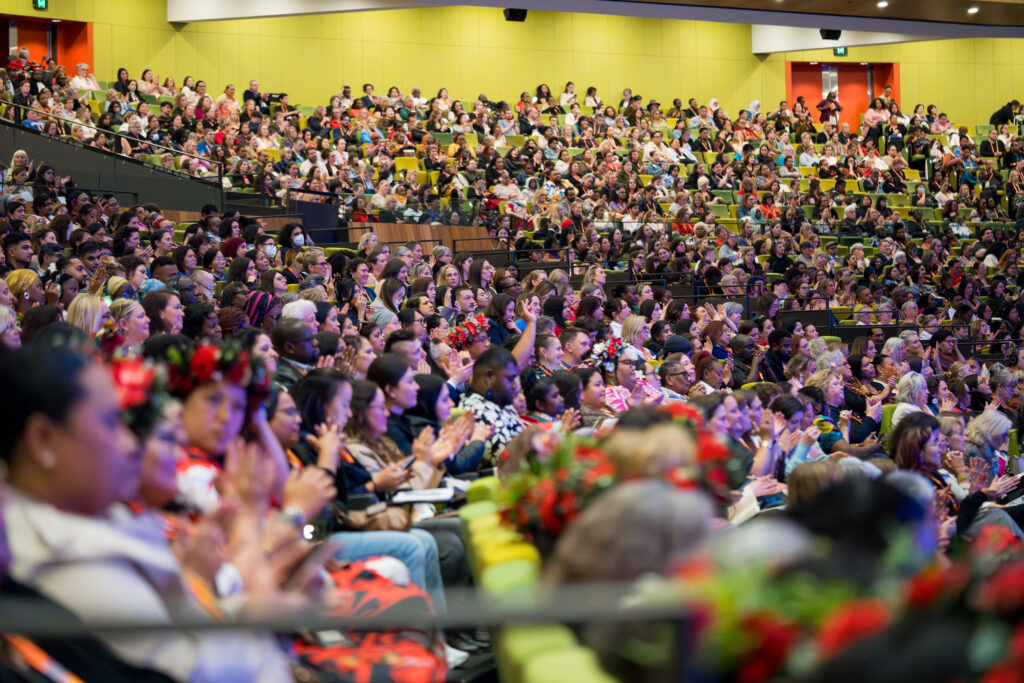
There is a particular kind of emotion that comes from being in a room or in a city with nearly 6,000 people who refuse to stop fighting. That was Day 1 of Women Deliver 2026 in Naarm (Melbourne) on Monday, and I felt it in my chest before the day was over.
I was fortunate enough to attend Women Deliver in Kigali in 2023, so I knew this convening brings a rare electricity of like-minded people converging across difference, across distance, across exhaustion. What I did not fully anticipate was how much more weighted this moment would feel. Because the world has not stood still. It has lurched, violently, in the wrong direction.
5,990 delegates. 189 countries. 246 languages. Those numbers, read aloud by Dr Maliha Khan at the opening ceremony, landed like both a miracle and a mandate.
We are living through what speakers at the first press conference named plainly and without flinching, the rise of an anti-rights movement actively dismantling decades of hard-won progress. Women in war-torn countries bear the highest cost of conflict. The climate crisis is falling disproportionately on women and gender-diverse people who hold the least political power and the fewest resources. And a creeping, emboldened retrenchment of reproductive rights, safety, and autonomy that is happening, as former prime minister Julia Gillard noted pointedly, not in secret. “We must push back,” she said, “and must not let the next five or ten years solidify the retrenchment of women’s rights.”
That is the backdrop against which Women Deliver 2026 opens its doors in this country, on this land and centering the voices of First Nations women. And the timing, as Amina Mohammed, Deputy General Secretary of the UN put it, matters enormously. “The geopolitical context matters,” she said. “The new era of crisis after crisis — COVID, war, climate change — we must create the momentum.” Thirty years after The Beijing Declaration, she reminded us, we are still arguing with men about women’s reproductive health. That sentence should not be possible. And yet here we are.
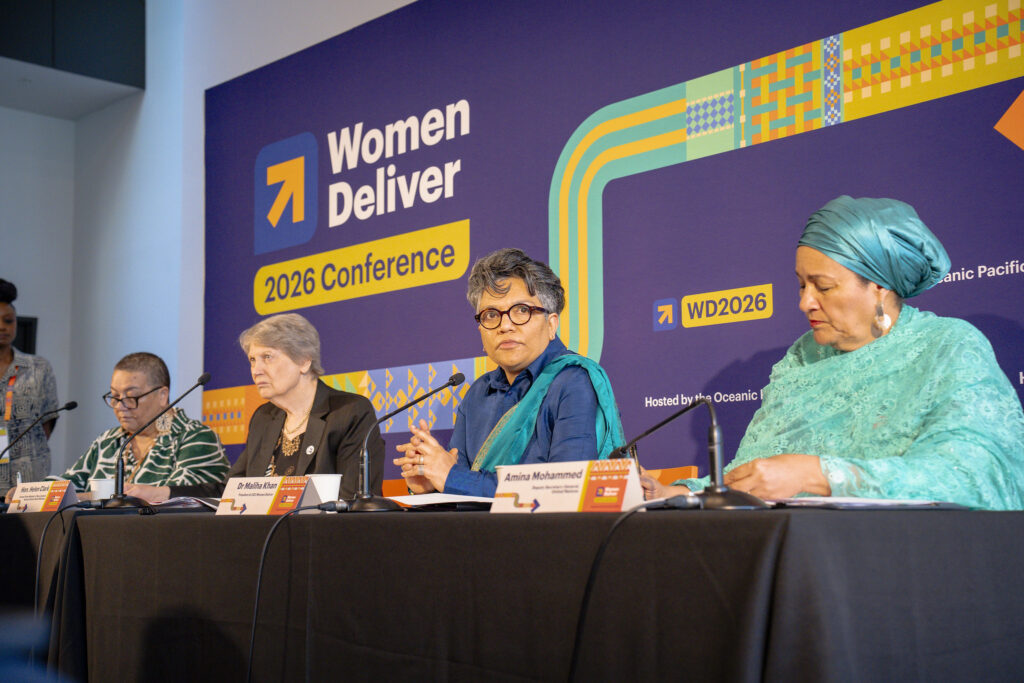
What struck me most about the first press conference and opening ceremony was not despair, it was the refusal of it. Dr Khan set the tone early, “no one is free until everyone is free.” These were not words of resignation. They were a call to building something new, because as she argued compellingly, the systems we inhabit were never designed with women, girls, or gender-diverse people in mind. Acknowledging that is not defeat. It is the beginning of honest strategy.
That honesty is reflected in the Melbourne Declaration, developed through 32 consultations with 652 people across the globe. A document that is feminist in its principles and unflinching in its premise that current institutions, as they stand, cannot deliver gender equality. Only states that hold genuine power can enact that change. And those states must be held accountable by a civil society that is funded, supported, and heard.
Former NZ prime minister Helen Clark said she was happy to see Women Deliver come to her region of the Oceania Pacific and then immediately reminded us not to take the gains for granted. “The gains are fragile,” she said. She’s right. Every right we point to as evidence of progress is also evidence of what can be undone. Sam Moysten, Governor General of Australia, named what many in the room were feeling, that while we are each more than our gender and gender identity, the gendered language of opposition has not gone away, it has only grown louder.
And yet Noelene Nabulivou, a Fijian activist and spokesperson on climate change, sustainable development, and gender equality and co-founder and political advisor for Diverse Voices and Action for Equality (DIVA), reminded us that 6,000 women working in a world more misogynistic than ever are still “breaking and building futures.”
The Prime Minister of Tuvalu, The Hon Feleti Penitala Teo OBE, a man who stood at that podium not to lead the feminist movement but to learn from it, to listen to young organisers who, as he said, are not waiting to make change. Political leadership, he offered, exists to stand with movements, not ahead of them. It was a model of allyship that felt genuinely, quietly radical.
Jacinta Allan, the Victorian Premier, closed the opening ceremony by reminding us why Naarm was the ideal host for Women Deliver, highlighting the work the state has done to advance gender equality.
We are the circuit breakers, the opening ceremony told us. We need our collective strength more than ever. We know what is being done to us, and we are naming it. Funding for this work is contracting. The space for civil society is shrinking. And still, 6,000 people crossed oceans and borders to be here because getting together and convening is exactly what change requires right now.
It is no small thing that this moment is being held in the Blue Pacific region. The women of this region have long adapted to climate crisis, held communities together and have been making change without budgets, titles, or recognition. They did not wait to be resourced before they led. They did not wait to be invited before they acted. That is the spirit Women Deliver carries into Naarm. Day 1 made me emotional because this is not just a conference. It is a reckoning and a renewal. Change calls us here, and we will meet this moment.
Women’s Agenda is a media partner of Women Deliver and is reporting live from the event in Melbourne. Check out all our coverage here.