
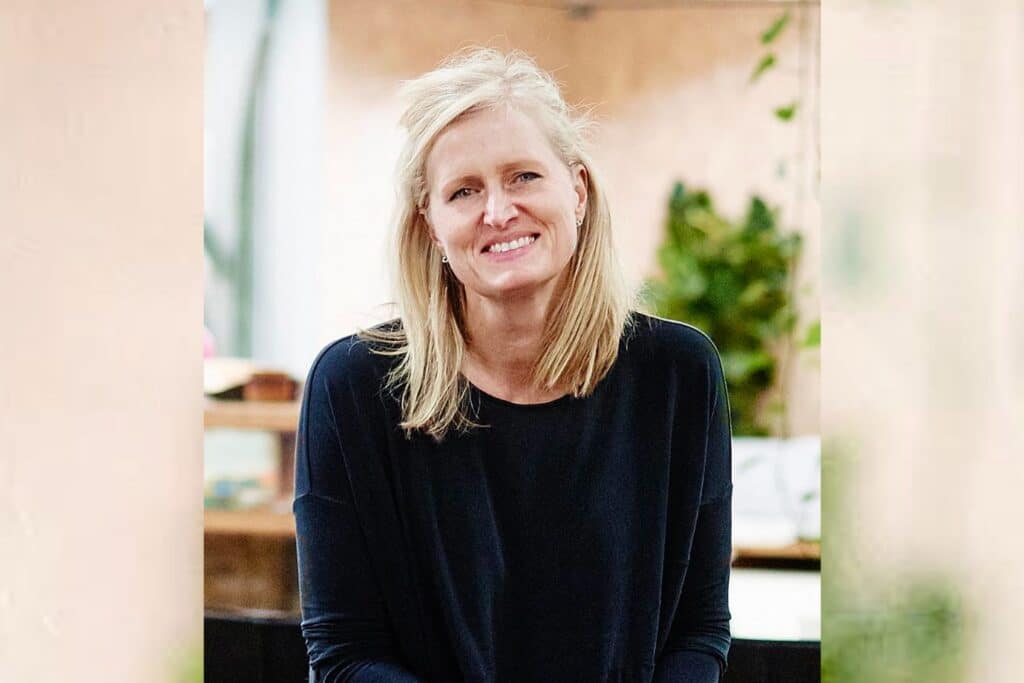
When Goodman Group proposed Project Mars, a large-scale data centre beside homes, a school, bushland and playing fields in Lane Cove on Sydney’s north shore, local businesswoman Sasha Titchkosky stepped up as spokesperson for the Lane Cove Responsible Planning Group.
Now, after Goodman Group has withdrawn the proposal, the community can claim a hard-won victory.
Driven by a lifelong desire to leave the world a little better than she found it, Sasha has long woven impact into her work, from climate and environmental campaigns to Kylea Tink’s election campaign.
With data centre builds accelerating rapidly and communities across Australia raising ongoing concerns about where they’re being placed and their environmental impacts, Sasha talks to Denise Shrivell about what the win means, what she learnt along the way and why the fight to stop data centres in Lane Cove is not over.
Let’s start with the outcome: what did you and your community achieve?
We managed to stop a $1.2bn hyperscale data centre from being built in a business park neighbouring the Lane Cove West community.
What were the community’s main concerns about the data centre?
The primary issues were its proximity to the established residential area that neighbours the business park and also potential and unforeseen impacts on the river and national park.
The closest house was less than 20 metres away from the site, the local school only 160m and a childcare centre a similar distance. The reason why this is significant is that these hyperscale data centres emit a low frequency humming sound 24 hours a day, they use diesel powered back up generators which are regularly tested emitting fine particulate pollution which is a known carcinogen, they generate huge amounts of heat, represent a major potential fire risk (this one would have had 1 million litres of diesel stored on site and 198,000kgs of lithium batteries) and their security lighting creates problematic lightspill.
Take us through the journey. How did it begin, and what were the turning points?
The community was first alerted to this data centre proposal in 2025 and a member of the community created a petition on change.org. When I joined the campaign in March 2026 there were about 600 signatories to the petition, we now have over 3000.
There was then some community consultation with consultants working on the project conducted late in 2025 but prior to any formal documentation with specific information about the project. I joined just before the submissions to the planning department closed and managed to create three different submissions raising concerns about the project for three different organisations. Incredibly, 374 submissions were lodged by individuals and organisations with only 9 supporting the project.
My interest in the project was less about being directly impacted as a resident and more about providing a voice for the National Park and River which I was surprised were not required to be considered in the planning approvals process. I have a real love for these places as I spend a lot of time on the river rowing and have seen first hand just how special and fragile this system is. It’s incredible to think it’s only 8km from the CBD yet you can be on stretches of it and not see another soul on the river. Sadly, on one part of the river the birdsong is now overshadowed by the hum of the Airtrunk data centre which was approved in 2019, before people really understood the impacts of this industry.
After I joined we built the Lane Cove Responsible Planning Group website, set up socials and actively responded to any media that were interested in the story. We worked on creating awareness both within the community and outside of it.
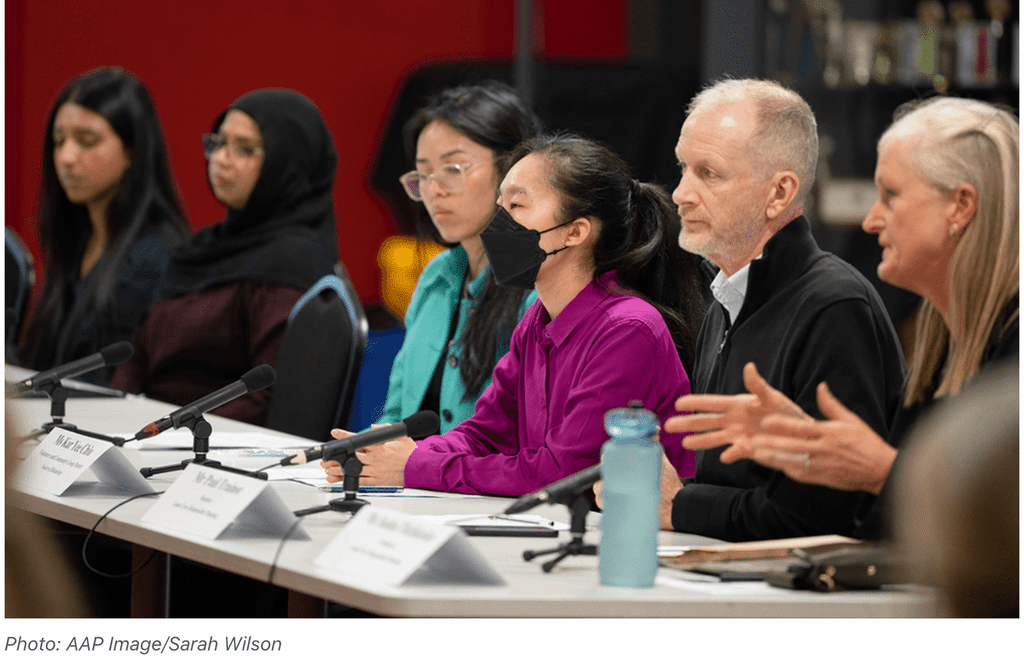
The really pivotal points were two community meetings that were held, the NSW State Data Centre Inquiry, the successful creation and lodging of a shareholder resolution and the Federal Data Centre Senate Inquiry (see image below) and Sydney Hearing held in Lane Cove.

What were the best and toughest parts of the campaign?
The toughest part of the campaign was managing all of the work required with a full time job and life! There was a core group of us that put in huge amounts of work on weekends and throughout the week as the data centre issue kept changing. At one point it felt as though there was a new announcement every week about a new guideline or proposed regulation which we needed to be across.
The best part of working on something like this is building connections and relationships across the community. It is such a special thing when ordinary people come together to work to change something they believe in. It really does restore your faith and belief in the power of democracy.
How did you actually organise? What does it take, practically, to take on something like this?
When I joined there wasn’t as much structure which I believe you really need to help be efficient and effective with tiny resources and no budget. We created key areas of focus and worked on trying to get different people in our little group to take responsibility for each of these areas. That really helped us to get more momentum and helped people focus and use their area of expertise.
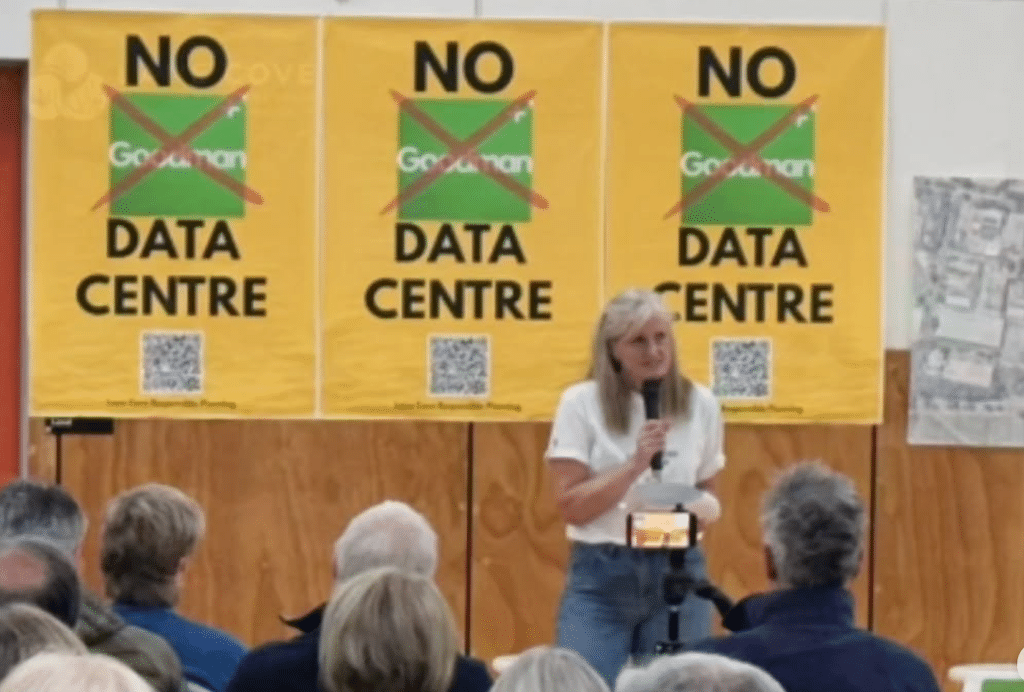
What are the politics behind this (there’s always politics) – and how did you navigate this?
The politics were tricky. We know that the little growth there is in the State and Federal economy is due almost entirely to the data centre buildout and that this was the primary motivator for both NSW State and Federal Governments.
The Greens and Independents have really led the debate on behalf of communities. We decided that it was important for us to try and get support from all sides of politics. It was eye-opening for people in the community to get an insight into how party politics works on an issue like this and how this can trump acting in your constituents’ best interests.
What have you learnt along the way – and what advice would you give other communities facing a similar fight?
Don’t give up. There were moments when it felt like there was no way we would be able to stop this development, that the proponents had an answer for everything, that they had huge teams and budgets that we could never match. But we just knew that we would keep fighting and keep trying to stop this development until we’d exhausted every possible avenue.
If people want to get involved or learn more, where can they go?
They can follow Lane Cove Responsible Planning Group on our socials (Instagram and LinkedIn) or check out our website which provides a good summary of the key issues.
What’s next for you and the group? Other data centres are planned for the area, so is this the first of several battles?
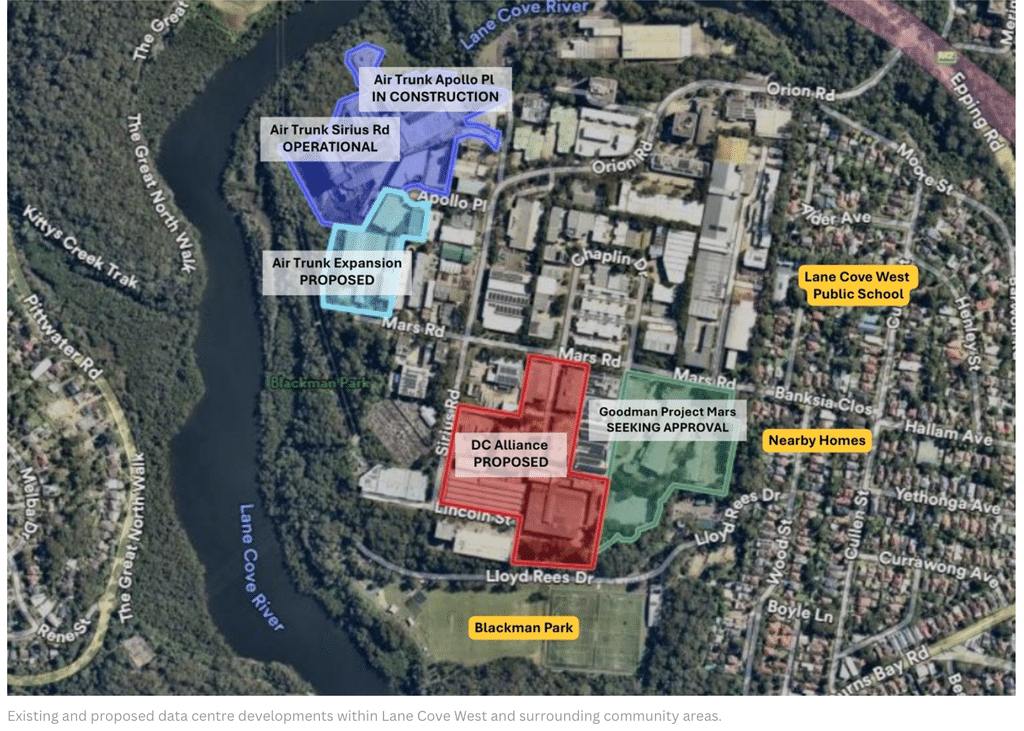
Sadly yes, we have two other data centre proposals in our area to deal with (see image below). One from Airtrunk, right near the river and the other from Lane Cove DC Alliance. We don’t believe that this small business park which was set up for light industrial uses like warehousing reflecting its location neighbouring the residential zone, national park and river is the right place for any more hyperscale data centres.
This Q&A with Sasha Titchkosky was produced by Denise Shrivell.
See other Q&A’s here > Dawn Nicholas – Kathy McKenzie – Janine Hendry