
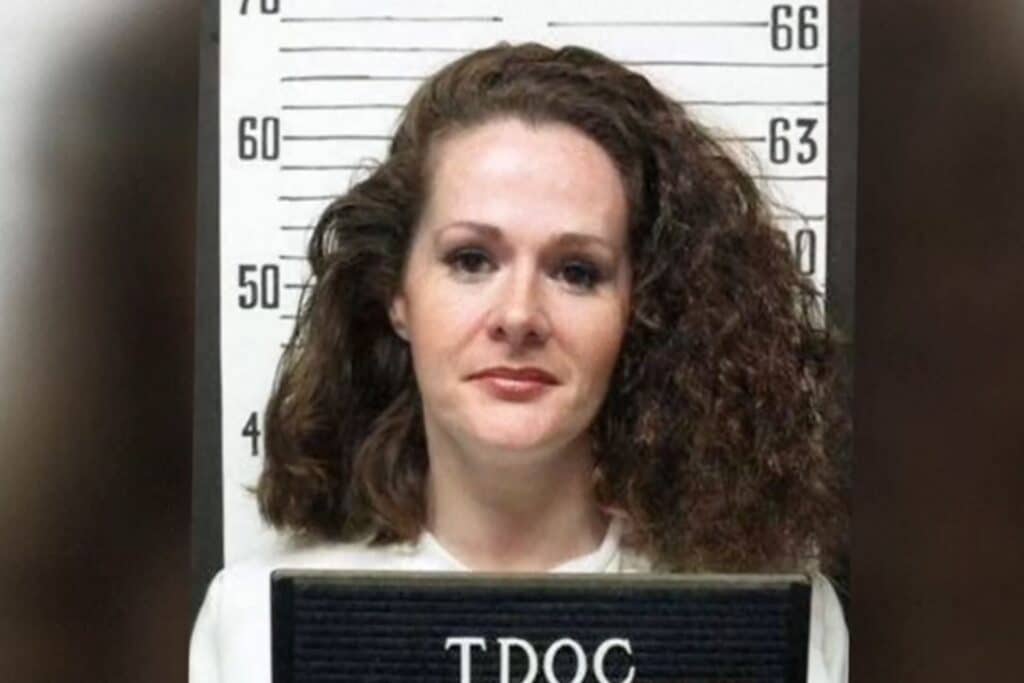
The state of Tennessee plans to execute Christa Pike on Wednesday. If it goes ahead, she will be the first woman put to death in the state in more than 200 years.
Pike, now 50, was 18 in 1995 when she and her then-boyfriend, Tadaryl Shipp, 17, beat, tortured and killed 19-year-old Colleen Slemmer, whom they met at a job training camp for troubled teens.
The details of the murder are horrific.
According to court testimony, Pike and Shipp lured Slemmer into the woods, then attacked her. For the next thirty minutes, Slemmer was taunted, beaten and slashed. Shipp carved a pentagram into her chest, and testified at his post-conviction hearing that he was the one who did it. Pike finished the attack by smashing Slemmer’s skull with a large chunk of asphalt. She kept a piece of the skull, showed it around the school, and was arrested within 36 hours. Other residents later testified that Pike had bragged about the killing before and after.
While court proceedings for both Pike and Shipp were lengthy, the two teenagers did not receive comparable sentences. Pike was sentenced to death. Shipp was given life with the possibility of parole.
The age gap matters. Shipp was 17, and the US Supreme Court has since barred the death penalty for anyone under 18. He could never have faced the same sentence. But Pike was not much older at 18, and was the youngest person on Tennessee’s death row when she arrived there.
The question her lawyers raise is what the system saw when it looked at two teenagers who committed the same crime, and why only one of them was treated as beyond redemption.
Pike has a documented history of childhood sexual abuse, abandonment and neglect. Her lawyers say she has PTSD stemming from being molested and raped from the time she was a toddler, and that if she were found guilty of the same crime today as a teenager, she would not receive a death sentence.
While Pike’s childhood trauma doesn’t excuse her horrific crime, her attorneys say the woman now facing execution is not the girl who committed the crime.
“The 18-year-old girl suffering from severe mental illness and near-debilitating trauma no longer exists,” they said. “Christa is a 50-year-old remorseful woman who understands her actions, receives proper treatment for her mental illness, and provides for and guides fellow incarcerated women.”
Sentenced in 1996, Pike sobbed as the judge told her she would die. Through tears, she pleaded, “Can I please hug my mom?”
With this execution, Pike is set to join a very short list of only 18 women who have been executed in the US since the 1970s, compared with 1,663 men. Women make up roughly 2 per cent of the death row population nationwide, and less than 600 women have been sentenced to death in total since the 1600s.

Pike is not the first woman whose sentence has looked harsher than that of the man beside her.
Tennessee has been here before. Gail Owens sat on death row alongside Pike until 2010, when Governor Phil Bredesen changed her sentence to life in prison. Owens was convicted of arranging her husband’s murder, and her case drew attention over her own history of abuse and the fact that the man who carried out the killing received a lesser sentence. Her removal from death row sparked conversation about Pike’s future, a conversation that continues even now, a day before Pike’s scheduled death.
In Georgia, Kelly Gissendaner was executed in 2015 for orchestrating her husband’s murder. The man who carried it out, her boyfriend Gregory Owen, took a plea deal and was sentenced to life with the possibility of parole. It was a pattern that critics of the death penalty have long noted: women convicted as instigators are often cast as the mastermind, while the men who committed the violence are seen as led astray.
Another interesting pattern of abuse emerges across these cases.
All three of these women have faced childhoods of molestation, assaults and generally awful living conditions as they’ve grown up. Without excusing any of their actions, it is hard to ignore how often the violence they were accused of follows years of violence done to them. The courts that sentenced them tended to treat that history as background rather than as context that might weigh against death. The question is not whether these women should answer for what they did, but instead whether a system that failed them first is entitled to treat them as beyond saving, when the men involved in these cases have so often been given a second chance.
Pike’s lawyers have asked the Supreme Court to halt her execution, just weeks before the scheduled date. They argue that being held down and strapped to a gurney will likely create “severe mental suffering and superadded psychological terror under Tennessee’s lethal injection protocol,” given the sexual abuse she survived.
Pike learned on Monday that Governor Bill Lee would not intervene. Before that, she wrote in a letter to NBC News, shared by her spiritual adviser:
“Whether my clemency is granted or not, I am at peace.” She added, “I am not afraid to die. I’m only nervous about the process.”