
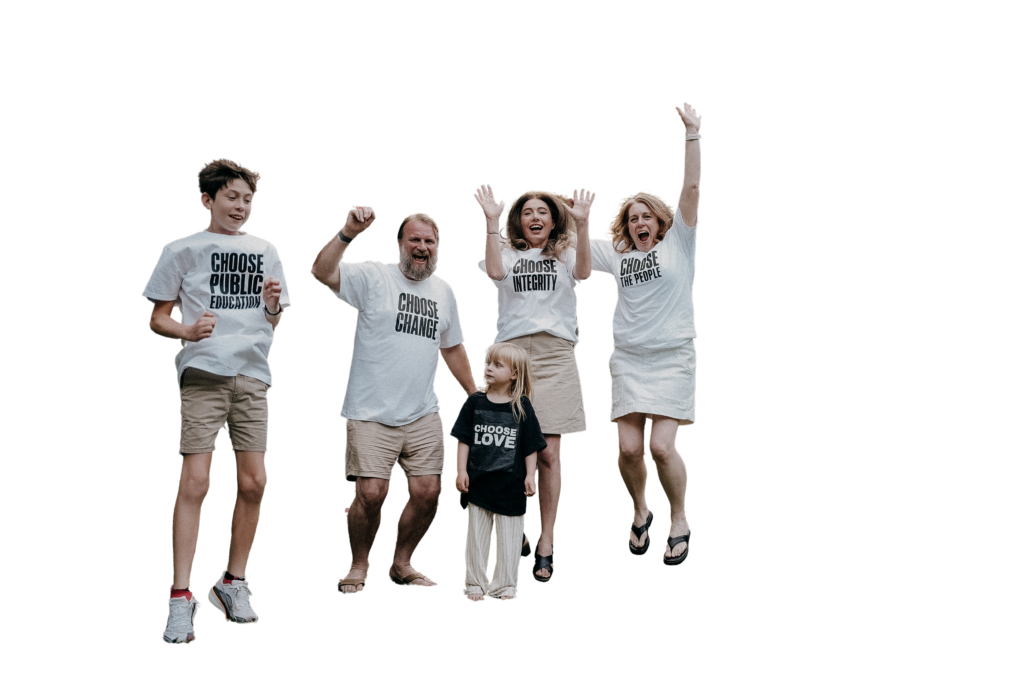
Aleta Moriarty launched a political campaign today around one key idea: we did not fight this hard for gender equality only to lose it now.
She says we’re at a critical point in 2026 where women are having to fight for the basics again, including reproductive rights, safety and the right to hold public office or stand up for human rights without being targeted.
“We did not fight for decades for equality only to watch it be quietly dismantled. I will not stand by while rights are rolled back, while violence is excused or explained away. Not on my watch,” she says.
Based in Geelong, Moriarty is campaigning for the Western Victoria upper house seat in the upcoming state election, putting women’s rights as the central, non-negotiable pillar of her campaign.
And Moriarty certainly has the experience — including supporting women’s rights across war zones and humanitarian disasters — to mount the case for the risks to hard-fought wins Australia is facing, and the advocacy needed to ensure women’s safety and health.
Having worked for gender equality and human rights across her career, including with UN Women, Aleta is concerned about what we’re witnessing globally, as well as the extent of gender-based violence in Australia, where services are chronically underfunded, the justice system is failing survivors, medical misogyny continues and reproductive healthcare remains patchy and in some cases inaccessible, especially for women in regional and outer suburban communities.
“I have spent my career working in places where women’s rights were hard-won and easily lost. I never thought I would be having this conversation in Australia. But we are watching a concerted, global attack on women’s rights play out in real time, and we are not immune. We are already seeing the effects here. I am not prepared to stand by and watch rights that women fought for over generations be quietly dismantled,” she says.
Aleta is also concerned about the fact that women in public life, including those working in human rights and related fields, are being targeted with online harassment campaigns, threats of violence and what she describes as a “normalisation” of the systematic undermining of women and misogyny in public discourse.
“We are seeing women attacked for speaking out on human rights or other public issues, for leading, for speaking. And we are watching institutions that should protect them shrug. That is not something I will accept or normalise. It is something I will fight against every single day,” said Aleta.
Aleta has made women’s rights a central, non-negotiable pillar of her campaign, born of a lifetime of work on gender equality and human rights in some of the world’s most difficult environments, including for UN Women.
“I have spent my career working in places where women’s rights were hard-won and easily lost. I never thought I would be having this conversation in Australia. But we are watching a concerted, global attack on women’s rights play out in real time and we are not immune. We are already seeing the effects here. I am not prepared to stand by and watch rights that women fought for over generations be quietly dismantled,” she says.
Aleta’s platform includes a commitment to campaign for the full funding family violence services need, system change to how the justice system handles gendered violence, action on medical misogyny, including training and accountability framework for healthcare providers, accessible reproductive healthcare in every community and a refusal to accept any rollback of reproductive rights in Victoria, or anywhere in Australia.
“I genuinely did not think that in 2026, in Australia, we would be revisiting reproductive rights, debating whether women in public life deserve basic safety, or watching a justice system struggle to take gendered violence seriously. But we are here. And the response cannot be hand-wringing. It has to be action,” said Aleta.
Raised in rural Australia, Aleta notes that she attended public school and acquired TAFE qualifications while working full time — and eventually securing a place at the University of Cambridge to study international relations. She has held leadership roles across the UN, UN Women, and the World Bank, and has worked in more than 20 countries in humanitarian emergencies and war zones, typically focused on women’s rights. She also has business experience, establishing the first sustainability department at the Cotton On Group and diverse organisations, including one of Victoria’s largest arts events, the Human Rights Arts and Film Festival.
Aleta also brings the experience of being a mother, raising a young family in Geelong — where, like mothers across the country, she volunteers at the local school sports club and community organisations.
Aleta is calling her campaign the WHAMpaign!, giving a nod to the iconic Choose Life Wham T-shirt with her own adaptations, including “Choose Gender Equality”. The branding is fun, she says, but the issues are anything but.
Taking an unashamedly pro-women’s rights stance is certainly welcome in Australian politics right now.