
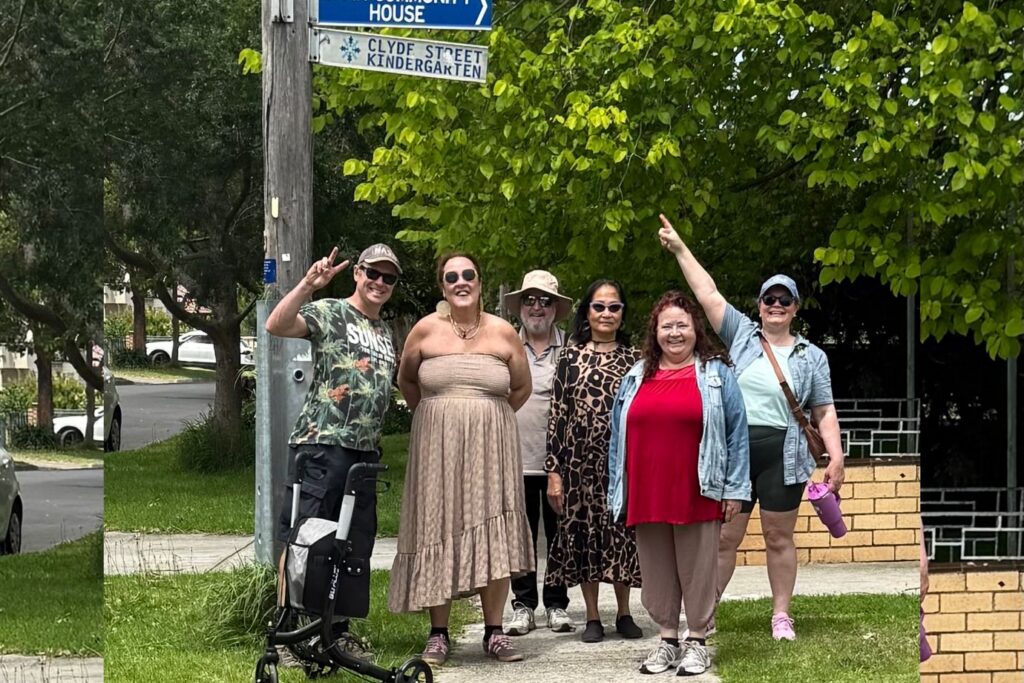
I am currently working on a PhD proposal while working in the community; I’m motivated to undertake the PhD because I am so deeply embedded and am sitting in the front row to the power and radical nature of this work. But unlike previous roles I’ve had, trust-building work questions the role of professionalism.
The word professionalism has always sat uncomfortably with me.
As a neurodivergent person, a feminist, someone navigating menopause, and someone working closely with communities I am also part of, the expectation to be “professional” often feels less like an ethical standard and more like a demand to split myself in two. One version of me is permitted at work; the rest must be carefully hidden. Some of this hidden self is the magic ingredient in the trust-building. Sharing stories and parts of ourselves is how we find kindred people.
A queer friend recently described having a “very different personality” at work compared with who they are at home. This, they said, is common, particularly for queer people, because self-protection is often necessary for survival. In practice, professionalism becomes a mask.
That tension sits at the heart of the Apple TV series Severance, which offers a dark satire of the modern workplace. In the show, workers undergo a procedure that splits their consciousness into two selves: one that exists only at work, and one that lives the rest of their life. The show raises unsettling questions:
Is it ethical to divide a person for the sake of productivity?
What does freedom mean if you only exist in your ‘free time’?
Are our true selves lost as we work hard to manufacture our ‘work selves’, and does work distract us from the neoliberal systems we live in, taking up the time we need to question them?
Where professionalism came from and how it has changed
The word profession comes from the Latin profession, which means a public vow. In medieval Europe, it referred to a religious commitment grounded in moral duty and service. During the Enlightenment, the term shifted to describe elite learned occupations such as medicine and law.
By the 19th century, professionalism became tied to credentialing, gatekeeping and social status. Professions were self-regulating, masculine, and exclusionary. With the rise of bureaucracies and modern capitalism in the 20th century, professionalism took on new meanings: emotional restraint, impartiality, loyalty to institutions, and strict separation between personal and professional life.
Scholars have long shown that professionalism reinforces classed, raced and gendered expectations, penalising emotion, accent, disability and cultural difference. What gets labelled “unprofessional” often has less to do with ethics or competence and more to do with deviation from dominant norms. These norms were never neutral.
Neoliberalism and the professional self
Under neoliberalism, professionalism has become a powerful disciplinary tool.
Rather than being externally enforced, it is internalised. Workers are expected to self-monitor their tone, emotions and bodies in the name of productivity. Authenticity is encouraged but only if it is palatable, non-threatening and aligned with organisational goals.
This produces a contradiction many people know intimately: be yourself, but not too much. Be authentic but not opinionated. Bring your whole self to work, except the parts that challenge power, disrupt comfort, or require care.
For people already navigating marginalisation- queer people, neurodivergent people, carers, people experiencing menopause, people working in community contexts- this split is exhausting; it is also unsafe.
Community development requires trust, not masks
I work in neighbourhood houses. I’m also a community member there. I run a community garden, implement climate projects, and co-facilitate a walking group with my partner. These are spaces where conversations get real and emotional. Neighbourhood houses exist, in part, to address loneliness and social isolation. Trust is the work.
In these contexts, professionalism as emotional distance doesn’t just fail; it actively undermines safety. People do not build trust with a performance. They build it through consistency, honesty and care.
Neighbourhood houses have long been radical spaces. They challenge neoliberal logics by centring relationships over efficiency, care over output, and community knowledge over institutional expertise. Yet the language of professionalism often sneaks back in to discipline those very qualities.
Research, authenticity and ethical presence
This tension is especially visible in community-based research.
Community-engaged and participatory research approaches are widely recognised as producing better, more relevant outcomes than detached, extractive research. They foster trust, improve data quality and ensure findings are useful to the people most affected. But they also demand something traditional professionalism resists: relational accountability.
You cannot research with a community while pretending to be neutral, untouched or unaffected. You bring your values, your history and your relationships into the work whether you acknowledge them or not.
Authenticity here is not about oversharing or self-centring. It is about reflexivity and understanding who you are, why you are there, and how your presence shapes the work. This kind of authenticity is disciplined, ethical and essential.
What comes after professionalism?
If professionalism no longer serves us, especially in community development, climate adaptation and care-based work, the question becomes: what replaces it?
The answer is not “anything goes”. Communities need safety, boundaries and accountability. But those are not the same as emotional suppression or false neutrality.
What we need instead are workplace cultures that value ethical presence over performative neutrality, recognising that people do not leave their values or experiences at the door when they come to work. Such cultures prioritise trust-building over mere compliance, understanding that genuine relationships, not rigid rule-following, are what enable safe and effective practice. They encourage reflexivity rather than detachment, asking workers to be aware of how their identities and assumptions shape their work, and they treat care as a legitimate and necessary form of labour, rather than an unprofessional excess.
For me, the stakes are personal. I want to continue researching and working on climate adaptation with communities not at arm’s length, and not at the cost of my integrity. I cannot maintain a neoliberal demand to split my life in two. Doing so would not only erode my mental health; it would undermine the very trust my work depends on.
Relational accountability in research
Professionalism, as we currently understand it, is not a neutral standard. It is one of the levers that maintains the status quo. If we are serious about equity, safety, inclusion and collective resilience (in our sector we are), we need to rethink professionalism. Our communities deserve to feel safe, behaviour that is mentally, emotionally or physically damaging for communities who trust us to have their safety as a core responsibility is unacceptable.
Knowledge and skills don’t belong to individuals. Rather, they exist in relationships. Working with communities and conducting research is not an extraction; it’s about being well within relationship throughout, before, during and after. Relational accountability is not a framework imported from outside, but an ongoing embodied practice of honouring the obligations that already exist within the relationships I am a part of and is how I want to work as a neighbourhood houses staff member I need to honour my relationship with the specific communities and places that I already belong. That belonging is built on trust and connection, which is an honest sharing of stories and experience, not a mask, a controlled narrative, or sharing half of myself.