
Mani Thiru works in the space sector but believes asking why NASA sent four humans to the moon and back, given everything that’s going on back home, is a fair question that deserves a real answer. Below, she explains why we go and continue to reach.
Somewhere in the Donbas, a soldier who is nineteen years old is sleeping in a hole in the ground. Somewhere in Gaza, a family has built a kitchen from rubble and calls it home. Somewhere in Sudan, a child walks two hours each way for water she’ll carry back in a yellow plastic jug.
And somewhere in Florida, engineers stacked a rocket on a launchpad that successfully took off, circled the Moon and returned to Earth.
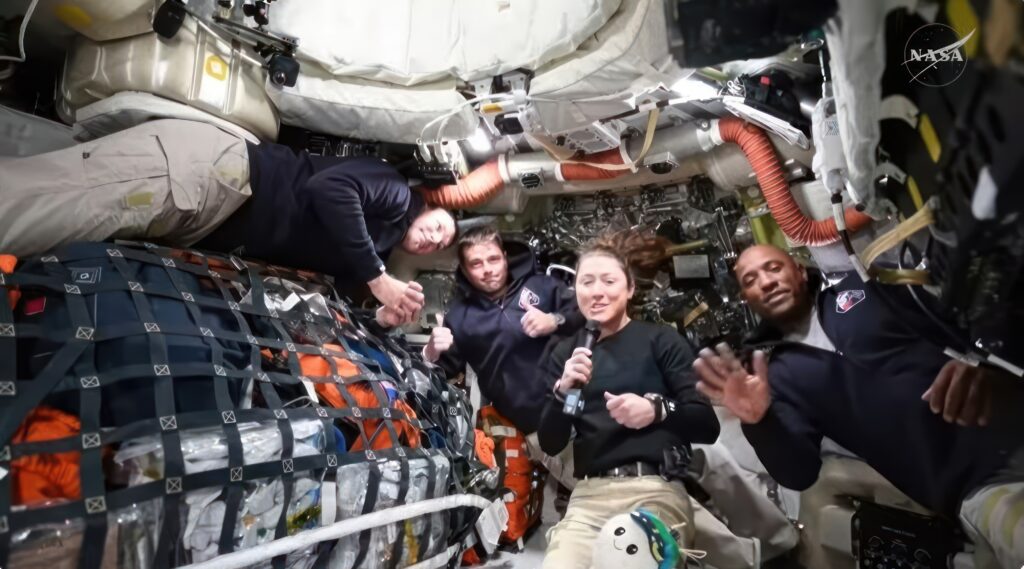
NASA’s Artemis II mission was a successful 10-day spaceflight that sent four astronauts further into space than any humans had gone before.
The above things have been happening at the same time.
When the launch window opened and the countdown began for launch back on April 1, I had some incredulous friends (outside the space industry) who asked the question Why are we doing this? Now? With all of this going on?
It’s a fair question. It deserves a real answer.
The economic argument for space exploration is the one that gets made in parliamentary committees and TED talks and op-eds written by people who know their audience. Spinoffs. Patents. Materials science. STEM advancement. The satellites that tell the fishing boats where to go and tell the insurance companies when the flood is coming. All of it is true. None of it is the point. The point, if there is one, lives somewhere else entirely – in the part of us that is not a market, that cannot be expressed as a return on investment, that has been doing this, building towards this impossible and unnecessary and absolutely necessary thing, since long before anyone thought to put a price on it.
We painted on the walls of caves at Lascaux while the predators were still circling outside. We understood, in whatever wordless way the body understands what the mind cannot yet articulate, that the painting was not a luxury. It was the most urgent thing. We built temples and cathedrals – centuries of them, stone by stone, generation after generation – while people starved in the shadow of their walls. We wrote symphonies in the middle of the plagues. The argument that suffering must be fully resolved before transcendence is permitted has never, in the entire lurching and terrible and magnificent history of this species, been applied. Because it would have left us with nothing. Because it mistakes the hierarchy. Because the reach is not a reward for solving the suffering. The reach is how we survive it.
A political act
There’s something else, too. Something harder to say without sounding grandiose, but no less true for being philosophical: the act of leaving Earth is a political act. Not in the partisan sense.
In the most ancient, human sense.
It is a declaration that we are not finished. That whatever we are doing to each other down here – the bombing, the killing, the ceaseless destruction of the environment – we have not yet decided that this is all we are.
Think about who builds these things. Not the agency logos, the contractor names, and the politicians at the podium. Think about the actual people.
There are welders working the overnight shift in Alabama, living on wages that don’t quite cover rent in the town they grew up in, laying perfect beads along the seams of a cryogenic fuel tank that must not fail at a hundred and forty thousand feet.
There are software engineers in Houston born in countries that are currently at war with each other, writing code together on the same repository, fixing each other’s bugs. There are materials scientists who spent their childhoods in poverty, who got into school on scholarships, who are now determining exactly what an astronaut’s boot sole must be made of to grip lunar regolith at minus 130 degrees Celsius.
And the reach extends further than Florida. Right here in Australia, in a quiet valley outside Canberra, scientists and engineers at CSIRO ‘s Deep Space Communication Complex – the same organisation that carried Neil Armstrong’s voice from the Moon to the world in 1969 – are once again listening for Orion as it crosses into the dark. They are not household names. They are scientists in a hill outside Australia’s capital, pointing a ground station at the Moon, because someone asked and they said yes.
At Mount Stromlo Observatory, researchers from the ANU Institute for Space | InSpace are doing something that has never been done before: receiving laser communications from a crewed spacecraft a quarter million miles away, testing the technology that will connect future astronauts to Earth.
And Southern Launch is using doppler tracking infrastructure to passively track the Orion spacecraft to collect tracking data without transmitting commands or signals to the vehicle.
There are hundreds of other Australian companies, large and small – Gilmour Space Technologies , HEO, Space Machines Company, Esper Satellite Imagery, Skykraft, so many more – reaching in the same direction. This impulse – this specific, stubborn, underfunded, extraordinary impulse – does not belong to NASA. It does not belong to any flag.
These are not trust fund dreamers. These are people doing extraordinary things for wages that would not impress a hedge fund intern, because the work matters to them in a way that no salary could fully explain.
Ingenuity isn’t a word for the comfortable. It belongs to people who have to solve real problems with the materials at hand.
There is a photograph from 1968 taken on Christmas Eve, by astronauts who had just watched the entire Earth rise above the lunar horizon. Earthrise.
You know it.
A marble of blue and white suspended in absolute black, impossibly fragile, impossibly beautiful.
The historians will tell you it contributed, in ways difficult to measure but impossible to fully dismiss, to the birth of the environmental movement.
People saw the planet from outside it, for the first time, as a thing that could be held in one hand – a thing with edges, a thing that could be lost… and something in the culture shifted.
We are not the same species as the one that looks only inward.
The countries currently at war with each other, the economies fracturing, the democracies wobbling …they are all still capable of producing human beings who will spend their careers trying to leave the planet.
That this impulse survives is not a distraction from our crisis. It is evidence that the crisis has not yet consumed everything.
A rocket launch is, at its core, an act of supreme audacity. You are sitting inside a controlled explosion. You are trusting that ten thousand people you have never met each did their job correctly -that every weld held, every line of code executed, every O-ring sealed properly. A trust extended across an entire civilisation of specialists (including Russian-Americans, Iranians who work at NASA). It is the most complicated thing our species has ever learned to do repeatedly. And it works. Not always. But enough.
And this is the part that should stop us, that should make us put down whatever we are doing and simply marvel.
That it works at all, while the same species wages war by drone and lets schools and hospitals be collateral damage – that is, if you look at it straight, one of the most baffling and stirring things about being human.
We contain multitudes so extreme they seem incompatible.
We are capable of such specific, meticulous, generous brilliance.
And we are capable of such catastrophic cruelty and indifference.
Both.
Simultaneously.
In the same century.
Sometimes in the same country.
Sometimes, god help us, in the same person.
The moon shot does not redeem us. Let us not ask it to carry that weight; it is already carrying enough. But it proves that the better version of us still exists … is still building things, still calculating trajectories, still writing the code.
That proof matters. Not as comfort but as evidence. As something to point to when the argument is made … and it is always being made, somewhere .. that we are simply too broken, too venal, too stupid and violent to deserve what we keep insisting we want.
The nineteen-year-old in the hole in the ground. If he survives (that if is doing enormous work). If he comes home, if he finds someone to love, if his body and mind allow him the ordinary miracle of children, those children will grow up in a world in which human beings live and work on the surface of the Moon. Not as a myth. Not as a metaphor. As a fact. As geography. As a place on a map that has been touched by human hands, named, argued over, studied, and eventually, in the way of all places that have been touched and named and argued over, made ordinary.
What does he think of that now, in his hole? His home, his family, survival perhaps.
But his grandchildren, and here is where we must be patient, where we must resist the tyranny of the immediate, his grandchildren may stand outside on a clear night, somewhere in Ukraine or Russia or wherever the borders eventually settle after all the killing is done, and look up at the Moon the way we look up at a mountain. The way we look at the sea. With the knowledge, carried somewhere below language, that it is a place. Those people have been there. That someone, once, stood on its grey and ancient surface, looked back across a quarter million miles of absolute nothing, saw the pale blue Earth hanging in the black like something someone had lost and not yet noticed, and said into a radio, to whoever was listening, that it was beautiful.
That is not nothing.
We go because we are broken and we go anyway. We go because the bills are due, the economy is tanking and the treaties are torn up.
We go even though children are dying of diseases we know how to cure. We go because the politics are rotten and the news is relentless and the ice is melting and the coral is bleaching and the forests are burning in fires that the satellites can see from space, which is, if nothing else, a reminder that space is watching.
We go because that is what we have always done.
We go because we cannot not go.
Because every time we have stopped reaching, something in us has quietly died, and we have had to learn, at great cost, to reach again.
We go because a species that has stopped trying to see beyond the next hill is already finished.
We go because the moon is there, and we are here, and the distance between them is, if you commit to it fully, crossable.
The countdown is not a distraction from the world. It is not escapism dressed up in mathematics. It is not the powerful looking away from the suffering they have the power to address. It is something older and stranger and more stubborn than any of that. It is the world – this broken, extraordinary, self-defeating, reaching world at its most defiant self.
Ten. Nine. Eight.
The ice is melting. The boy is in his hole. The child walks to the well.
Three. Two. One.
We go.