

Healthcare for women has long been underfunded, overlooked and undervalued – and the impacts of this have been devastating but in Australia, a movement has begun.
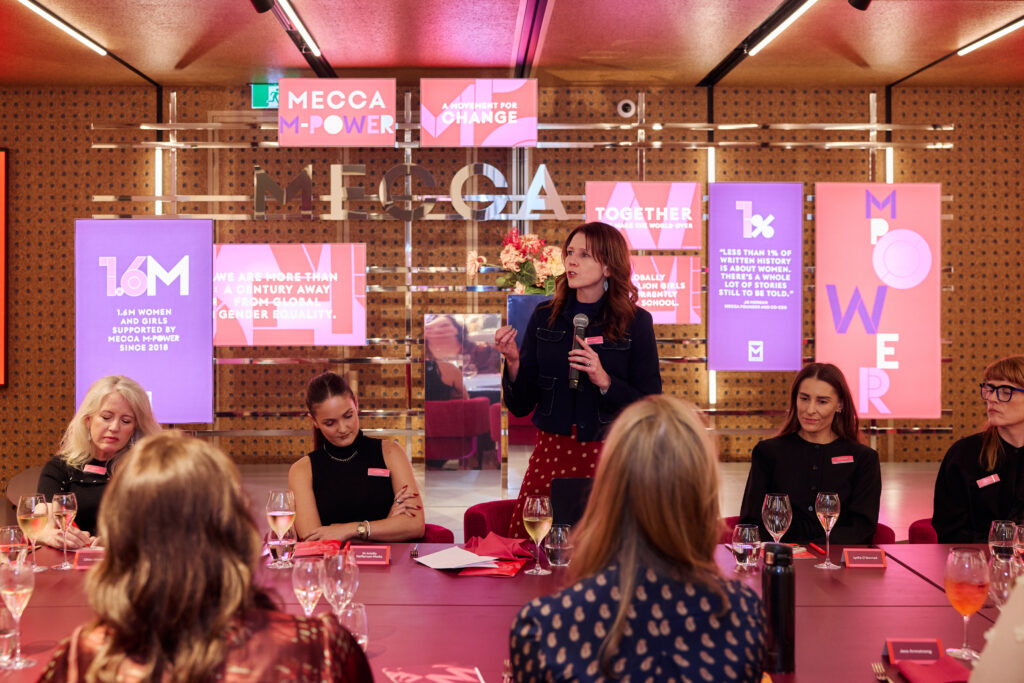
At the end of last month, a group of some of the country’s most innovative minds including entrepreneurs, clinicians, service providers and investors came together for a dinner with a difference.
The conversation led by MECCA M-POWER, Women’s Agenda and Sentiment sought to answer one key question: how can we make Australia the best country in the world for women’s health innovation?
“This is an ideas trust just waiting to be unleashed,” said MECCA founder Jo Horgan.
And it could not have started at a more critical time.
While Australia is a world leader in health research and innovation, investment in solutions for women falls short.
In 2020, McKinsey found that only 1 per cent of health research and innovation around the world went towards conditions specific to women (excepting oncology).
Investment in all-women founding teams has also gone backwards with just 2 per cent of VC funding going towards these ventures last year, according to the latest State of Startup Funding report.
“Gender equality they’re saying is going to take over a 100 years to get to,” said Horgan.
“It’s up to us to try and find ways to play our part in changing that.”
Women’s Agenda founder Angela Priestley also noted that now was the optimal time to enact this change with momentum building around women’s issues across the government and private sectors.
“We are at a pivotal moment in Australia,” she said.
“We are at a time when women’s health is getting a lot more attention.
“We are seeing state and federal governments funding various commitments across women’s health.
“There have been great wins but we have so much more to do.”
Embedding a gender lens in health research and funding
During the discussion, a number of women raised what recent research has made clear: too often real symptoms are dismissed, undermined and not listened to by healthcare professionals meant to notice.
Victoria’s inquiry into women’s pain found an overwhelming majority of women who sought assistance for pain were dismissed by their doctors.
June Health founder Grace Toombs who launched her company to empower women with at-home testing kits for reproductive issues, said the pain she suffered was ignored by clinicians for years.
“I’m one of the one in seven Australian women who have endometriosis,” she said.
“I tell you what, it was a bloody hard journey to get that diagnosis.”
Djirra Director Karen Bryant shared a similar experience with doctors almost missing endometrial cancer.
“It took me nearly four months to get my doctor of 19 years to listen to what my symptoms were,” said Bryant.
“Doctors and GPs are not listening enough.”
These experiences spotlight how critical it is for women to be prioritised in health research and funding.
Giant Leap partner Rachel Yang said innovators, researchers and founders building health solutions for women are not working on ‘niche’ ideas and investors across government and private capital cannot afford to keep ignoring them.
“We’re really proud that around 60 per cent of our portfolio is run by women,” Yang said.
“That’s not because it’s charity, it’s because women present outsized opportunities for commercial return.
“If you don’t back them, you’re leaving value on the table.”
Venture capital firms like Giant Leap and Scale Investors are actively working to shift the stats.
Scale Investors General Partner Roo Harris said women-led startups in the health space are an untapped opportunity.
“We were very keen to plug the gender investment gap but I’m more and more excited about the gender innovation gap and the extraordinary gold mine that we’re sitting on if we actually fund women who are injecting their lived experience into innovation,” said Harris.
Strengthening the women-led health innovation ecosystem
The roundtable was made up of a phenomenal group of innovators and disruptors building technologies that could revolutionise healthcare for women.
Associate Professor Helen Frazer, for example, the recipient of the inaugural MECCA prize for Healthcare Technology Innovation, is a pioneer in using AI technology to improve cancer screening and detect breast cancer early in women.
“I’m a radiologist, a breast cancer clinician and an AI researcher,” she said.
“With a very talented team of researchers, I’ve been developing AI algorithms for early detection of breast cancer on mammograms, now in trials in BreastScreen Victoria.
“However, the opportunity is even bigger.
“The two main causes of premature deaths of women in this country are breast cancer and cardiovascular disease.
“We have shown AI models can also predict future risk of both breast cancer and cardiovascular disease from the mammogram alone. So if we can focus on just those two areas, with AI and data capabilities, we can potentially solve or reduce 20 per cent of all premature deaths of women in our country and that would be game‑changing.
“But movement in healthcare is very slow and local capability needs to be better supported.”
The broader ecosystem health tech innovators like Frazer operate in needs to be structured in a way that better validates their work, recognises the urgency of what they are trying to achieve and brings investment in.
A number of strong suggestions were made around this including calls for a gender lens in grant funding, procurement processes and other investment circles.
There was also a push for investors to avoid teams led entirely by men and to place more focus on ventures working on health conditions specific to women.
Larger funding bodies like the Medical Research Future Fund, the National Health and Medical Research Council and superannuation funds can play a role in all of this and help tilt the ecosystem.
Greater collaboration and knowledge sharing could also accelerate women-led ventures as they navigate regulation, contracts and AI advancements.
During the discussion, the idea of a coalition for multidisciplinary stakeholders in the health tech space was raised where expertise could be shared and collaboration fostered.
This would prevent women operating in silos and solving the same problems.
The Karman Project co-founder Hannah Ashford, who works on international diplomacy efforts for outer space, said it could help bring together women in a powerful way.
“It’s important that such conversations continue, and I wonder whether we can form some type of coalition to build on the multidisciplinary expertise we see around this table – from communications to funding to cutting-edge research,” she said.
“We should avoid duplicating existing efforts, so we don’t necessarily need to create yet another council to advocate to the government, but I do think we have collective power and synergies in this room that we can leverage.”
Protecting sovereign IP in Australia around women’s health
Many of the founders in the room on Thursday night are on the frontlines of AI development building tools in clinician scribing, diagnostics, data platforms and specific healthcare like menstrual support.
Among them was Ovum AI founder Dr Ariella Heffernan-Marks who has been developing what will essentially be a lifetime health assistant for women providing them with a tool that integrates wearable data, symptom tracking, nutrition, exercise and reproductive health data into one one longitudinal memory system.
“We’re building toward the largest proprietary dataset in women’s health to help close the gender health gap,” she said.
“Already, we’re seeing strong momentum with over 50,000 health insights collected from women aged 15 to 84, and 83 per cent choosing to contribute their data to research.”
Chloe Shorten, a non-executive director in health and superannuation with expertise in AI governance for public good, said women’s health is no longer a “niche” sector.
In fact, it is being redefined as “health for 51 per cent of the population”.
In line with this shift, Shorten said there should be mandatory reporting on women’s health investment, expenditure and data.
“Understand that while we have a data gap, we will always have a diagnosis gap,” Shorten said.
“So let’s have a public data drive and make sure the conditions of trust in that process are firmly in place so we can transform healthcare into a service that meets growing and changing demands.
“We have some of the richest health data in the world so it must be handled with care.
“The whole health system has to protect privacy and trust, because evidence shows health privacy leaks actually stop patients returning to hospitals.”
With rapid advancements in AI, founders are increasingly able to develop new tools and apps without needing to be a software engineer.
It presents an exciting opportunity but one with risks.
When other nations like the US lead the charge with big tech, the data of users in Australia can be exposed at any time.
Australia is a leader in health research and as a matter of urgency should be looking to strengthen its sovereignty around AI models and data.
Investing in health tech pioneers like Frazer would not only make Australia a leader for women’s health innovation, but it would help create a stronger foundation for the sovereignty and protection of our data.
Building proprietary models that Australia trains and develops with women in mind could offer a powerful alternative to models coming out of places like China or Silicon Valley.
“Ontario did a great study all over Canada and they found every time there is a data leak, it’s immutable,” said Shorten.
“Once it’s gone you cannot get it back and so digital innovation relies on everyone to collect and use data for AI responsibly.
“Trust and consent builds up your relationship with your consumers.”
Work together, make noise and drive change
Complex systems are hard to shift but if the roundtable dinner proved anything this week, it’s that collaboration, activism and perseverance can shift the dial.
Opportunities for women to connect like this and have their voices heard by policy makers in government and other key stakeholders is critical.
Because the onus for change cannot land entirely on the shoulders of women working against the tide to transform systems and break down barriers.
For Australia to be a world leader in women’s health innovation, investment is needed from everywhere including private equity, venture capital and procurement opportunities for women.
The solutions female founders are working on need to be recognised for the real value they are creating and we cannot afford to overlook women innovators who are mid to late-career.
As entrepreneur and journalist Madeleine Hanger Grummet so brilliantly put it: “We need more women at the top and at the table where decisions are made”.