
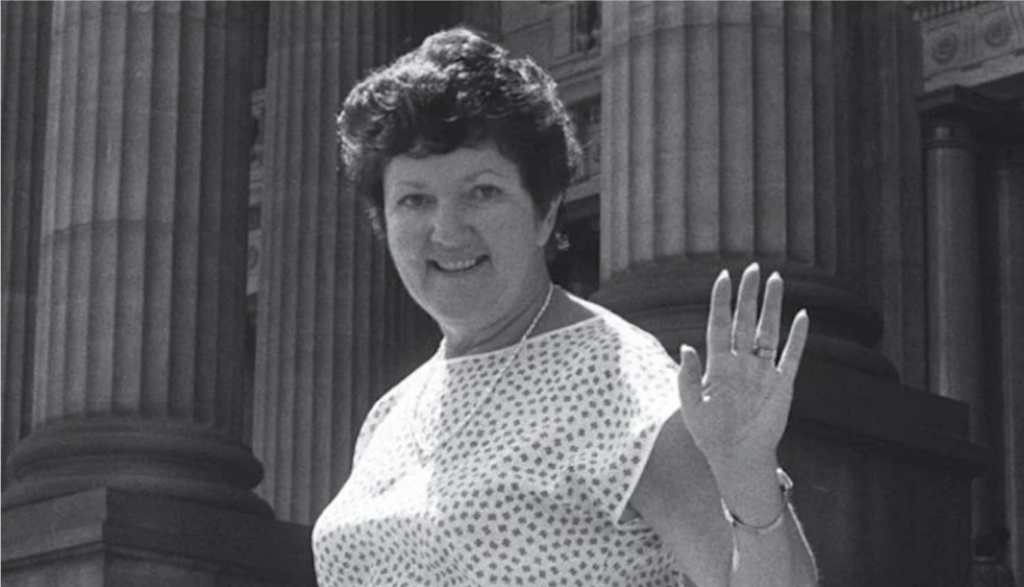
This Book Week, playgrounds around the country will be full of tiny princesses, wizards and superheroes. But imagine, for a moment, a different kind of costume on display. Imagine girls walking into assembly in polka dot dresses, chins up, telling their teachers they have come as the woman who became Victoria’s first female Premier.
That image is exactly what a new children’s book is hoping to make real, and it could not have arrived at a more necessary moment.
Polka Dot Joan is the debut title from Little Shero Stories, a new feminist children’s publishing imprint founded by Gender Lens Australia. It is an illustrated biography of the late Joan Kirner, tracing her path from a young activist and teacher through to the day she became the first woman to lead the state of Victoria. Aimed at readers nine and up, it is written to make political history and gender equality feel like something a child can hold in their hands, not an abstract lesson reserved for adults.
As a reviewer and as a woman who has spent a career watching other women get torn down for the way they dress, the way they laugh, the way they simply take up space in public life, I found this book quietly devastating in the best possible way. It does not shy away from the fact that Joan Kirner was mocked. Her polka dot dresses became a punchline, a weapon the media and her political opponents used against her rather than engaging with her policies. What makes her story so powerful is not that the mockery happened but what she did with it.
“Joan’s polka dot dresses became a source of political attack by the media and her opponents. But she learned to reclaim them as sheroic, adopting the Spot On, Joan slogan,” says Dr Maree Overall, researcher and co-founder of Gender Lens Australia. That single act of reclamation, turning ridicule into a rallying cry, is the emotional heart of this book, and it is a lesson many grown women are still learning today.
Tanja Kovac, writer, poet and co-founder of Gender Lens Australia, put it plainly when she said Joan Kirner was a legend, “a mother, teacher, activist, leader and rock n roller” and a pioneer for women’s leadership in politics. Kovac makes the point that despite everything Kirner achieved, no biography of her existed until now. That gap says as much about our culture as any statistic could. We have no shortage of stories about kings, generals and boy wizards. We have precious few about the mother of three who reshaped a state’s education system and then went on to remake the national conversation about women in politics.
Reading Polka Dot Joan now, in 2026, it is impossible not to draw a straight line from Joan Kirner’s treatment to what former Victorian Premier Jacinta Allan endured, including a “ditch the witch” style campaign that echoes the gendered nastiness Kirner faced decades earlier. If anything should tell us how far we still have to go, it is this. The specific outfits change. The specific slogans change. The underlying contempt for women who dare to lead does not.
That is why the parts of Joan Kirner’s legacy that live beyond her time as Premier matter so much. After leaving office, she co-founded EMILY’s List Australia in 1996, an organisation built to support female Labor candidates committed to equity, diversity and reproductive choice.
It is difficult to overstate how much of today’s progress traces back to that decision. Australian parliaments are edging closer to genuine gender balance, with women now making up half of Labor’s representation federally and women make up 54 per cent of the Labor caucus and 64 per cent of the Cabinet in Victoria, and that did not happen by accident. It happened because Joan Kirner understood that getting one woman into power means little if you do not build the scaffolding for the next hundred to follow her.
That is the quiet genius of this book and this new publishing imprint. Stories like Joan Kirner’s are so easily lost. They live in newspaper archives, old parliamentary records and the memories of the women who were there, and without someone deliberately choosing to write them down for the next generation, they slip away. Little shero stories is doing something genuinely important by refusing to let that happen. We cannot understand how far we have come, or how much further we still need to go, if we do not remember how we got here in the first place.
Representation is not just about the history books adults read. It is about what a nine-year-old girl believes is possible for her own life.
Polka Dot Joan is the first in a planned series profiling trailblazing Australian women, and if this debut is any indication, it is a series worth watching closely.

Hermione Granger had nothing on Joan Kirner. Next Book Week, I would love nothing more than to walk into a school and see a handful of girls in polka dots, telling anyone who asks that they have come dressed as a future Premier. That is how we create a gender equal world.
Polka Dot Joan will be launched at Her Place Women’s Museum on Tuesday 1 September 2026 from 6 to 8pm, with readings from author-illustrator Tanja Kovac and illustrator Laura Morellon, and a conversation hosted by Jo Stanley with a panel of Kirner’s former colleagues reflecting on her legacy. Limited edition hardcopies and little shero stories merchandise will be available at the launch and online, with the book also set for worldwide release as a print on demand and digital title.