
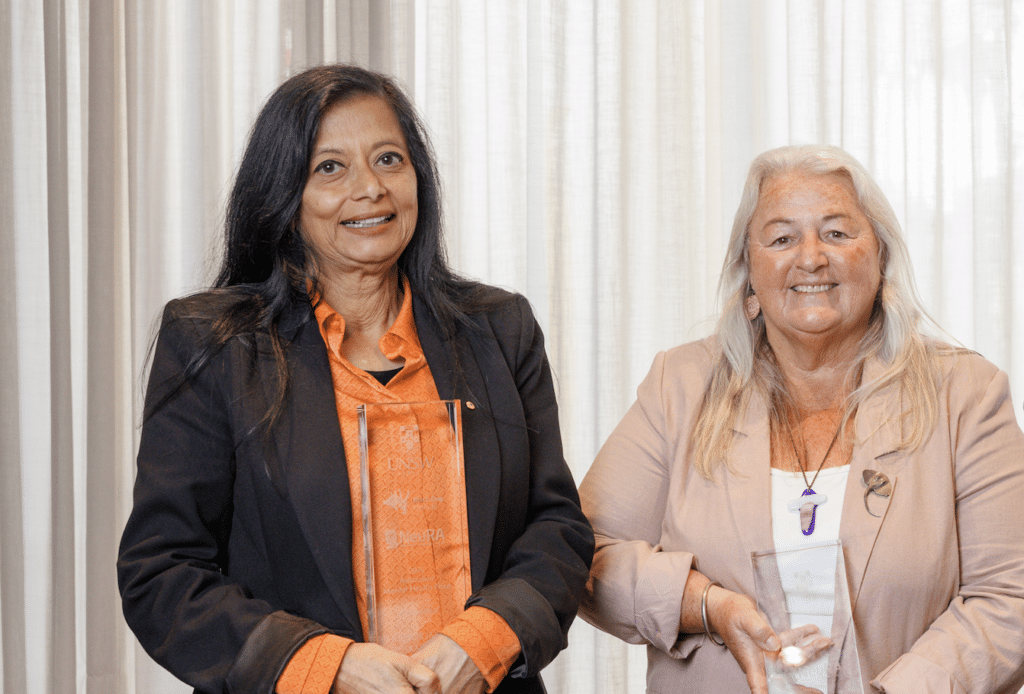
Dr Elizabeth McEntyre and Professor Jayashri Kulkarni AM have spent their careers challenging gaps in Australia’s mental health system, advocating for approaches that recognise the people, communities and experiences often overlooked.
When Dr Elizabeth McEntyre reflects on the work that has shaped her career, she doesn’t draw a line between mental health, criminal justice, disability, ageing or the wellbeing of Aboriginal communities. For her, these are not separate issues to be addressed by separate systems, but deeply connected parts of people’s lives.
It is a perspective that has informed decades of work as a Worimi Guringay and Wonnarua Elder, social worker, researcher and advocate, and one that has now been recognised through the 2026 Australian Mental Health Prize.
“I’ve always worked deliberately to connect systems that are designed to segment Aboriginal individuals, families and communities,” McEntyre says.
Presented by UNSW, Black Dog Institute and NeuRA, the Australian Mental Health Prize recognises people making significant contributions to mental health in Australia. This year, McEntyre is being recognised in the Aboriginal or Torres Strait Islander category, alongside Professor Jayashri Kulkarni AM, who has received the professional award for her pioneering work in women’s mental health.
Although their careers have taken different paths, both women have challenged established approaches to mental health care, particularly where conventional systems have failed to recognise the complexity of people’s experiences or provide treatment that responds to their needs.
For McEntyre, that work has involved bringing cultural knowledge, lived and living experience, research and policy together to improve outcomes for Aboriginal and Torres Strait Islander people, particularly those navigating the mental health and criminal justice systems.
Her work has included advancing culturally responsive models of care and alternatives to imprisonment, with a particular focus on First Nations people transitioning from custody back into the community. She has held leadership roles across Commonwealth and NSW public services and the Aboriginal Community Controlled sector, serves on the NSW Mental Health Review Tribunal, and advises governments, universities and peak bodies.
The judges recognised her rigorous work across criminal justice, mental health, disability and ageing, as well as her leadership in improving the social and emotional wellbeing of Aboriginal and Torres Strait Islander peoples.
But McEntyre is clear that meaningful reform isn’t simply about individual services working better while leaving the broader system untouched.
“We still rely too heavily on fixing models within an unfixed system,” she says. “We separate people and problems into different parts — you deal with this bit, someone else deals with that bit — when what we really need is to think collectively.”
That means asking not only whether an intervention works for an individual, but how decisions made today will affect families, communities and future generations.

“For me, collectiveness shouldn’t just be imagined; it should be realised,” she says. “Aboriginal communities understand the importance of relationships, community wellbeing and thinking beyond the individual need.”
It is also why relationships sit at the centre of her approach to research and reform. McEntyre says the communities she has worked with have trusted her with their stories over many years, and that responsibility is something she does not take lightly.
“When people feel culturally safe and know they can trust you, the research becomes rich and real because Aboriginal people are leading and controlling the process and the outcome rather than simply being researched,” she says.
She describes the people, families and communities she has worked alongside, including her own, as a significant part of what continues to drive her work.
“I am fully awake to the profound and pervasive injustices experienced by Aboriginal people, my people, but I don’t believe that means giving up my capacity to experience beauty, relationships, pleasure and joy that life presents each day,” McEntyre says.
“We can hold both. We can work towards addressing injustice while also recognising the things that fill us up and make living meaningful.”
For Professor Jayashri Kulkarni, the path to reform began with seeing how often women’s experiences of mental ill-health were misunderstood or inadequately treated.
An internationally recognised psychiatrist and researcher, Kulkarni has spent decades advancing understanding of the relationship between reproductive hormones, trauma and women’s mental health. She founded and directs two major psychiatry research groups and, in 2021, established Australia’s first women’s mental health hospital at Cabrini Health in Melbourne.
Her work has challenged approaches to psychiatric treatment that fail to account for the ways women’s bodies, hormones and experiences can influence their mental health.
Kulkarni says it was the women she encountered throughout her clinical work who motivated her to pursue change.
“Meeting women with lived experience of schizophrenia, women with menopause-related depression and women who experienced significant trauma but were diagnosed as personality disordered — all of these courageous women motivated me to work to improve their outcomes,” she says.
She recalls seeing women with mental ill-health treated in ways that did not adequately account for their specific needs, prompting her to establish a service built around more tailored care.
“After seeing the awful conditions and ‘gender blind’ treatments provided for women with mental ill health, I became determined to set up a special hospital for women, with female-focused treatment programmes,” she says.
“I was able to do this and opened Australia’s first women’s mental health hospital in 2021. This has improved outcomes for the women treated in it and has now become a model for other services.”
The recognition through the Australian Mental Health Prize is, for Kulkarni, about more than an individual achievement.
“This is a great honour for me personally, but more than that it means that the work done to improve women’s mental health is recognised as being important,” she says. “That means so much to me and my team.”
Together, the two recipients highlight different but complementary challenges for Australia’s mental health system: the need to recognise the cultural, social and community contexts in which people experience mental ill-health, and the importance of ensuring that treatment responds to differences in gender, biology and lived experience.
Neither approach can be reduced to a single intervention or service. Both require systems to question assumptions, listen to people whose experiences have too often been overlooked, and build care around what people actually need.
For McEntyre, that means continuing to bring people together to tackle problems that might otherwise be dismissed as too difficult.
“I’ve never been someone who steps away when people say something is too hard or too unimportant to matter,” she says. “My instinct is usually to say, ‘Let’s sit down and talk about what we can do and how to do it.’”
Often, she says, when the right people come together, a way forward becomes clearer.
“You can get a whole lot done with a few people who have that good head and heart combination.”