
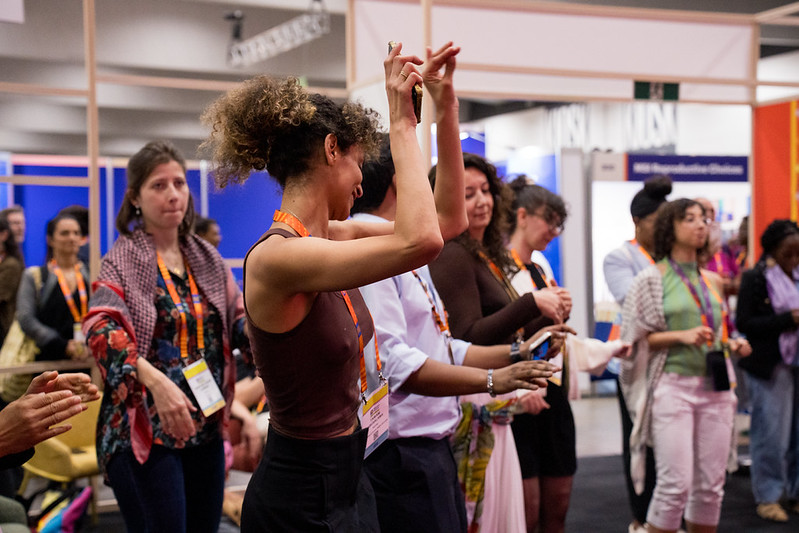
6,123 people. 189 countries. A city buzzing with the kind of energy that only arrives when women who have refused to be silent finally find themselves in the same room.
Women Deliver 2026 landed in Melbourne at a moment of profound geopolitical rupture. The theme Change Calls us Here was not aspirational rhetoric. It was a reminder that the future is not waiting politely, it is arriving in the form of defunded gender equality programs, emboldened authoritarians proudly violating laws they once at least pretended to uphold, and a philanthropic sector still fumbling toward the scale the moment demands.
The numbers framed the stakes. 44 percent of attendees came from the Oceanic Pacific region and 20 percent from Africa. This was not a conference designed for the comfort of donors in the Global North. This was a declaration that feminist leadership looks like the majority of the world, not a narrow slice of it.
Over four days, more than 110 concurrent sessions covered feminist data, sexual and reproductive health, women in politics, family violence, and feminist technology, because yes, the lack of investment in feminist tech spaces while billions pour into AI is both a political issue and a feminist issue. The Melbourne Declaration for Gender Justice, now backed by over 200 organisations and ten countries, including Colombia, Norway, the UK, Mexico, Spain and France, gave the gathering teeth. The Melbourne Declaration is a framework for collective voice, for rooting transformation in solidarity rather than spectacle.
But no session captured the raw reality of this moment more than the final plenary called Women Are Not Negotiable: Conflict, Power, and Accountability.
Simona Abdallah, a Palestinian woman and one of the few Arab women to play the darbuka, the drum traditionally played only by men, walked onto the stage and did something that speeches could not. She grief and rage and the ache of a people the world has decided it can look away from. As a Lebanese Australian woman in that audience, I can tell you every beat landed in the depths of my soul. Tears came not because I chose them, but because grief, when it finally finds its form, cannot be contained. The standing ovation was an act of solidarity and grief made visible.
Then came the panel. Former New Zealand prime mininster Jacinda Ardern, Noor Azizah from the Rohingya Maiyafuinor Collaborative, Zohra Mousavi from Bridge to Safety — Forcibly Displaced People Network, and Tamam Abusalama, who was born and raised for eight years in a refugee camp and is now a journalist and human rights activist.
For the first time at Women Deliver, the conversation was open and unguarded, and included discussion of Myanmar, Afghanistan, and Palestine, with lived experience from women sitting on a stage in Melbourne telling the world what it has failed to do. The covered displacement, trauma, and fury at the leadership structures that sanction the abandonment of women and girls in conflict as an acceptable cost of geopolitics.
On the conference’s first day, Women Deliver CEO Dr Maliha Khan said: no one is free until we are all free. By the final plenary, the weight of that truth had become almost unbearable. Because these women and the women they had left behind are not free. And the world, as currently constituted, permits it.
When the moderator asked Ardern how anyone could stay optimistic, she said: We cannot give up hope and shrink our expectations simply because those in power want us to. To do so would be to hand them the victory they are counting on.
From what I witness, everyone walked out of that plenary feeling raw. Finally, we were not sanitising the grief, not performing optimism, not letting the scale of what is broken excuse us from doing the work.
And the work has never been more urgent, because the systems we built and relied on are crumbling before our eyes. The rules-based frameworks, the institutional protections, the slow progress we defended inch by inch, they are being dismantled proudly by those who have decided that domination is preferable to equity.
That means a feminist movement needs to be willing to set a genuinely different direction. One that harnesses collective power and includes shared decision-making, and restructuring the relationships between funders, movements, and communities.
And we need more than solidarity.
We need corporate tax reform so that corporations extracting wealth from the world’s most vulnerable communities are finally required to fund what justice requires. We need feminist technology resourced at the same scale as the tools being built to concentrate power. We need philanthropy to stop treating gender equality as a niche cause and start treating it as the foundation of everything else.
The future called us to Melbourne. It did not ask us to leave inspired and do nothing.