
The pushback against women’s rights globally is well-documented. But how and why is it happening?
It’s not merely a matter of certain misogynistic influencers. Nor can it be entirely attributed to a certain US president, although his second term hasn’t helped.
Rather, much of the backlash stems from well-funded and organised machines that extend across borders and into the democratic institutions, media and hearts and minds of populations everywhere.
The European Parliamentary Forum for Sexual and Reproductive Rights found that funding equivalent to US$1.18 billion, organised by 275 actors, was involved in anti-gender initiatives in Europe alone between 2019 and 2023. It found Russia to be the biggest funder of anti-gender movements, but US Christian right groups were also spending heavily during that time.
Further analysis has examined funding over the 2024 and 2025 years, finding well-organised, well-funded machines getting stuck into think tanks, social media campaigns, grassroots campaigns, and even political campaigns across the far right.
Meanwhile, Project 2025 — which the second Trump presidency has taken on with gusto — has over 100 conservative partners working to reshape the US federal government. It. provides the framework to dismantle democratic norms across the US, redirecting US foreign aid and funding the momentum to provide robust and sustained attacks on gender rights.
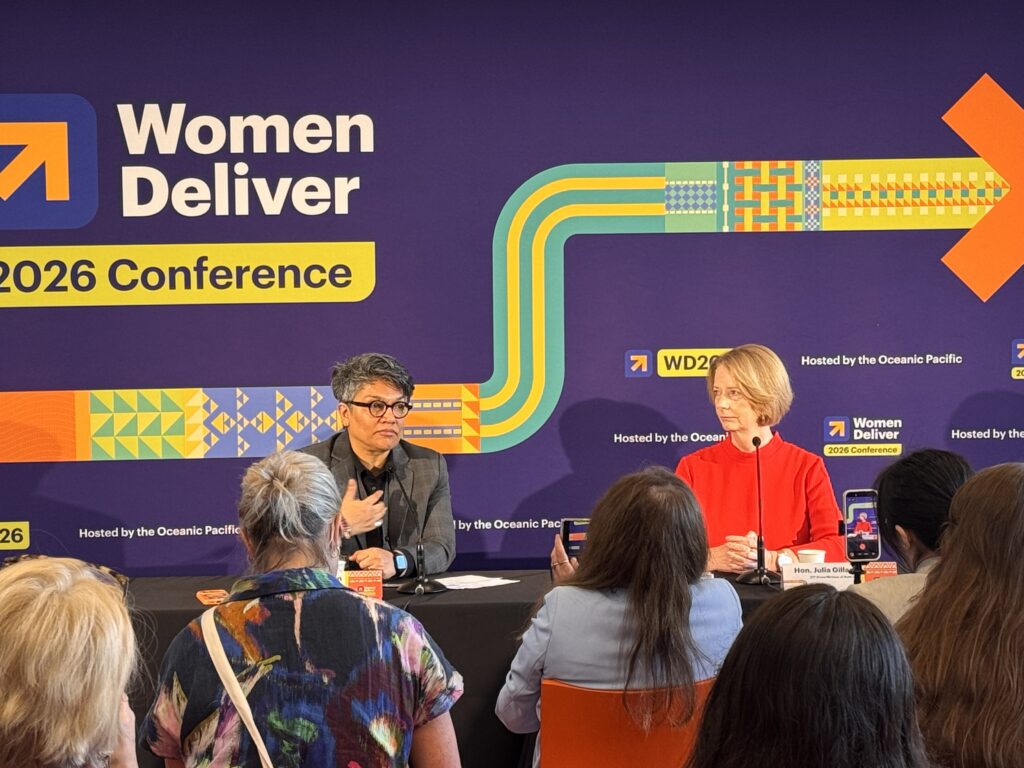
I put the issue of these well-funded machines to former Prime mininster Julia Gillard and Women Deliver CEO Mahlia Kahn during a press conference at Women Deliver on Tuesday.
Dr Kahn said that some of the gains made for women have been taken for granted, and those seeking to protect and extend women’s rights need to become more organised, and recognise the scale of what we’re up against.
“We need to recognise that all the funding that flows into the system… should also flow into the feminist movement, the rights movement, youth movements, which we’ve been very, very reluctant to fund and organise in really concrete ways,” she said.
Kahn shared her concern for the scope of what we’re up against.
“They are well funded, they are well organised, and there’s a lot of them. But if we look at the overall funding that flows into agendas that could be so much more pro-gender, pro-feminist, pro-women’s empowerment — it’s much more.”
She described Hungary’s recent democratic success story as proof of what can be achieved.
“Victor Orbán was thoroughly defeated in an election. And I’m not saying that the person who defeated him is exactly a left-wing feminist, but what they did campaign against was the centralisation of power, the moving away from Europe, and the attack on rights.”
Gillard highlighted an uncomfortable idea that needs more attention: the fact that, despite massive cuts to overseas development, especially for feminist and women-led organisations and initiatives supporting women’s health, there has been little pushback from voters.
“Around the world, major donors have cut back overseas development assistance spectacularly, the US, but not just the US, the UK, France, Germany, Japan. As far as I’m aware, in none of those democracies have those cutbacks caused voter distress, voter protests, or voters going to see their local member of parliament… It has effectively been, in most democracies, a pain-free cutback,” she said.
“Despite multiple years of campaigning to build community support for overseas development assistance, we didn’t win hearts and minds.”
Gillard and Kahn also responded to questions on the centralisation of power in the hands of a few tech leaders.
“We have already seen a major transfer of power from citizens, from nation states, to technology companies,” Gillard said.
“It’s the sense of loss of control of your own information that technology companies now extract so much information from us as individuals.”
Gillard said the impact of this power shift is well documented and that citizens are increasingly aware of what they’re up against.
“When we look at nation states, the impact of social media on community polarisation, on understanding the difference between facts and conspiracy, the intersection of social media and corrosion in democracies — this has all been well studied now. We can all think of examples of where it’s really told in tearing communities apart or having an impact on electoral outcomes.”
She is also optimistic about what can be done and even the idea of AI supporting more good.
“I’m an optimist, and I actually think we are at a stage now where community understanding about what has gone on is much more sophisticated than it used to be… I don’t think anybody, certainly not me, thought way back when, when you were doing Facebook and sharing stories about your family barbecue, that we were going to end up here.”
Gillard also highlighted the Australian social media ban as proof that legislation ending social media access to young people can be popular, and that popularity highlights the community’s desire for change.
“I actually think this is a great time for activists generally, and feminist activists in particular, to be pushing on these issues and trying to create a world in which these technologies do serve us rather than us serving them.”
Kahn urged those feeling defeated by the power imbalance of tech leaders (recently described as ‘demi-gods’ by The Economist) to look to history and see that there have been worse times, and that there have been unelected leaders controlling things globally whom many people fail to even name anymore.
She outlined the William Randolph Hearst parallel, a newspaper publishing baron in the 1800s.
“We have to remember William Randolph Hearst. How many people remember him? He controlled everything back in the day. He was one of the world’s richest men, and he controlled almost all the media in the US. So not only were they extracting information, but there was one person dictating what everyone would read, what they considered to be news. And at that time, there was so much written about how dangerous it was to have such concentrated power,” Kahn said.
“The fact that most of you have never heard of him gives us a huge amount of optimism that maybe our grandchildren will be like, ‘Musk, who the hell?'”
Kahn also stressed the need to think bigger than tech leaders. “They live rent-free in our heads. Can we get them out and actually present a forward-looking vision of our own?”
Finally, Gillard shared a powerful line to reframe the task ahead.
“We obviously want to be breaking glass ceilings, but right at this moment we’ve also got to make sure we’re standing on concrete floors, that the things we already know that we have can’t suddenly crumble away.”