
A new landmark study confirms what First Nations health advocates have argued for years: when maternity care is designed around the specific cultural needs of the women receiving it, babies are healthier, mothers are safer, and the gap in outcomes between Indigenous and non-Indigenous families starts to close.
The research, published in the medical journal The Lancet, tracked 669 Indigenous babies born across three Melbourne hospitals — the Royal Women’s Hospital in Parkville, Sunshine Hospital, and the Mercy Hospital for Women in Heidelberg — between 2017 and 2022, all born to mothers enrolled in the Baggarrook Yurrongi, or “Women’s Journey,” midwifery program. Their outcomes were compared with more than 1,000 First Nations babies born in the same hospitals between 2012 and 2017, before the program existed.
The results speak for themselves. Babies born through the culturally tailored model were less likely to be born pre-term or with low birth weight, less likely to require neonatal intensive care, and their mothers were more likely to successfully establish breastfeeding. Under the program, eligible women are assigned a known midwife who stays with them through pregnancy, birth and postnatal care, backed by support from each hospital’s First Nations health unit and local Aboriginal health services.
Lead researcher Professor Della Forster, from La Trobe University and the Royal Women’s Hospital, said the results are the kind other health systems around the world will want to replicate. She points to the model’s continuity of care as central to why it works, because midwives are in more regular contact with the women in their care; they are more likely to notice early warning signs such as decreased foetal movement, pre-eclampsia, and gestational diabetes, and can intervene before they become emergencies.
The program will now expand further in Victoria to Bendigo, Mildura, Eastern Health and Peninsula Health.
It would be easy to read this story as simply a win for midwifery continuity of care. But that undersells what actually changed the outcomes. The program was built around the recognition that a First Nations woman’s experience of pregnancy and the health system is not the same as a non-Indigenous woman’s, and that generic maternity care, however well-intentioned, was failing to account for that difference.
This is intersectionality in practice.
The term was coined by legal scholar Kimberlé Crenshaw in 1989 to describe how different aspects of a person’s identity such as race, gender, class, disability, sexuality, and more, overlap and interact to shape their experiences of discrimination and disadvantage in ways that cannot be understood by looking at any single factor alone.
A First Nations woman does not experience the health system as “a woman” and “an Aboriginal person” in two separate, cumulative ways. She experiences it as both, simultaneously, and often encounters compounded barriers that include racism, cultural unfamiliarity, mistrust born of historical harm, and geographic and financial disadvantage that a one-size-fits-all model of care simply cannot see.
That is precisely why mainstream maternity care, however clinically sound, has historically produced worse outcomes for First Nations mothers and babies. It was designed for a default patient who does not reflect the realities of every woman walking through the door. Baggarrook Yurrongi worked because it was co-designed with the Victorian Aboriginal Community Controlled Health Organisation and delivered in partnership with Aboriginal health units, building trust, cultural safety and continuity into the model from the ground up, rather than bolting cultural considerations onto an existing system.
The lesson here extends well past maternity wards. An intersectional lens is just as critical in workplaces, education, family violence services, aged care and housing policy. A workplace flexibility policy designed around a “default” employee, for instance, may overlook the compounded pressures faced by a single mother, a woman with a disability, or a migrant woman navigating both racism and gendered expectations at once. A family violence service that does not account for the specific barriers facing Indigenous women, women in rural areas, or women from culturally and linguistically diverse backgrounds risks being inaccessible to the very people who need it most.
The Baggarrook Yurrongi results offer a template for how any institution might approach service design. A successful service design model consults the communities affected, is built around their specific realities rather than a generic average, and measures whether outcomes actually improve for those who have historically been left behind.

As Professor Forster notes, these findings support Australia’s Closing the Gap goal of more First Nations babies being born healthy and strong. But they also offer a broader proof point. When we stop designing services for an imagined “everywoman” and start designing them for the women actually in front of us, in all their complexity, everybody does better.
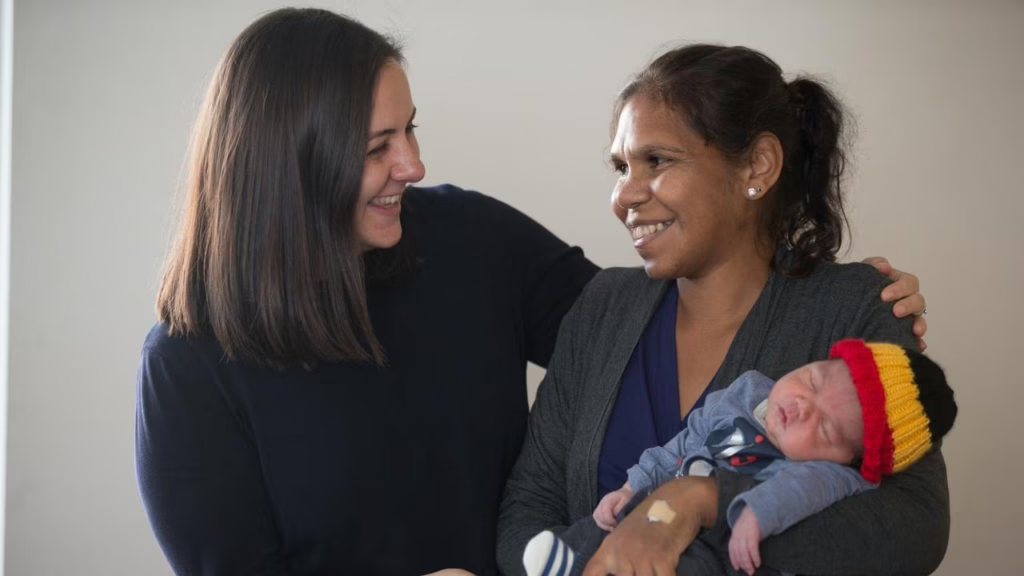
Pictured above is midwife Amelia Stephens with mother Rosie and her baby Jindara, who was the 100th baby born in the program. See more on the program here.