

One of the biggest decisions women in same-sex relationships make when starting or growing their family is: who will carry the baby?
The question also sits at the centre of one of the most common misconceptions Dr Alice Huang hears when seeing female same-sex couples.
“Some people worry that if you have a carrying parent and a non-carrying parent, that the non-carrying parent can be seen as less important,” she tells Women’s Agenda.
Dr Huang is a specialist gynaecologist and fertility doctor at Genea where she has helped many same sex-couples on their journey to conception.
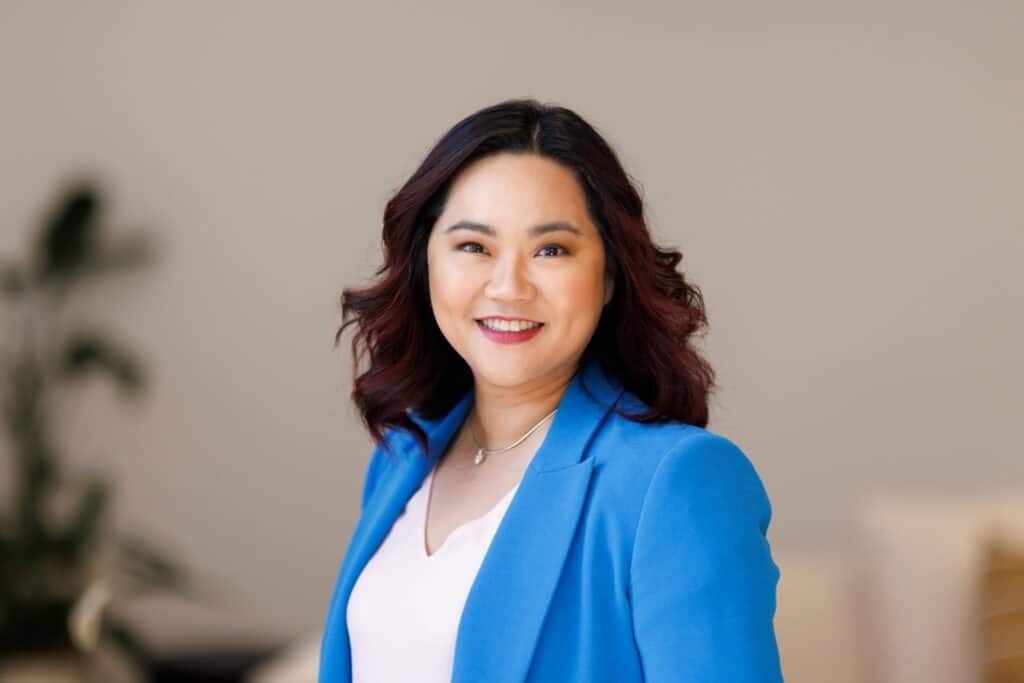
“In good fertility care, we always try to include both parents from the start,” she says.
“We need to remind them and we need to be very mindful that the family that’s been created, no matter whose body is involved in what step, the family that is created belongs to both parents.”
If both partners would like to be a part of the journey physically, Dr Huang says one may choose to provide the eggs while the other can carry the pregnancy.
This is called shared or reciprocal IVF.
“That’s a very special type of IVF treatment where both partners can be involved biologically,” says Dr Huang.
“And what that means is that one partner will have a genetic connection to the embryo and the other one will have a pregnancy and birth connection.”
Aside from deciding which partner will carry the pregnancy or provide genetic material, same-sex and non-binary couples must also consider their options for donor fertility treatment.
“Conception could be through treatment like intrauterine insemination, so IUI, that’s where the sperm is placed inside the uterus so that the egg and the sperm can meet naturally in the body, creating a pregnancy,” she says.
“Or through IVF where eggs are collected out of the body and the egg and the sperm are inseminated in the laboratory to create an embryo and then the embryos placed back into the uterus to create the pregnancy.”
Each couple is different and how much each person would like to be involved in the process of conception and pregnancy will vary.
Dr Huang says it’s important for couples to consider their emotional and relational needs before deciding which way to go.
“For some couples, reciprocal IVF feels very meaningful because both partners play a central role in creating the family,” she says.
“For some couples, they feel that’s very important.
“But for other couples, it may not be medically necessary for them and they may not feel it’s that important to them because they want a more straightforward pathway to pregnancy.”
A couple’s fertility health and circumstances will also be a deciding factor.
“We need to look at things like age, ovarian reserve, medical history, sperm donor availability and if there are any other fertility factors of either of the partners so that we can come up with a treatment plan,” she says.
IVF is not the only option
Another misconception Dr Huang often hears is that IVF is the first and only option for treatment for women in same-sex relationships.
“That is not true,” she says.
“For some women who have no fertility issues, they’re regularly ovulating, they have open fallopian tubes, IUI is actually a very appropriate treatment to start with.
“I usually recommend IVF for things like age-related fertility issues or tubal factors or unsuccessful treatment cycles before.”
To make an informed decision, it’s best for couples to connect with a trusted fertility specialist and develop a plan based on their own unique needs.
Aside from medical health, couples need to work out how much time they have, how many children they want and how much each partner would like to be involved in the physical pregnancy.
“When both partners feel informed and heard and not rushed, I think that’s how they come up with the best decisions,” she says.
Choosing a donor
Same-sex couples can choose between a sperm donor they know or an ‘unknown donor’.
However, in Australia, donor-conceived children can request information on the identity of the donor once they become adults regardless of whether the donor was known or not.
“In Australia, there is really no such thing as an anonymous donor anymore,” Dr Huang says.
“So we usually call ‘unknown donors’ clinic-recruited donors.
“They are recruited through a sperm bank or through a fertility clinic. And then these donors undergo rigorous infectious diseases screening, genetic screening, counselling processes, consenting processes and it’s all within a very regulated legal framework in a
formal fertility practice setting.
“So for a lot of people, that does provide some comfort and it’s a very straightforward process because the role of the donors are very clearly defined from the start.
“Whereas a known donor is usually someone that the couple knows like a friend or someone in their social circle.
“And sometimes for some couples that is more meaningful to know the identity of their donors so that their child may have some knowledge or some connection when they’re growing up with the donors.”
Both options have advantages and disadvantages.
“With a known donor arrangement, we really need to have very careful counselling and very clear legal frameworks,” says Dr Huang.
Because of this, she advises couples to consult a clinic instead of DIY home inseminations which can be fraught with legal, ethical and health safety challenges.
“That’s why I do recommend, if we’re going down a known donor sperm treatment, we really need to go through a formal fertility practice,” she says.
“That helps everyone understand their roles in the treatment.
“The safest approach is to actually deal with all these legal and counselling steps and issues before treatment rather than when pregnancy has occurred.”
With all donors in Australia, there are limits on how many families each one can create.
These rules vary from state to state and can affect the donor options available to couples.
For same-sex couples wanting to start or grow their family, Dr Huang says there is room to explore what is right for them before taking any step forward.
“Often many people come in thinking that they need to have all the answers already,” she says.
“They really don’t.
“The first appointment can actually just be mapping out the options. It’s completely normal to still be deciding what they want.”