
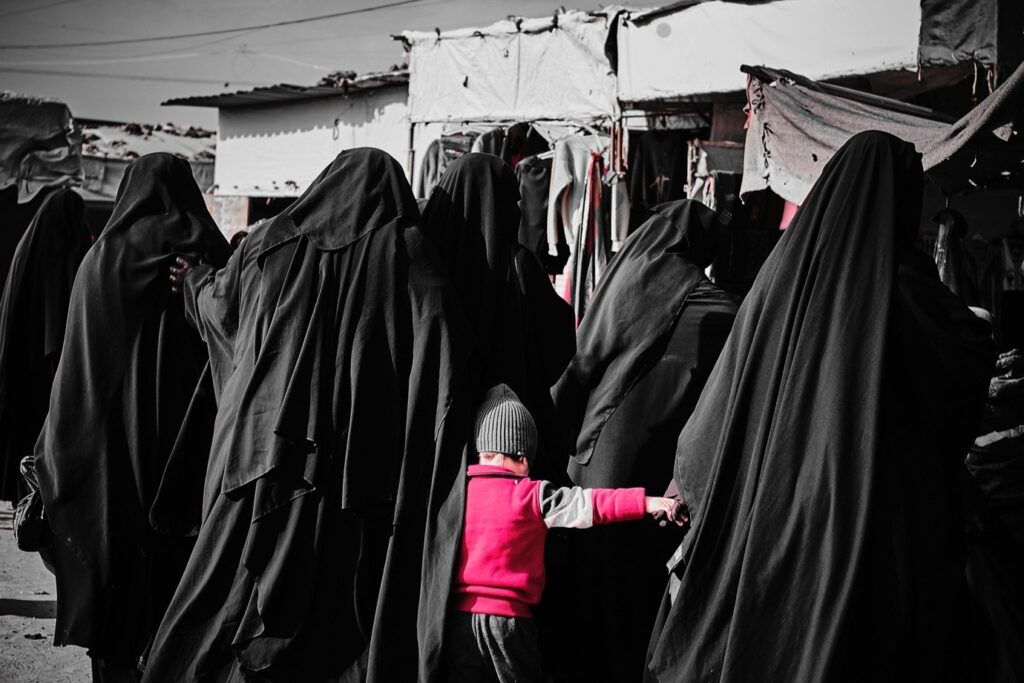
Two women and four children who are Australian citizens have returned to Australia after managing to smuggle themselves out of Syria’s violence al-Hol detention camp.
The women and children from former Islamic State caliphates first went to Lebanon, where they were issued Australian passports after passing security checks.
Often referred to as ‘ISIS brides’, these women and children had been living in an internally displaced people camp following the 2019 fall of the self-proclaimed Islamic State (IS) group.
Australian Federal Police Assistant Commissioner Stephen Nutt said authorities were preparing for the arrival of more people under similar circumstances, with the number uncertain.
Human Rights Watch has described conditions in the camps as “inhuman, degrading and life-threatening”.
Earlier this year, the US government’s suspension of foreign aid to nongovernmental organisations operating in the Syrian camps exacerbated these conditions, Human Rights Watch said.
On Wednesday, Home Affairs secretary Stephanie Foster confirmed that, unlike previous repatriations, the federal government did not assist the Australian women and children with their return.
Foster also confirmed that the federal government was aware of their intention to return since June this year, and that intelligence and security agencies are monitoring the situation.
The opposition has been critical of the Albanese government for the return of the so-called “ISIS brides”, claiming their return to the country was kept a secret from the public and is a risk to community safety concerns.
Opposition leader Sussan Ley said she was “gravely concerned” that the group of women and children had returned to Australia, describing them as “a highly dangerous cohort of individuals who associate themselves with the barbaric Islamic State regime”.
Labor frontbencher Murray Watt reassured the public’s safety on Wednesday, saying: “I can assure people that our security agencies are aware of the people of interest who are in this cohort.”
“Our agencies have been monitoring these individuals for some time and our government has confidence in those agencies to keep Australia safe.”

A spokesperson for Home Affairs Minister Tony Burke said: “The Australian government is not providing assistance and is not repatriating individuals in Syrian [internally displaced persons] camps.
“If any of those people find their own way to return, our security agencies are satisfied that they are prepared and will be able to act in the interests of community safety.”
Australian Federal Police Commissioner Krissy Barrett said: “I do want to provide assurance and confidence that the AFP remains appropriately prepared and positioned to respond to any self-managed returns from the internally displaced persons camps”.
Some people have begun calling out the political football field that these women and children seem to be caught up in when it comes to returning to Australia.
Chief Political Analyst at the Australia Institute Amy Remeikis wrote on X: “Australian citizens have the right to return to Australia. Calling them ‘ISIS brides’ does not change the law. They are Australian.”
The organisation, Save the Children Australia has long advocated for the government to safely repatriate the Australians stuck in Syria.
A federal court challenge from Save the Children to get the government to return its citizens failed in 2024, however the court did find that “if the commonwealth has the political will” to bring women and children back to Australia, “it would be a relatively straightforward exercise”.
“Every child deserves a life free of violence and fear. As conditions in the camps worsen and the region grows more unstable, we hold serious concerns for the wellbeing of the innocent children who remain there,” said Save the Children Australia CEO Mat Tinkler.
The organisation is calling on Australian authorities to provide returnees with comprehensive support for reintegration into Australia.
This is a call for action that the Australian government has previously done in 2019 and 2022, when it undertook two limited repatriations. In 2019, this included eight orphaned children, and in 2022, four women and 13 children were brought back to Australia from Syria.