
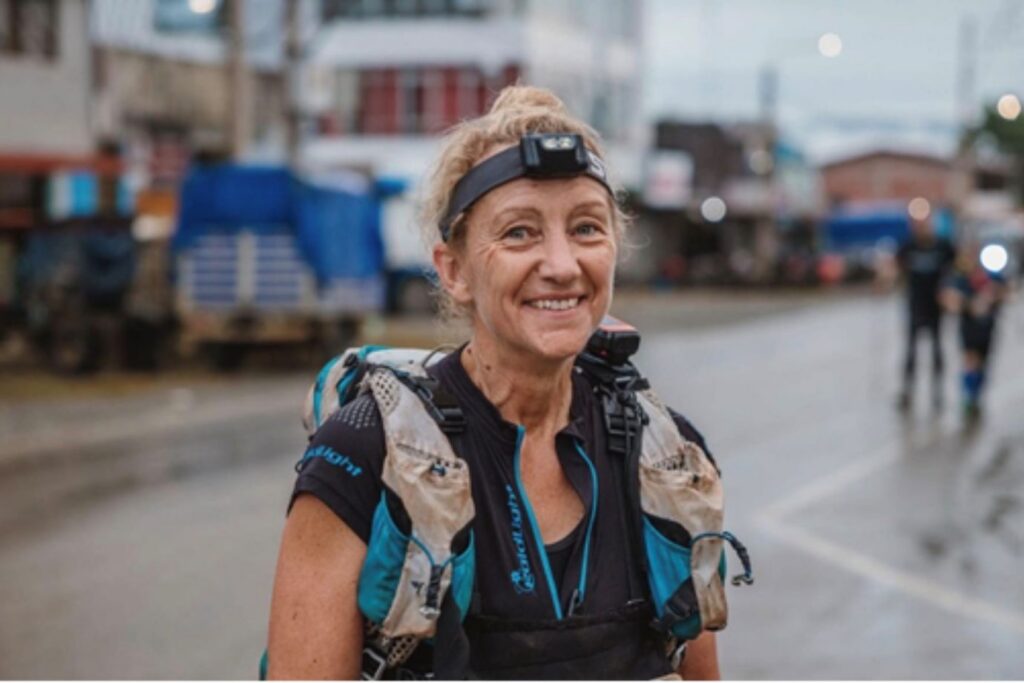
Ultramarathoning is one of the world’s fastest-growing sports, and the longer and harder the race gets, the more women pull ahead. Richard Castles shares his experience of watching his running mate, Tracey Waterfall, finish the Amazon’s brutal five-day Jungle Ultra.
It’s hard to believe that four decades after the ‘Forrest Gump’-style craze of the 1980s, running is still booming more than ever, suggesting it was never just a craze to begin with. It’s also hard to believe that prior to 1984, there was no women’s marathon at the Olympics.
Running has grown globally across all distances post-Covid, with marathon participation increasing by nearly 50 per cent. The 2026 London marathon set a world record of nearly 60,000 runners (24,000 women), not to mention the million-plus applicants who missed out on an entry. 5km park runs, 10km fun runs, and 21km half marathons have all surged in popularity.
But with an increase of nearly 350 per cent over the last decade, ultramarathoning leads the way as one of the world’s fastest-growing sports, driven mostly by a rise in female participation.
Meaning ‘beyond a marathon’, the word ultramarathon is actually misleading, implying that the race is simply longer than a standard marathon (42.2km) – although that is the technical definition. But an ultramarathon is so much more than just a long run that it really qualifies as a different sport entirely. It’s more of an ultra-adventure.
To begin with, ultramarathons usually take place on trails rather than roads, with more ups and downs and more technical skills required than a flat-track marathon.
Australia’s premier trail-running festival, Ultra-Trail, takes place in The Blue Mountains and offers 50km, 100km, and 160km options. These are single-day ultramarathons. Beyond these are the multiday races, such as the 5-day, 230km Jungle Ultra in Peru, which I recently took part in with my running mate, Tracey Waterfall, a 55-year-old mother of two.
Tracey is one of the increasing number of female runners competing in ultramarathons worldwide. It makes sense, as both performance data and biological evidence suggest women are well-suited to ultra-endurance – hardly surprising when I think of the labour I put my mum through in an unairconditioned hospital on a 42-degree day in 1968. That was around the year Kathrin Switzer was almost physically pulled out of the Boston Marathon for being female.
Biologically, women seem to have several characteristics that are advantageous for ultra-running. These include a higher percentage of slow-twitch, fatigue-resistant muscle, superior fat metabolism, and lower demand for muscle blood flow. All these allow for steadier pacing and fatigue management, reducing the kind of burnouts that hinder male performance over long distances.
It seems the longer and more gruelling the event, the more the respective performances of the sexes converge. In most sports, men perform at approximately 10 per cent higher levels, while marathon world record times show about an 8% difference between men and women. In ultramarathoning, it narrows to between one and four per cent, with a number of events now being won outright by women. Maybe the real issue race directors had with Kathrine Switzer was that the Boston Marathon wasn’t long enough.
But something more than biology accounts for women’s success in these events. As any mother will tell you, it takes a particular kind of resilience to be pushed to your limits, to deal with the multitude of slings and arrows fired at you all day, to have no choice but to push on to the end, and then no choice but to get up and do it all again the next day. That gets close to describing a multi-day ultramarathon.
The Jungle Ultra

Let me tell you a little about the Jungle Ultra, starting with the equipment. While running a regular marathon basically requires a pair of runners, socks, shorts, a singlet, cap, sunscreen, Vaseline, and some strategically placed Band-Aids, the Jungle Ultra requires runners to be self-sufficient for five days, carrying their food, gear, sleeping bag and hammock for the duration of the race. The mandatory equipment list alone runs to 46 items — that’s just the compulsory stuff, and doesn’t include optional items like hiking poles, gloves, a cup or bowl, thongs, an inflatable pillow, and toilet paper. The list includes items like a compass, whistle, syringe needles, scalpel blades, trauma dressing, head torch, knife or scissors, glowsticks, an emergency bivvy bag, and an assortment of pharmaceutical pills and ointments, all of which add up to a backpack weighing around 10 kgs. Then add 2.5 litres of water.
The race starts at an altitude of 3,000 metres, higher than any point in Australia, then takes you up and down thousands of metres of ascent and descent into the humid, densely forested Amazon Basin. Altitude sickness is a real concern at the beginning, the wildlife a concern the rest of the time. I was lucky to see only two dead snakes on the roads, my singing and stomping evidently effective in warding off the jaguars and anacondas.
Compared to the concrete urban jungle of a regular marathon, the first 10 kilometres of the Jungle Ultra alone passes through five distinct ecosystems.
Over the course of five days, you run along dirt roads, up and down muddy rainforest trails, through semi-rural fields, along and across flowing rivers up to your knees, over makeshift fallen-log bridges, and through the remotest of villages. You’ll be treated to a zip line river crossing and even a couple of boat rides, manned by a local team of strong Peruvian paddlers.
Swatting mosquitoes and ants of all sizes and colours is a constant. Scrambling up or down a steep muddy trail, the choice is sometimes between reaching for a supportive branch covered in bastard ants (formicidae bastardus) or prickles (prickly prickus), or falling and sliding 20 metres until you careen into a tree at the bottom of the hill. Unlike regular running, virtually every step requires care and technical precision, muddy climbs and rocky river crossings being particularly tricky.
Needless to say, the going was slow for Tracey and I in the Jungle Ultra. On day 3, it took me over six hours to reach the first checkpoint, a distance of just nine kilometres. One-and-a-half kms per hour! At that pace, it would take me well over 24 hours to complete a regular marathon. In an ultra, it becomes more about time than distance. Patience and fortitude come to the fore over simple athletic strength, a deep resolve to simply put another foot in front of the other. And this, I think, is where the women really step up.
I said I participated in the Jungle Ultra with Tracey, but I didn’t say I finished.
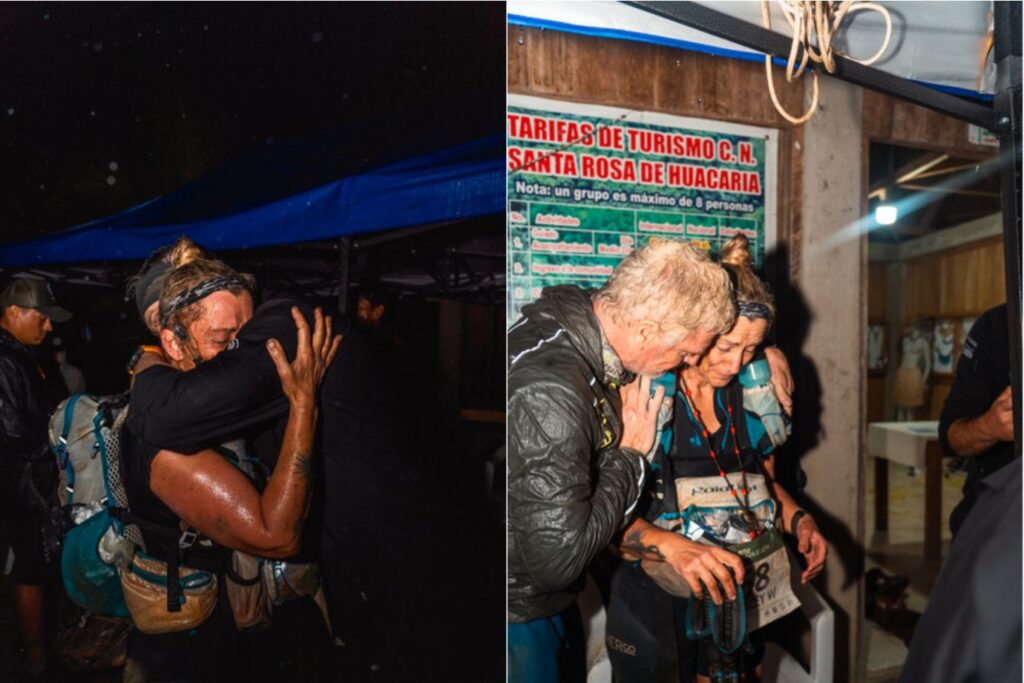
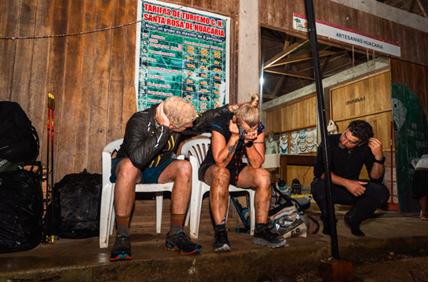
I pulled out on the especially challenging day 3, although I did return to complete the long day 5. Tracey, however, earned her finisher’s medal with true grit. Watching her headtorch emerge from the jungle at the end of day 3 in the rainy night is something I’ll never forget. She crossed the line and broke down for five minutes; I burst into tears in sympathy. Yes, she cried like she’d just given birth after 14 hours labour, but her bravery was beyond inspiring. She attended to the feet, stings and abrasions, put up her hammock and prepared her dinner. Then, she got up and set off again the next day, a warrior woman in the appropriate Amazonian location.
Ultramarathoning certainly isn’t going to be everyone’s cup of camp soup. Beyond the physical demands, in the Jungle Ultra, for instance, the trials of mud, chaffing, sunburn, insects, cuts and bruises, gear troubles, snapped poles, and so on, were enough to make the toughest cry out, “The horror! The horror!”
But if you’re a woman who’s ever had a smidge of a thought of doing an ultramarathon, you’re probably the kind who should. You’ll be joining an ever-growing number of women leading the charge. You may curse often and loud, but you’ll never regret it. And a year or so later, you’ll forget the pain and want to do another. If you don’t like jungles, you can always opt for the relative comfort of the 230km Ice Ultra in the Arctic or the legendary 250km Marathon des Sables in the Sahara.