
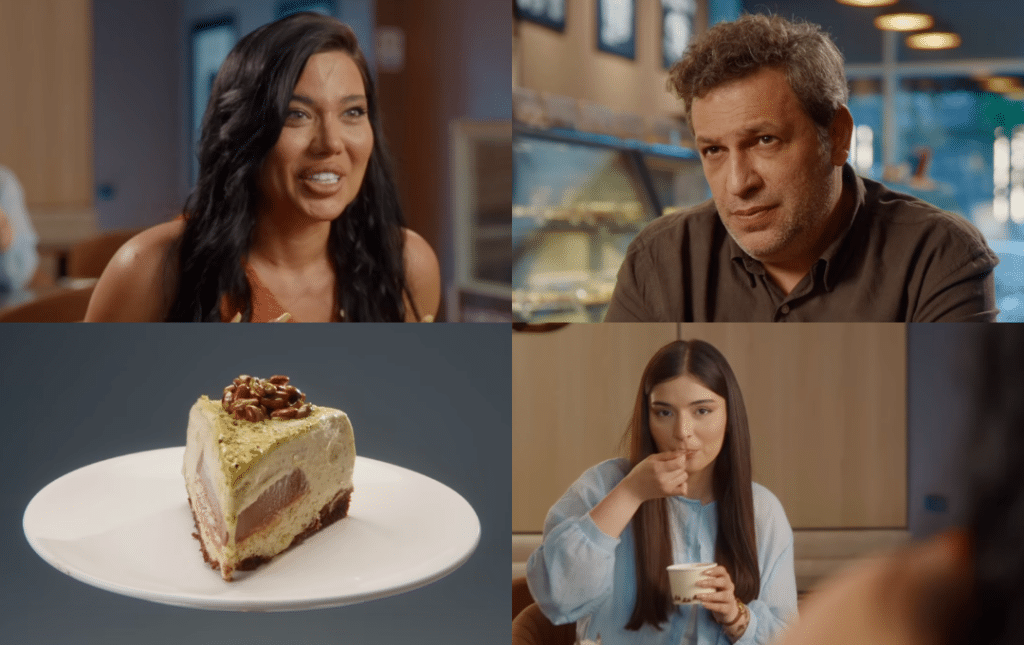
A new advertisement from a cake bakery in Azerbaijan has used women and cosmetic surgery as the punchline in an attempt to sell its products.
The 55-second Instagram reel, shared by Almond Cake & Bakery to its 300,000 followers, follows a man on a date who quickly disengages from the conversation, and begins to mentally catalogue what he assumes are her cosmetic procedures. While his date is being reduced to a checklist, her conversation on astrology is also being used to frame her as shallow.
He then notices another woman sitting across the café, who is presented as “natural” and therefore more desirable. The ad concludes by asking viewers whether they prefer “what is natural” before cutting to the bakery’s products, made with natural fruit, nuts and honey.
It’s a common trope. Rather than celebrating its products on their own merits, the campaign relies on turning women’s bodies into product labels as they position the “artificial” woman as intellectually and romantically inferior to her “natural” counterpart.
Sexism in advertising obviously isn’t new. There are countless examples and many that sink just as low as this one.
A UK air-conditioning company in 2019, for example, used a billboard displaying a woman in hot pants with the text: “Your wife is hot! Better get the air conditioning fixed”.
Or, this Coca Cola print advertisement for a premium milk brand featuring retro pin-up models half-naked and covered in milk, accompanied by taglines like “drink what she’s wearing.”
However, the issue is not so much that sexism has existed in advertising and marketing, it’s the lack of evolution. When we see these ads, year in and out, it’s hard to believe that any progress is afoot.
Existing as a woman can often feel like a no-win situation – where every choice, from embracing cosmetic procedures to rejecting them entirely, is met with relentless scrutiny. Women are constantly told that their appearance is either too much or not enough, with their bodies and choices subjected to endless criticism.
This ad reinforces the harmful idea that women exist simply for the approval of the male gaze. Instead of challenging these outdated expectations, it simply repackages them as entertainment and marketing.