
The Fair Work Commission’s decision to lift minimum wages by 4.75 per cent from 1 July has been rightly welcomed by Australian unions and for good reason. For the three million workers who rely on these wage decisions, Tuesday’s increase offers long‑overdue relief in an economy where the cost of living has become a daily crisis. With inflation sitting at 4.2 per cent, this rise broadly keeps pace with price pressures and prevents the lowest‑paid workers from falling even further behind.
This year’s decision includes a 6 per cent increase for around 100,000 workers on the very lowest award rates — matching the ACTU’s claim. It lifts the base rate for ongoing work from $24.95 to $26.44 an hour, or an extra $56 a week for a full‑time worker. A retail worker on level 2 of the retail award will see a $49.78 weekly increase, or $2,588.70 a year.
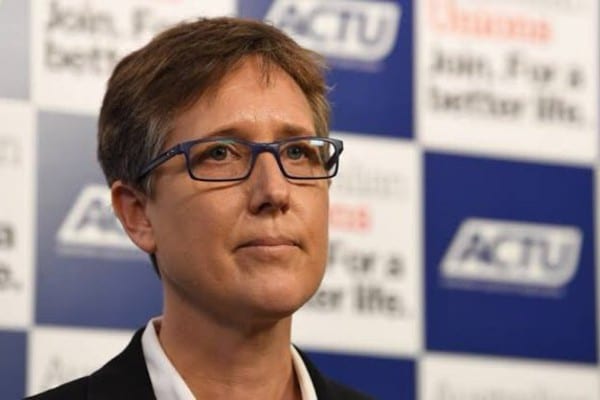
ACTU Secretary Sally McManus (pictured above) put it plainly, “it means relief is on the way for lower-paid workers to help keep up with price pressures and avoid the need to cut back on essentials like food or seeing a doctor… This is a positive real wage increase, and it will provide some buffer against the worst impacts of the Trump war.”
To understand the true significance of this decision, we need to look at who Australia’s minimum‑wage and award‑reliant workers actually are. Because this is not just an economic story, it is also a gendered one.
Women make up more than 60 per cent of award‑dependent workers. They dominate the lowest‑paid sectors, which include retail, hospitality, aged care, disability support, childcare, cleaning, and health support. These are the jobs that keep our communities functioning, our children cared for, our elderly supported, and our essential services running. Yet they remain chronically undervalued, underpaid, and disproportionately insecure.
In other words, when we talk about minimum wage increases, we are talking about women.
For women, especially those in part‑time or casual roles, this buffer is not abstract. It is the difference between filling a prescription and going without. Between paying the electricity bill or falling into debt. Between staying afloat or slipping below the poverty line. No one in a wealthy, first‑world nation should be living below the poverty line, yet hundreds of thousands of women are.
The gendered impact of low wages is not limited to the weekly pay packet. It compounds over a lifetime. Lower earnings mean lower superannuation, fewer savings, and greater financial vulnerability. This is why women over 50 are the fastest‑growing cohort of people experiencing homelessness in Australia. Many have worked their entire lives in feminised industries that are essential but undervalued. They raised children, cared for ageing parents, and held together the social fabric only to find themselves locked out of financial and housing security in later life.
A minimum wage rise will not solve this crisis, but it will help prevent more women from joining its ranks.
The Fair Work Commission acknowledged the “wild card” economic impacts of global conflict and instability. But for women in low‑paid work, the real wild card has always been a labour market built on the assumption that “women’s work” is worth less. The sectors where women cluster are not low‑paid because they lack skill or social value, they are low‑paid because they are feminised.
This wage increase is a step forward, but it is still only a step. Unions had sought a 5 to 6 per cent increase, arguing that anything less would leave workers worse off than before the pandemic once inflation is accounted for. And they are right, as today’s rise, while welcome, does not restore the real wages lost over the past several years.
Still, it matters. It lifts the wage floor and it puts money directly into the hands of workers who spend almost everything they earn stimulating local economies. And it recognises, even if modestly, the dignity and value of the people who keep this country running.
If Australia is serious about gender equality, then lifting wages for the lowest‑paid workers who are predominantly women is not optional. A stronger minimum wage is a necessary reinforcement of the economic floor women stand on, but true gender equality demands we keep building upward.