
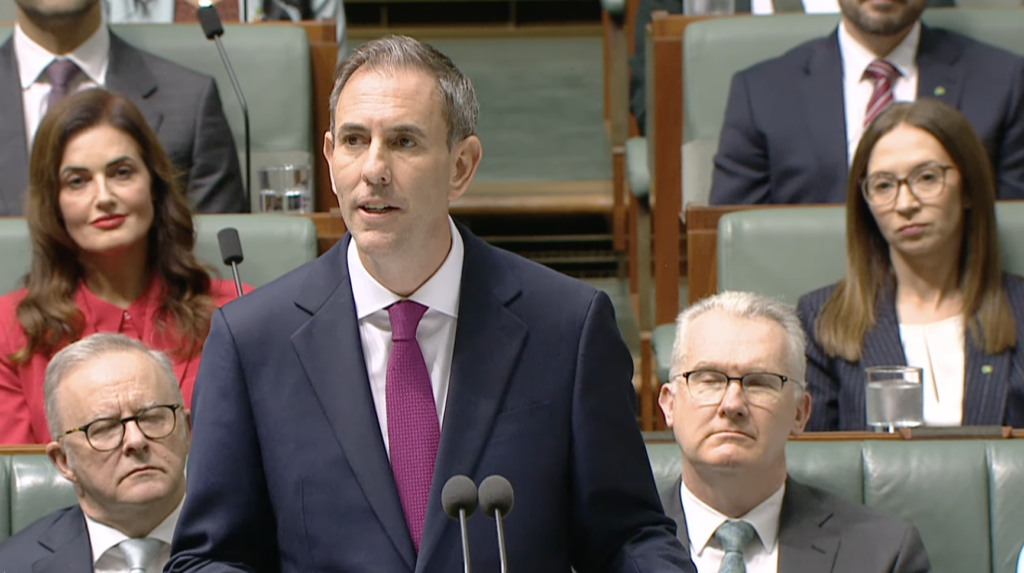
Treasurer Jim Chalmers handed down the government’s Budget tonight, with a patchy “winners and losers” narrative.
As expected, the war in Iran and Australia’s response to the global oil shock was referenced as context to the “longstanding challenges” faced in “productivity, performance, our housing market and tax system”, but with the silver lining that “we are much better placed and better prepared than most countries” to deal with the fallout.
“As Australians, we confront these serious challenges together from a position of strength”, he said.
In the short term, the government is responding to the fuel crisis with a significant $14.8 billion plan. The main aspect of this is a $10 billion investment in immediate fuel supplies and a permanent fuel security reserve.
In terms of broader measures on productivity, we were promised a Budget of widespread resilience and reform but delivered something closer to fairly constructive tinkering.
Certainly, for women, there was little in the way of new funding or initiatives. However, the investment of $182.6 million to make the child support system safer, was a welcome commitment.
Currently, there is more than $1.9 billion of unpaid child support in Australia with close to 100,000 parents and carers in the child support system who have experienced or are at risk of experiencing domestic and family violence.
The government’s reforms are the first major changes to the child support system in two decades and are designed to improve several elements, from initial assessment through to payment and compliance. They include:
- New online support and outreach for parents first entering the child support system to help them choose the best collection method
- Expanding the use of ‘employer withholding’ as the default payment method, making $520 million payments per year more reliable
- Increasing the use of Departure Prohibition Orders so that parents with large unpaid child support arrears need to arrange payment before travelling overseas.
- Enabling Services Australia to pursue unpaid child support from private collection arrangements when parents move to Agency Collect System
- Enabling Services Australia to stop harassing behaviour and to protect the information of parents (primarily mothers) at risk of abuse or coercion.
- Enhance data sharing between Services Australia and ATO for more accurate child support assessments.
Minister for Women Katy Gallagher described the changes as “significant”.
“Child support should never be used as a tool for control or coercion, these reforms put us on the path towards making the system safer for women and ensuring children get the financial support they are owed”.
So, what else came out of this year’s Budget with specific impact on women?
Capital Gains Tax Changes
The government has “come to a different view” on capital gains tax changes, the Treasurer told media on Tuesday afternoon. Chalmers claimed “it would have been easy but wrong” to see the changes in the housing market and pressures intensifying for young people without acting—despite his previous position 12 months ago that CGT would not be altered.

The CGT changes applied to all asset classes will replace the 50 per cent capital gains tax discount with inflation-adjusted indexation.
The government will also introduce a minimum 30 per cent tax rate on capital gains from July next year and on discretionary trusts from July the year after.
For housing, the CGT changes will likely benefit younger Australians and female first home buyers, with housing expected to become more affordable.
CGT reforms will only apply to gains after 1 July 2027.
Negative gearing
Negative gearing compounds the impact of the CGT discount on housing affordability with investors overwhelmingly opting for existing housing stock and locking prospective homeowners out of the market. The government will limit negative gearing to new builds from 1 July 2027. Existing arrangement will remain unchanged for all properties held before tonight. The CGT discount and negative gearing reforms will help improve affordability and support 75,000 additional owner-occupiers over the next decade.
Further Tax Tinkering
- The introduction of a $1,000 instant tax deduction will benefit 6.2 million Australian workers from 2026-27. The instant tax deduction allows workers to lower their taxable income by $1,000 without keeping receipts for things like self-education tools or work -related care expenses, with an average tax saving of $205
- The Working Australians Tax Offset (WATO) will be delivered for every Australian worker on top of the tax cuts announced in the 2024-25 Budget and the two upcoming rounds announced in the 2025-26 Budget. The WATO is a permanent, annual tax offset of up to $250. While the offset is small, it will marginally support workforce participation for lower-income workers, particularly women.
Cheaper medicines
This Budget includes a $25 billion investment in public hospitals to reach a record $220.3 billion over five years. $5.9 billion was also allocated to list new medicines on the PBS, including treatments for cystic fibrosis, chronic kidney disease and various cancers.
More social housing
An investment of $59.4 million will see 4000 young people aged 16-24 who are at risk of or experiencing homelessness placed in stable housing. The government will also continue in its affordable housing agenda with a further 55,000 social and affordable homes built and $100 million to improve the quality of housing for First Nations Australians in remote communities.