
I am more familiar with the Clavicular and Androgenic beef, than I am with the Alex Cooper and Alix Earle fallout. Suffice to say, as a young woman, my career as a men’s health researcher has taken me to some interesting places. None more so than the manosphere.
I’ve spent time in corners of the internet most women have never heard of: 4chan, Discord, Odyssey, Rumble. Not as a regulator or a judge, but as a researcher at the Movember Institute, trying to answer one of the most important questions of our time: What do young men’s digital worlds actually look like, what are they doing to the boys and men who inhabit them, and what spills out to the world around them?
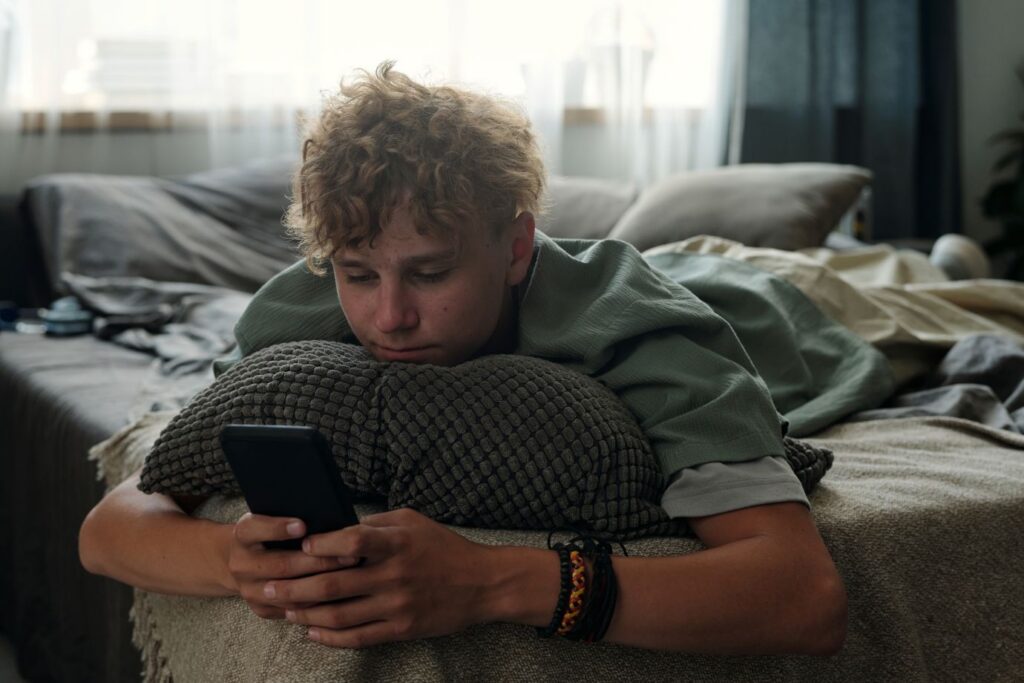
To answer those I walked in the shoes of a young man online – to see what he sees, scroll what he scrolls: So for the last two years I’ve had two TikTok accounts.
Mine: Krista, early thirties, Australian, female.
And “Liam”: seventeen, American, male. Built for my research.
The contrast between these feeds was disorienting.
Krista’s feed: Anne Hathaway’s ‘ageless face.’ The latest six-star BookTok recommendation. High-protein recipes and #WIEIAD videos.
Liam’s feed: a new ‘research laboratory’ selling Retatrutide. Dating tips to escape the ‘friend zone.’ BDSM scenes from Euphoria. NBA highlights from Luka Dončić’s sixty-point game.
Switching between Krista and ‘Liam’s’ for-you-pages was like crossing a chasm between parallel digital universes that rarely touch. Different messages. Different pressures. Different ideas about identity, gender roles, relationships, body image – all delivered through hyper-personalised algorithms that learn and weaponise our vulnerabilities the minute we enter our gender, age and interests.
But ‘Liam’ only showed part of the story. A dummy account misses everything that shapes a young man’s online experiences; his viewing history, his sense of self, his ideas about what it means to be a man.
So our team went further. We analysed the real TikTok viewing histories of 142 young men across Australia, the US and the UK. What was most shocking wasn’t the extreme content (one per cent of the 2,000 videos), or covert misogyny and rigid stereotypes of masculinity (five per cent), it was the everyday stuff – sports, gaming, fashion (38 per cent of videos). Ordinary game-day highlights sitting at the start of a pipeline of identifying ideological and health messages. The cultural packaging through which harmful messages become palatable, pulling young men in faster, darker tides without them realising, because they’re still swimming in the same cultural waters.
This is what we’re getting wrong about the manosphere. It’s not a binary thing. It’s not one ideology, made up of one type of man. It’s a broad spectrum and young men are not simply in or out of it.

Watching these videos I had the privilege of perspective, of objectivity, of distance. But it turns out even for me, immersion in the manosphere leaves a mark.
Some days I’d be watching participants’ videos and thirty minutes would pass without me noticing. I was scrolling without knowing what I was looking for. Some of this content was genuinely engaging. Motivating, even aspirational. I could imagine with uncomfortable clarity what it would feel like to be a young man – anxious, insecure, inexperienced. The promise of ‘levelling up,’ the products and people that claim to have all the answers, to make you richer, more attractive, more in control: I could see how compelling these promises would be when you’re growing up in a world offering very few certainties.
One afternoon I landed on a looksmaxxing subreddit with 300,000 members. A 16-year-old had posted a photo of himself requesting an ‘honest’ rating on his physical appearance – a score out of ten with advice on how to improve.
Ninety-four comments. Scores of one to three. “Face symmetry average.” “Eyes too far apart.” “If you lost weight you’d be okay.” “Lefort 3 or rope” [craniofacial surgery or suicide]. I felt physically sick. The commenters had forgotten there was a human being at the other end, someone whose self worth, and mental health, hinged on the numbers they typed back. The anonymity of these forums creates environments that feed off, and fuel shame – where boys can be both victims and perpetrators of harm in plain sight, while trusted adults in their lives (parents, caregivers, teachers, siblings) have no idea it’s happening.
Moments like this gave me two things simultaneously: genuine empathy for young men drawn to this content and these communities, and genuine concern about what it’s doing to them and those around them. These two things are complementary, not contradictory.
My immersion in the manosphere did not stay digital. Content circulates and becomes conversation. Conversation circulates and becomes culture.
I started seeing it happen in real time – at dinner tables, at bars on the weekend, at sporting events. Conversations that started with “I saw this thing online…” and ended with claims I recognised immediately: The Johnny Depp and Amber Heard trial repackaged as proof of widespread false domestic violence accusations. Vaccine side effects “nobody was talking about.” The Justin Baldoni and Blake Lively case, reduced to memes before the facts were established. These viral trends were talked about with complete confidence, no mention of where this “evidence” came from. And why would they question it? They’d encountered these ideas through sources they trusted – podcasts they loved, creators they followed – repeated so many times it had started to feel like common knowledge.
That’s the thing about algorithmic echo-chambers. They don’t just shape what we believe. They shape what we think is worth questioning. With no friction, no counter-perspective, no outside voice challenging what’s being served, ideas calcify into certainty. Over time these silos reinforce and deepen existing power structures with real consequences – for women, for gender and sexually diverse people, for anyone who sits beneath men in the patriarchal hierarchies deeply entrenched in Western societies. Hierarchies that existed long before TikTok, but that algorithms now industrialise.
I did not need two years of research to know these hierarchies exist. I feel them viscerally – in the way I move through the world, in the calculations I make every day, in the risks I weigh before I take them. But the research gave me a strange double vantage point: I saw the aspirational pull of messages that uphold these hierarchies in the data, while navigating life as a young woman within them.
I’ve also come to understand that uncertainty, insecurity and vulnerability can exist alongside problematic attitudes in young men: One does not excuse the other. Young men who cause harm must be held accountable, and the attitudes that drive that harm must be dismantled. Girls and women deserve protection.
But compassionate accountability is where long-term, preventative change will happen.
Reactive and punitive responses alone aren’t enough – we can’t just wait for harm to actualise before we intervene. We must ensure young men have the community and tools to interrogate what they’re seeing online, support that pulls them out rather than pushes them further toward content causing harm, and platform accountability for the digital environments they’re building and profiting from.
People often ask whether two years in the manosphere has made me more nihilistic, more suspicious, more guarded.
The answer is the opposite.
I’ve come away more empathetic, more committed, and with a much clearer picture of what we need to build. The digital worlds young men like “Liam” inhabit are reshaping how they see themselves, their relationships and the world around them.
We can’t just respond to harm when it surfaces. Instead we need to build digital worlds worth protecting.