
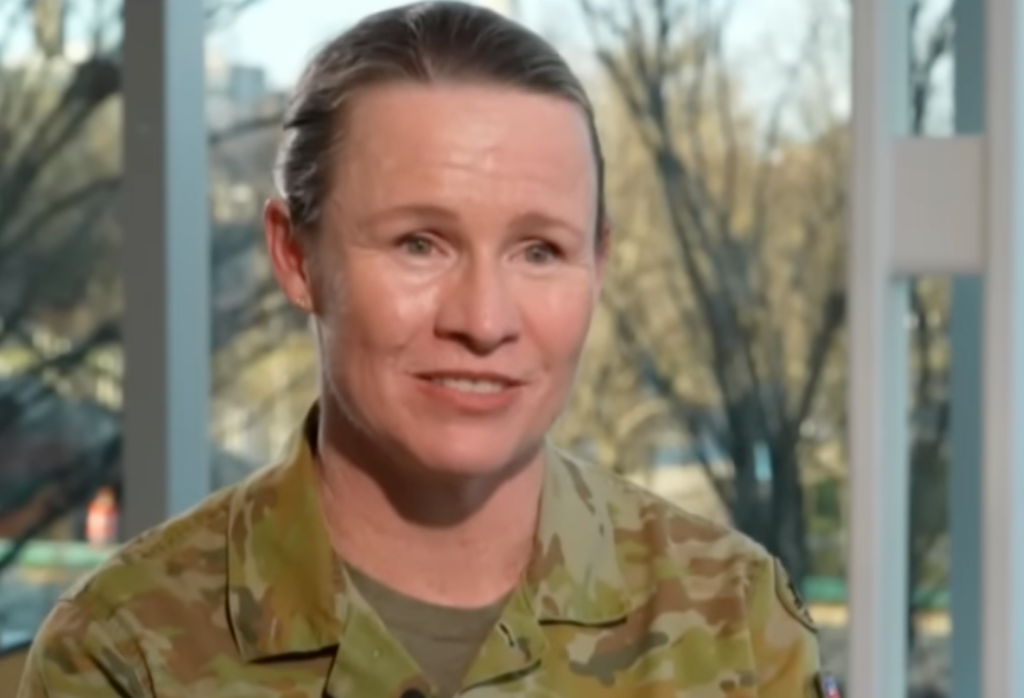
Lieutenant General Susan Coyle, 55, has been appointed as the new Chief of Army, becoming the first woman in history to command the Australian army.
During his announcement, Minister for Defence Richard Marles described Coyle’s promotion as “a deeply historic moment.”
“Lieutenant General Coyle will be the first woman in our nation’s history to command the Australian Army,” he said.
“[She] has commanded at every rank that she has held, which is in itself a remarkable achievement, has most recently been the Chief of Joint Capability at a time where we have been expanding and changing our capability, and she was very much the standout candidate to be the next Chief of Army.”
“[She] said to me: ‘You cannot be what you cannot see.’ [Her] achievement will be deeply significant to women who are serving in the Australian defence force today and women who are thinking about serving in the Australian defence force in the future.”
Prime Minister Anthony Albanese added, “From July, we will have the first ever female chief of army in the Australian Army’s 125-year history.”
Today, we look a closer look at her distinguished career and consider the significance of a female army chief.
Who is Susan Coyle?
At the age of 17, Susan enlisted as a soldier in the Army Reserves in 1987, graduating from the Australian Defence Force Academy in 1992.
Born in Kyogle in northern NSW, her early life was spent travelling around “from dam site to dam site” for her father’s job at the Water Resources Commission within the NSW government.
Coyle’s professional pathway, as published on the ADF website, is extraordinary in its breadth. In her nearly 40-year military career, she has shifted across dozens of roles. She has worked at the tactical, operational and strategic levels and in command roles. She has held positions as head of information warfare, commander of Joint Task Force 633 (in the Middle East), commander of Task Group and commanded troops on deployment to Timor-Leste, Solomon Islands and Afghanistan.
When she was deployed on promotion to Major General as Commander Joint Task Force 633 in early 2020, she became the first female Two-Star officer to be deployed on operations commanding Australian military forces.
“A sign of how times have changed, her husband will also be deploying to a separate operation around the same time she is deployed, and they’re leaving the kids at home to look after themselves,” former Defence Minister Linda Reynolds said at the time. Coyle’s husband is an engineer in the Army and the pair share three children.
In July 2024, she was appointed Chief of Joint Capabilities, becoming the first woman to occupy the post. In the role, she was responsible for the ADF’s information warfare and cyber and space commands.

As the army undergoes a sweeping transformation—investing in long-range strike capabilities, drones and other modern tools of warfare—Coyle said this week that her background in areas like cyberwarfare would inform her approach in the latest role.
“This breadth of experience provides a strong foundation for the responsibilities of command and the trust placed in me,” she said.
In July, Coyle will replace Lieutenant General Simon Stuart, who will retire after more than 35 years in the army.
A turning point for gender in the ranks
As the Australian military faces mounting allegations of systemic sexual harassment and discrimination, Coyle’s appointment is likely to be welcomed as it seeks to increase the number of female officers.
In October, a class action was commenced against the Commonwealth of Australia on behalf of current and ex-serving Australian Defence Force (ADF) members, reporting they had experienced gender-based sexual assault, harassment, and discrimination during their service in the ADF and alleging that the organisation failed to protect thousands of female officers from systemic abuse.
At the time, several news outlets covered the allegations from women, including 60 Minutes andThe Age.
On Women’s Agenda, Rita Nasr described how the alleged systemic abuse has left many women in the ADF suffering lasting psychological harm, disrupted careers, and a loss of trust in institutions.
“This class action is a chance for the ADF to confront the institutionalised sexism, systemic dysfunction and deep-rooted misogyny that have plagued what should be one of our most respected institutions,” she wrote. “It is a call to ensure that no woman has to endure abuse in silence. And it is a reminder that justice must be more than a promise; it must be a reality.”
“As a society, we must stand with these women. We must demand accountability, support survivors, and work tirelessly to create safe, respectful workplaces.”
Currently, women make up roughly a fifth of the Australian Defence Forces. The ADF has made explicit efforts to increase the number of women in leadership roles, with current figures reaching 18.5 per cent of women in Senior Officer roles. The organisation said it is committed to increasing women’s representation to 25 per cent of its total workforce by 2030.
The 2024 Defence Workforce Plan identified three lines of effort for the ADF workforce to “stabilise, remediate, and grow.”
“Supporting women’s participation, addressing barriers for retention, and increasing the recruitment of women will be critical for achieving these outcomes,” the report said.
Around the time of the report’s release, Coyle expressed optimism about the growing role of women in the armed forces.
“There’s lots of really good women coming through, who have worked really hard, have done all the right types of jobs and I think being recognised,” she said. “It’s a wonderful place to be.”
“Men and women take extended breaks now as part of maternity or paternity leave. And I think that’s a really enriching experience for them and their families.”
Last year, paid maternity leave for ADF members increased from 14 weeks to 18 weeks, and new policies were introduced to increase flexibility for serving members.
Coyle’s appointment shows both how far the Australian army has come in opening its ranks to women, while also exposing how far it still has to go.