
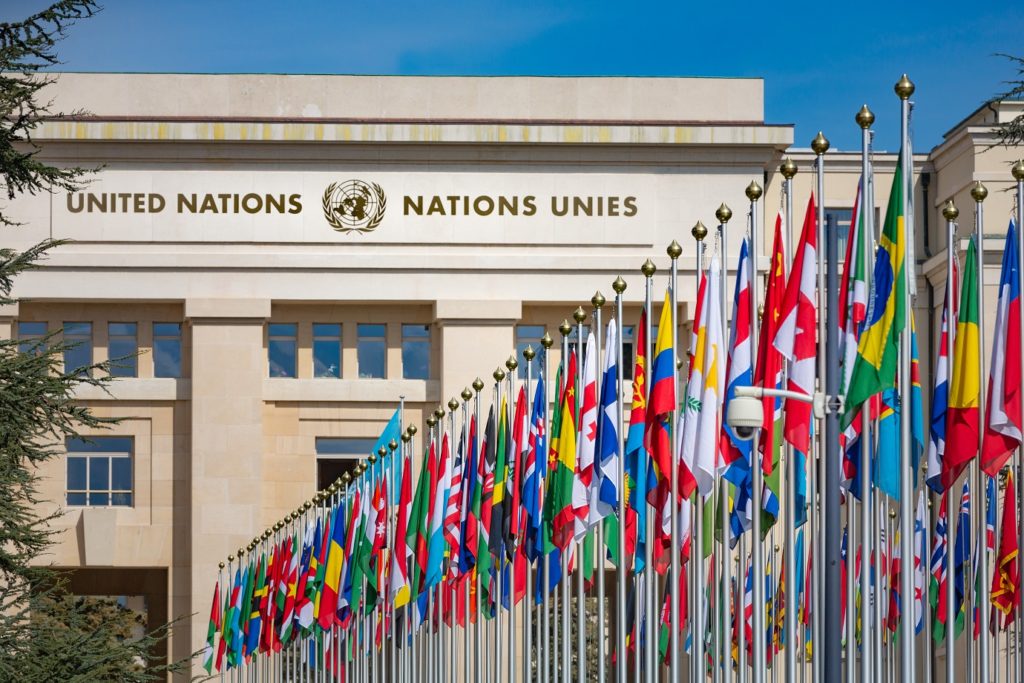
The United States stood alone during a United Nations vote on the “agreed conclusions” document to establish priorities for advancing women’s rights worldwide last week.
The moment marked a victory for countries that are determined to stand firm on an inclusive vision of equality for women and girls, even in the face of Trump-led attempts to meddle in women’s rights, such as by trying to remove terminology like “reproductive rights” from key gender equality documents.
So much so that the General Assembly Hall erupted into a loud, standing ovation, as the US pushed for a vote on the text and failed miserably. The document was passed 37 in favour, 1 against (from the United States), with 14 abstentions.
The goal of the Agreed Conclusions is to provide a collective roadmap for advancing gender equality, and also for reaffirming commitments across issues like women’s rights, safety from violence and access to sexual and reproductive health services.
But the Trump delegation had arrived at the Commission on the Status of Women (CSW70) with the goal of further expanding its war on women by attempting to override decades of progress and previously agreed international language.
In the weeks leading up to CSW, delegations have been negotiating to reach a consensus on language acceptable to all member states.
The US had a number of objections, including references to “gender” and “reproductive health rights,” as well as across provisions that sought to address issues like regulating artificial intelligence. The US delegation was also concerned that the language in the text could be interpreted as endorsing abortion rights, among other things. It attempted to pursue eight amendments to the documents and failed on all of them, including references to gender-based violence, language around disinformation and intersectionality.
In the end, the final document was put to a vote, leading to cheers as the US-shennangians failed. The US was left “isolated” on the world stage, according to Outright International, marking the first time in 70 years that the UN had broken from consensus at the Commission on the Status of Women.
The good news is that the US failed miserably in its attempts to disrupt long-standing, agreed language on the inclusive vision for equality for women and girls globally. The cheers that erupted in the General Assembly were a reminder of those determined to stand firm.
But there are also lessons in the disruption the US delegation caused, creating the first time in 70 years of the forum that such a vote was needed.
The Trump-led US delegation provided an example of what happens when women aren’t in the room. The US delegation at CSW70 was not led by women fighting for women’s rights, but rather by men and political appointees tasked with showing up to the vote to attempt to remove words like “gender”, “reproductive health”, and “bodily autonomy” from a global agreement on women’s access to justice.
The disruption should also provide a warning of where these votes could go in the future, and/or how, once accepted, consensus on the language we use to protect marginalised people can come under threat, especially as women’s rights continue to send shockwaves across the world. And also, the proportion of women in leadership positions worldwide is not enough to ensure we can hold the line. At any point, such rights can go backwards. At any point, we can again find ourselves fighting over words like “reproductive health”. Only next time will those rallying against such terms gain more traction.

Indeed, we often ponder how different the world would look if women were in the majority of leadership roles.
At CSW70, we received a hint of an answer, as 37 countries with delegations mostly led by women held the line on women’s rights—even in the face of the most powerful country in the region, the United States. We also saw that the countries that abstained or voted against were almost entirely countries where women hold little or no power in government. The correlation here should highlight the roadmap we need ahead: one with more women in foreign affairs, in treasury, across justice and defence. And more women in general, in Cabinet positions.