
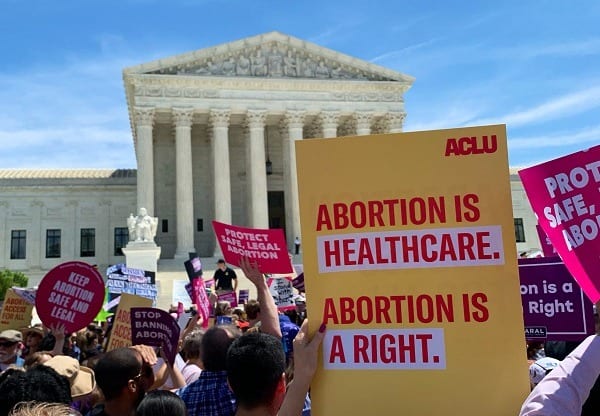
Abortion rights advocates in the US are concerned about recent firings that may weaken enforcement of long-standing federal protections for access to reproductive health care. But they’re also marking small victories. Here’s a look at recent developments.
Attorneys in the US responsible for prosecuting anti-abortion extremists who attacked abortion clinics have been fired by Trump, in a move marking the latest in a purge of Justice Department employees which began last year.
Last week, the Justice Department fired at least four U.S. Attorneys who were involved in prosecuting anti-abortion extremists under the Freedom of Access to Clinic Entrances (FACE Act) during the Biden administration.
After they were convicted by juries of violating the FACE Act, Trump pardoned them last year. A Justice Department spokesperson said in a statement that the department “has terminated the employment of personnel responsible for weaponizing the FACE Act who still remained at the department.”
Among the prosecutors fired was veteran Civil Rights Division prosecutor Sanjay Patel, who spearheaded the team enforcing the FACE Act, and Sunita Doddamani, a federal prosecutor in Michigan’s Eastern District.
In March, Patel was placed on administrative leave as a draft of the FACE Act report and the Biden Justice Department was being finalised.
The FACE Act report remains under development by the Justice Department’s “weaponisation working group,” which was established at the beginning of former Attorney General Pam Bondi’s tenure.
In a statement to CBS, Sunita Doddamani said it had been an honour to serve as a federal prosecutor and to “uphold the rule of law.”
“I am proud of my service at the Department of Justice and of the work our teams carried out in accordance with the law and our professional obligations in matters assigned to me,” she said.
The FACE Act was passed in Congress in 1994 to combat growing concerns about threats and intimidation faced by women at reproductive health clinics. Under the Act, the use or threat of force or physical obstruction to prevent individuals from obtaining or providing reproductive health care services became a federal crime.
Renee Chelian, Founder and CEO of Northland Family Planning — a clinic that was attacked by one of those whom Trump had pardoned, said that she felt “sick” upon hearing of prosecutors firings.
“Blocking people from getting medical care is a crime,” she said. “Our patients and staff were traumatised. Some of my staff members were so traumatised they left their jobs, and many sought mental health support. Sitting through the trial was three weeks of hell—we were scared to be near these people, but the prosecutors worked so hard to be as fair as possible. I am worried for my safety now that Trump has given these zealots his blessing. Who can we call now? Who will protect us?”

Former Civil Rights Division lawyer Stacey Young, contributed her own criticism of the firings, saying in a statement, “Firing DOJ attorneys for zealously enforcing the law is unconscionable — it politicises the department’s enforcement actions and punishes dedicated civil servants for doing their jobs.”
Young, who founded and leads the nonprofit Justice Connection, reiterated the importance of the Act, adding that Congress had passed it “…with bipartisan support more than 30 years ago, and courts have consistently upheld the constitutionality of its provisions that ensure safe access to reproductive health services.”
Meanwhile, in Mississippi, midwifery is subject to stricter restrictions, although advocacy groups are pushing back. Earlier this year, the American College of Nurse-Midwives pursued legal action against Mississippi to challenge a state requirement that nurse-midwives must practice in collaboration with a physician.
Since the 1970s, advanced practice nurse practitioners in the state including certified nurse-midwives have not been permitted to practice without a signed “collaborative practice agreement” with a doctor. Several other states enforce similar requirements, including Texas, Louisiana, Alabama and Nebraska.
The case, filed by Pillsbury Law and the Mississippi Center for Justice, argues that the requirement violates federal laws by capping the number of certified nurse-midwives, thus reducing competition for physicians. It also alleges that the rules prevent nurse-midwives from filling gaps in maternal health care in a state that has some of the country’s worst maternal and infant health outcomes.
While supporters of the law believe it protect patients, nurse-midwives groups argue that the requirements are unreasonable and do little to ensure physicians are actually available when needed.
Mississippi state Republican Rep. Dan Eubanks has attempted to repeal the requirement, saying it has “created an unfair economic disadvantage for [certified nurse-midwives] in Mississippi, effectively barring them from practicing.”
Advocates from Sisters in Birth, a group that works to increase access to midwifery care and community health services in Mississippi have been advocating to repeal the requirements for years.
Getty Israel, founder of Sisters in Birth, said that the state’s collaborative practice requirement has prevented her from trying to build Mississippi’s first freestanding birth centre.
“I can’t build the birth centre I intend to start building this year if I have to pay off doctors,” Israel said in January. “Nobody should have to pay off another profession in order to practice their profession.”
“Why do they require a (collaboration practice agreement) from a licensed, regulated, insured, credentialed, board-certified group of professionals … but they don’t require anything from this group over here? Because (the latter) are not in the hospital and so they are not a threat.”
Meanwhile, there have been positive developments in the US. Earlier this month, Governor Abigail Spanberger signed the Right to Contraception Act into law, a move that will ensure the women of Virginia can access contraceptives free from government interference.
Reproductive Freedom for All President and CEO Mini Timmaraju celebrated the signing, saying, “This is a monumental victory for people across the commonwealth who have made it clear they don’t want politicians making their health care decisions. This legislation further protects Virginians’ access to birth control from the whims of whoever has the majority.”