
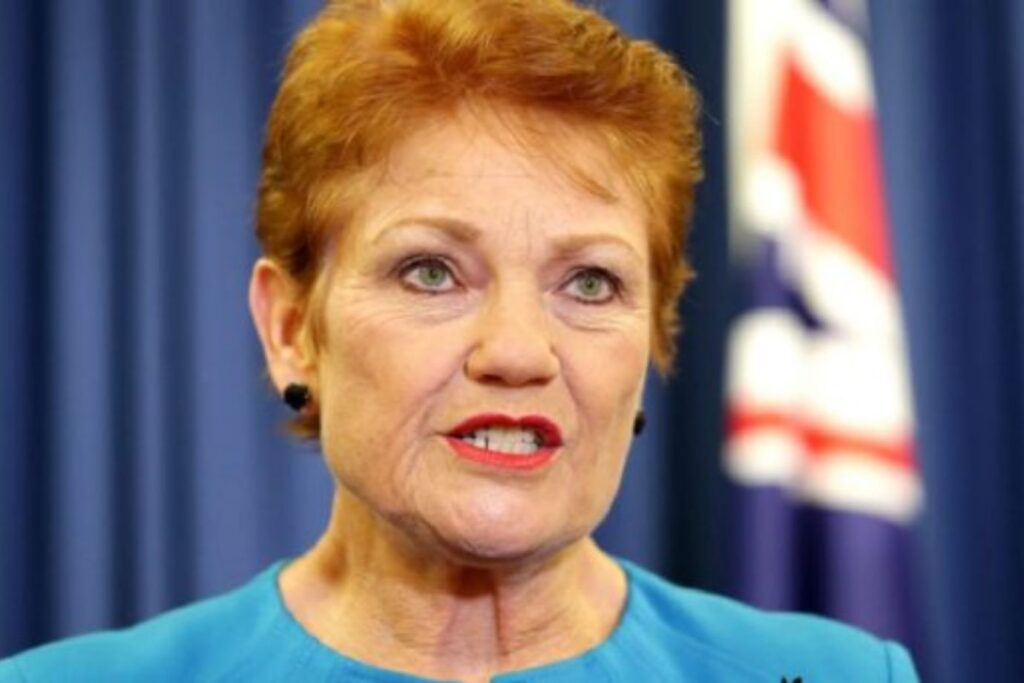
Democracy, according to Pauline Hanson, does not happen on the ABC, at The Age or The Guardian newspapers. Presumably it happens in the car park outside, where she can address the press pack of her choosing without anyone as rude as to ask a follow-up question.
On Monday, the One Nation leader stood in Melbourne to unveil her Victorian election candidates and, in the same breath, banned The Age, the ABC and The Guardian from the room. “I’m not putting up with their rubbish,” she told the reporters who were allowed to stay. “I’m not putting up with their spin, their lies, whatever. I want truth and honesty.” New state leader Warren Pickering added that One Nation “welcomed scrutiny” — scrutiny being, apparently, a thing you welcome by locking three newsrooms out of the building.
The irony of that idea is doing a lot of heavy lifting here. This is a party whose entire founding mythology is holding the establishment to account, speaking truth to power, refusing to be silenced by the elites. And its solution to being asked hard questions is to decide, unilaterally, which journalists get to ask them. Rebel News, a foreign-owned outlet with an openly right-wing bent is welcome. Sky News is welcome. The outlets asking about, say, her taxpayer-funded junket with Gina Rinehart? Not so much.
It is worth asking who exactly Hanson is protecting from scrutiny here. Rebel News is a Canadian-owned outlet whose Australian bureau chief has spent this campaign openly registering slogan-based micro parties designed to harvest left-leaning voters and funnel their preferences straight to One Nation. He also happens to be a convicted family violence offender, fined and found guilty after throwing a chopping board at his ex-wife’s head. That is the preference-harvesting friend Hanson wants standing at the front of the room. The Age, apparently, is the dangerous one.
Hanson says she is sick of being treated differently to other parties, sick of gotcha moments, sick of spin. Fair enough nobody enjoys being door-stopped. But “fair go” apparently only flows one way. Because it was only weeks ago that Hanson had some very different advice for a woman being subjected to actual, sustained, sexist attacks.
When mobile billboards depicting Premier Jacinta Allan as a witch, echoing the exact “Ditch the Witch” campaign wheeled out against Julia Gillard over a decade ago, were condemned by the Prime Minister as sexist and dangerous, Hanson’s response was not solidarity. It was “suck it up, sweetheart.” Politicians, she explained, must deal with public scrutiny. Scrutiny, it turns out, is a word Pauline Hanson loves right up until it is pointed at her.
So, which is it, Senator? Do politicians have to cop scrutiny as the cost of public life, or don’t they? Because you cannot tell Jacinta Allan to grow a thicker skin over a genuinely misogynistic billboard campaign and then, a month later, storm out of the room the moment a journalist wants to ask you something you would rather not answer. That is not a principle. That is a mood.
In regional Victoria, where One Nation is tipped to make its biggest gains, are the communities which rely most heavily on the ABC. They do not rely on the ABC for gotcha journalism, but for local news, emergency broadcasts, flood and fire warnings, the stuff that actually keeps people safe.
Greens Senator Sarah Hanson-Young did not hold back on the point, branding Hanson a coward for banning scrutiny while chasing votes. She suggested regional voters tell Pauline to “get stuffed” at the ballot box. Banning the national broadcaster while campaigning in its heartland is not a communications strategy. It is contempt pure and simple.
None of this is new, of course. It is the same playbook Donald Trump has perfected: when the coverage is unflattering, the problem is not the story, it is the storyteller. Declare the press the enemy, cozy up to the outlets that ask nothing, and rebrand accountability as bias and ‘fake news’.
It works right up until someone points out that Rupert Murdoch’s empire, hardly a hotbed of left-wing spin, somehow escapes the blacklist too.
Journalists in this country have brought down Premiers and Prime Ministers. That is not persecution, that is the job. You can absolutely ask for fair reporting. You can push back, correct the record, even be furious about a bad headline. What you do not get to do, in a functioning democracy, is decide unilaterally who is allowed to hold you to account and who is not, especially while insisting, with a straight face, that you are the one fighting for the little guy against a rigged system.