
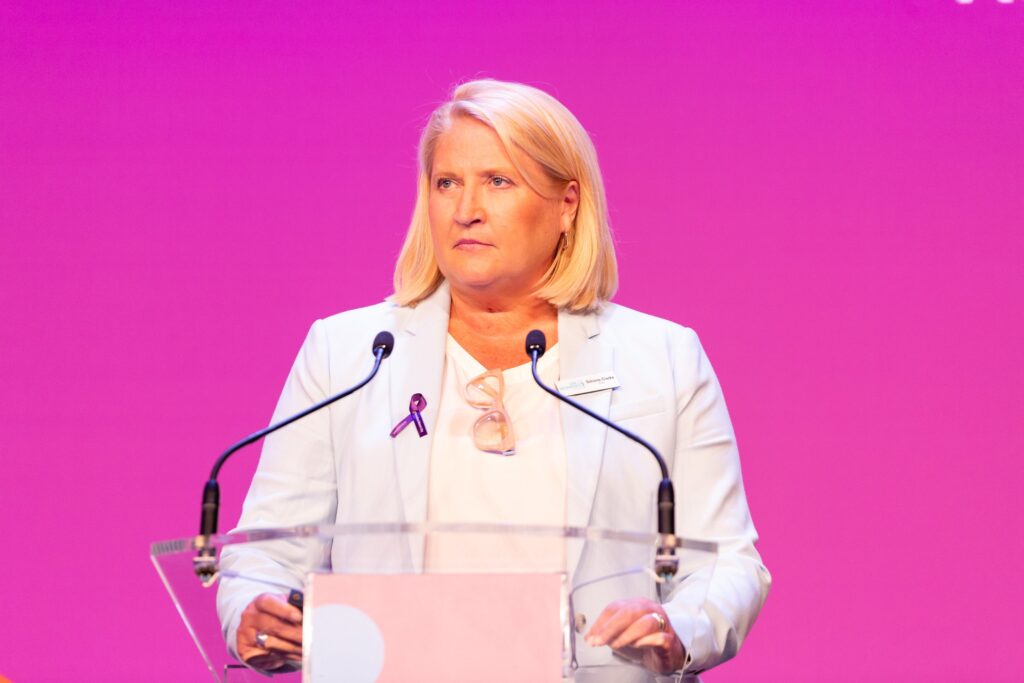
‘How Much Longer?’ will be the official theme of International Women’s Day in 2027, a question that asks governments, companies and communities to reflect on how long we will tolerate gender inequality as progress slips further out of reach.
UN Women Australia has released the official theme today, as new data shows not a single global gender equality target is on track to be met by 2030.
“We know women are paid less. We know women aren’t safe. We know we need more women in leadership,” UN Women Australia CEO Simone Clarke said.
“’How Much Longer?’ is a question we’re posing to governments, companies, communities and individuals – to everyone that laments the lack of progress for women – but has waited to act.
“If not now, then when?”
The lead up to International Women’s Day, held on March 8 next year, comes as the UN Women and UN DESA’s Gender Snapshot 2026 reveals the world is going backwards on nearly every gender equality measure.
In just two years, one in three institutions built to protect women’s rights has been stripped of power. Funding for gender equality initiatives is at its lowest level since 2021
In the past 12 months, 316 million women experienced physical or sexual violence from an intimate partner.
There are only three years left until the 2030 deadline and not a single target is on track to be met.
While we have seen some progress on gender equality measures locally here in Australia, for example, we cracked the top ten in the World Economic Forum’s global gender equality ranking this year, there is still much more to be done.
Women continue to do the lion’s share of unpaid work (31 hours per week) compared to 22 hours for men, and sexual, family and domestic violence is rife with one in four women being subjected to intimate partner violence since the age of 15. So far, 54 women have been killed by violence in Australia in 2026, according to Sherele Moody’s Australian Femicide Watch.
The gender pay gap (21.1 per cent on a total remuneration basis) saw women work an extra 48 days into the new financial year to catch up on the pay men received.

Women’s health and abortion rights are also under threat in Australia, with One Nation gaining momentum ahead of upcoming state elections in Victoria and New South Wales. Recently, the party’s leader in NSW stood outside of parliament house and vowed to ‘stop’ abortion if he was elected.
“We want to make sure that same-sex, oh sorry, abortion is stopped. We want to make sure that people have the right to life, and we will vote for you in favour of that,” Mike Newman said.
Other global threats, like climate change and the rapid advancement of AI and the corresponding job displacement, will also be felt most acutely by women.
Simone Clarke says a theme alone cannot shift the dial. Governments, businesses and institutions need to act urgently, and International Women’s Day is an opportunity to increase the pressure on them to deliver, she says.
“The Gender Snapshot shows women still spend two and a half times as many hours as men on unpaid domestic and care work. Nearly one in three women globally have experienced physical or sexual violence in their lifetime. These are not challenges we can keep acknowledging without changing the conditions that sustain them,” Clarke says.
“And while the need for action remains enormous, resources are going backwards. Bilateral aid with gender equality objectives fell by 13 per cent between 2023 and 2024, and funding for women’s rights organisations fell by 28 per cent over the same period. We cannot expect faster progress while withdrawing support from the organisations working to achieve it. The report also shows that only one in four countries has systems to make gender equality a transparent and trackable public spending priority. We need to be able to follow the money.”
The theme ‘How Much Longer?’ comes as UN member states prepare to gather for the 71 session of the Commission on the Status of Women in March next year, alongside International Women’s Day.
“When Member States gather at the Commission on the Status of Women next March, we need concrete, funded commitments, with clear deadlines and accountability. Not another round of platitudes or promises that go unfulfilled,” Clarke says.
“In Australia, we need to examine where we’re falling short. Domestic violence is a massive issue here we can’t stay silent on, as well as inequality in pay and the unfair burden of unpaid care. We need governments and employers to be specific about what they will change and how they will measure progress. We know why inequality persists, and we know what it takes to address it.
“What’s missing is action at the scale and urgency required. The test is not what people say on International Women’s Day. It is what they fund, change and deliver.”