
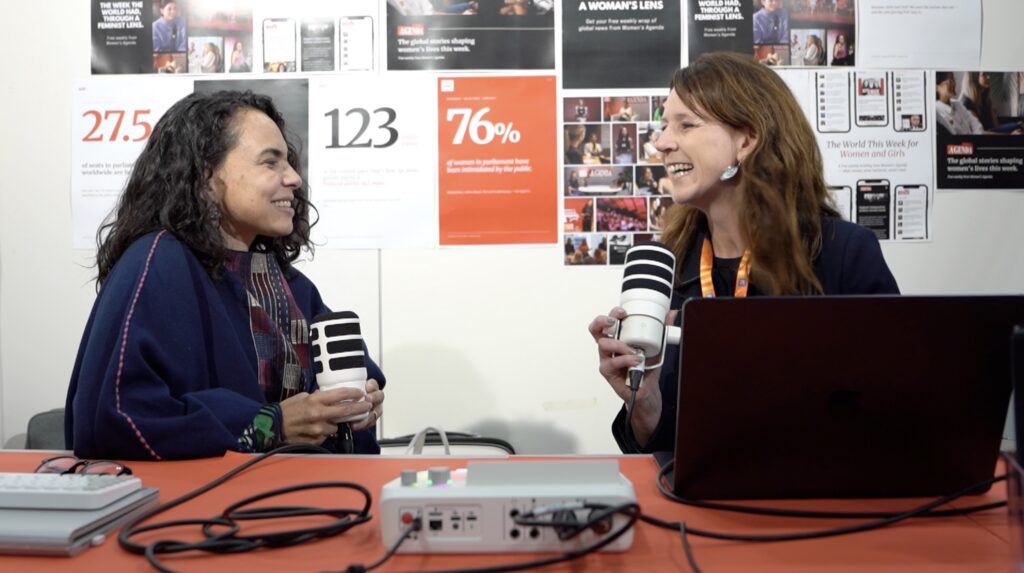
Just months ago, Maria Antonieta Alcalde stepped up to take on one of the toughest gigs globally: leading the International Planned Parenthood Federation at arguably its most challenging point in history.
Just imagine what she’s up against daily, running the world’s largest reproductive health network. There’s the ongoing, mounting impact of massive funding cuts, thanks to Trump’s second term in office, as well as to wealthy countries slashing their foreign aid budgets. There’s the cashed-up global network of organisations seeking to destroy hard-won gains on women’s rights. There the increasing impact of conflict and climate-related disasters that are affecting women and girls globally.
And yet Maria’s energy for getting the work done is high. And it’s infectious.
I met Maria on the sidelines of the Women Deliver 2026 conference to discuss the global backlash against women’s rights, as part of our Backlash Conversations series for the Women’s Agenda Podcast, recorded live with leaders at the coalface of holding the line for women and girls globally.
Maria immediately issued a reality check on the word ‘backlash’, declaring the destruction of women’s rights globally is about something bigger.
“This is not a backlash. Backlash sounds like something that is reactive and that will go away. This is an organised, well-funded strategy that the anti-rights movement has been planning and implementing for decades,” she said.
“The US is the centre of that power, and they have been exporting these movements all over the world. Now, under the Trump administration, their funding has increased, and their hate speech is validated. So they are coming way stronger, way more violent, and now with even more resources.”
Maria shared what we can learn from the success achieved across Latin America, where she’s been fighting for women’s rights for the past three decades. The region presents a powerful playbook, something Maria highlighted by pointing to the green bandana she was wearing around her wrist.
“The green bandana doesn’t belong to one organisation. It’s not branded. It doesn’t have one leader or one CEO… that’s something we as a reproductive health and rights and abortion movement need to do more. And this is also a self-critique for organisations like IPPF — we’re very interested in having our logo there, being in the press conference with our branding. That really prevents people who may not agree with you all the time from joining you.”
This lesson is important. The green bandana is a non-branded movement symbol, and the Latin America playbook found success in not concentrating a movement in any one group of people, but rather in making it accessible for everyone to join and feel a part of.
As for Australia’s contributions, Maria noted that small additional investments from Australia could yield disproportionate gains across the Pacific. It was a telling reminder leading into Australia’s next Federal Budget, and one that comes as countries internationally, including Australia, have been slashing their foreign aid budgets. Across the Pacific, particularly, Maria issued a warning about rising HIV rates in Fiji.
Meanwhile, Maria also issued a powerful reframing of those who try to position family values when denying women access to vital reproductive health. She asked, what is more family-centred than allowing women to make decisions about their own bodies? What is more family-centred than not forcing a woman to be a mother when she is not ready to be a mother?
You can listen to my full conversation with Maria Antonieta Alcalde on the Women’s Agenda Podcast, available on Apple Podcasts and Spotify. Or take a listen below.