

“I just burst into tears and said — I’m not a real man.”
When sports broadcaster Sam Hargreaves and his partner Evie started trying for a family, he received some news that floored him.
After months of actively trying and failing to conceive the couple went and had some tests done.
Sam, who was a radio presenter at the time, got a phone call about his results ten minutes before going on air: “There’s nothing we can use – you have zero sperm”.
Sam was stunned.
“I just remember it hitting me like a tonne of bricks,” he says.
“I thought there might have been an issue but I wasn’t expecting ‘nothing’.”
The results sent Sam down a spiral of shame and he began questioning his identity as a man.
Even though he grew up in a home where mental health was openly talked about, he felt unprepared for the surge of thoughts, feelings and despair that erupted at the realisation he was infertile.
“Seven out of ten suicides in this country are men – I’m not saying infertility is the reason but I can’t help thinking it’s been a contributing factor somewhere along the line,” says Sam.
Men account for about 30 per cent of infertility cases and Sam hopes his story will encourage others to open up about it.
When he initially told his partner Evie about the news and how not having sperm made him feel like he was less of a man, her candid response helped bring some light in.
“She just laughed it off essentially, that was quite a powerful moment,” he says.
“She says ‘that’s ridiculous’ and ‘that just couldn’t be further from the truth’.
“And then we really did start to embrace the notion of what makes you a man? The measure of man isn’t by the measure of his sperm count.”
As Sam and Evie navigated a long and difficult journey through IVF, he says one of the best things he decided to do was to accept support through a counselling service.
This helped him make sense of everything and speak up about the pain he was feeling.
It also empowered him to show up as a better partner for Evie who was working through her own fertility issues along with the psychological and physical impacts of IVF.
“The work I did after [my diagnosis] has actually made me a much better man than I think I was beforehand,” he says.
Prior to this, Sam says he was less equipped to be there for himself and Evie when trouble hit.
Looking back, he wishes he could have known some of what he knows now when they had a miscarriage.
At the time, Sam says he retreated into himself and tried to stay distracted while Evie needed him to be present so they could lean on each other through the heartbreak.
“If I could take anything back, it would be that – I just wasn’t there for her in the way that I wish I should have been,” he says.
Miracle interventions
Through investigations with fertility specialists, Sam learned he had no sperm in his ejaculate because of a sporting injury in childhood.
But the fertility clinics he worked with were able to help him overcome this challenge.
With the support of counselling, a trusted group of friends and family, along with some lifestyle changes with diet and drinking, Sam and Evie eventually gave birth to their first child.
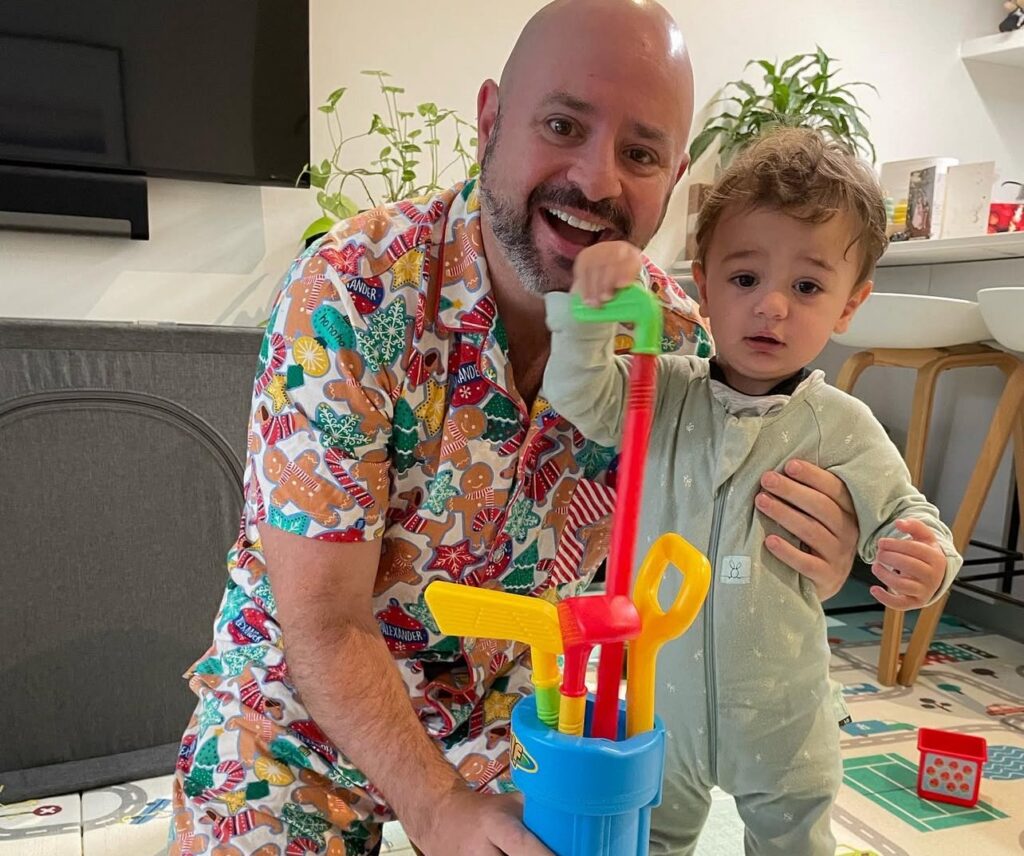
They have since welcomed a second.
“We almost gave up on it, I’m so glad we didn’t,” he says.
Sam hopes his story encourages other men to get their fertility tested.
“It actually does take balls to get tested,” he says.
“That’s where the real courage in this is. Go and get tested. Do that not for you but also for your partner. Because I think it’s always been women who have had to shoulder the responsibility or the blame.
“That’s just the least you can do as a partner in a relationship if you truly want to have a child, if you truly want to have a family. Leave no stone unturned.
“It’s like a cricketer not checking the pitch before they go out to bat. You sort of want to know what you’re dealing with and what you’re playing with.
“Couples put themselves under so much pressure to conceive naturally but if you knew that you had issues before you were going in then you could just skip ahead to the point where you went and got help.
“You’re not alone.
“There are options. The science and technology is so incredible. It’s not the end. Just please talk to someone.”
Male infertility is more common than you think
One of Sam’s fertility specialists, Dr Chandrika Parmar at Genea, says many men struggle with their sense of manhood after learning they have an infertility issue like sperm count.

“A lot of men associate their sperm with their masculinity or their ability to be the person who is going to provide everything,” she says.
“They see themselves in that role of protector and provider and they often feel when they have low sperm count, they’re just not man enough.”
Male infertility is prevalent but silence, stigma and societal structures have created an environment where men delay and avoid the issue altogether.
Dr Parmar says men are often shocked to learn they have an infertility issue and for some, it can have a significant impact on their mental health.
That’s why men are encouraged to be present at consultations and fertility appointments early on if they are looking to become a parent.
This can help ensure they are provided a safe space to talk about results and connect with counselling or a support service.
“I often talk to them about how it’s a puzzle – we’re putting together one and two to make a baby and so we need to be in it from the start,” says Dr Parmar.
“So I encourage them to attend all consultations, and we offer them both equal support as they’re going through the consultation and their treatment.
“They can reach out to one of our counsellors if they feel they need to talk to somebody.
“A lot of my consultation does end up being a little bit of counselling.”
Dr Parmar says male infertility is a factor in about 50 per cent of the couples that come to Genea.
“In the general population, about one in 20 men will have some issue with their fertility and they’re totally unaware because they’re quite well and unless they’re trying to fall pregnant, they wouldn’t know,” she says.
There are many causes of male infertility.
In some cases, there can be issues with production of sperm in the testicles due to genetics, hormone imbalances or other reasons. For others, poor motility – how the sperm moves – or abnormal shape may prevent it from fertilising an egg.
Lifestyle and environment factors can also be at play.
“For anybody who’s got low sperm, scientifically we have options whether there’s a known cause or unknown cause,” says Dr Parmar.
“You would have heard of people going to the gym and taking steroids to sort of pump their bodies up. Those steroids can lead to lack of sperm so you can reverse that quite easily.
“If there is a medical metabolic issue that can be reversed, diabetes, obesity or lifestyle issues like smoking, alcohol, all of that stuff can be reversed.
“And once you give them some changes, within two or three months they might see recovery of sperm.
“But the ones that there is no cause found or there is nothing that we can reverse, we have techniques that we use in the lab to help them fall pregnant.”
Fertility science and technology has advanced rapidly giving people with all sorts of fertility issues new hope.
Assisted reproductive technology like Intracytoplasmic Sperm Injection (ICSI) allow specialists to inject one viable sperm into an egg, giving men with very low sperm counts the chance to have biological children.
Other developing techniques mean sperm can surgically be retrieved from the testicle if they don’t show up in ejaculate.
“It’s advanced to the point where we might have a handful of sperm in our hand and we can still make embryos,” she says.
Dr Parmar’s advice to men who get bad results on their fertility is to remember that this is not necessarily a bad thing.
“Because if you find a reason for why things aren’t working out, you can actually work towards the solution,” she says.
“So I encourage men to see their GP for a test.
“It’s actually the simplest thing to do for a man, to ejaculate and give a sample in a lab. It doesn’t take much out of them. There’s no blood test or anything involved.
So it’s easy enough to read, easy enough to diagnose and easy enough to treat.
“There should be just a little bit more awareness, a bit more coming forward,” says Dr Parmar.
“We need to take the stigma away so that they can come forward and do this and get good outcomes early.”