
Julie Inman Grant calls it “outragement”: the addictive, pull-you-in content across social media that mixes outrage with entertainment.
It’s tough for adults to resist, so what hope do kids have?
As the public face of enforcement behind Australia’s world-first Under 16s social media ban, Julie has also been the subject of “outragement”, especially across X, where Elon Musk has shared his opinions on the eSafety Commissioner and his followers have dutifully followed up with their own.
She knows what she’s up against goes well beyond the megaphones and fanbases of Musk & Co., with the five tech companies her office is currently investigating over their compliance with the Under-16s social media ban, worth a combined US$2.4 trillion, compared to her office’s budget, which is closer to $50 million.
“We are good, and we are smart, and we are wily. But it takes a lot to out-gun these really deep pockets that will throw money at litigation and lobbying to constantly try to throw rocks in the gears,” she says.
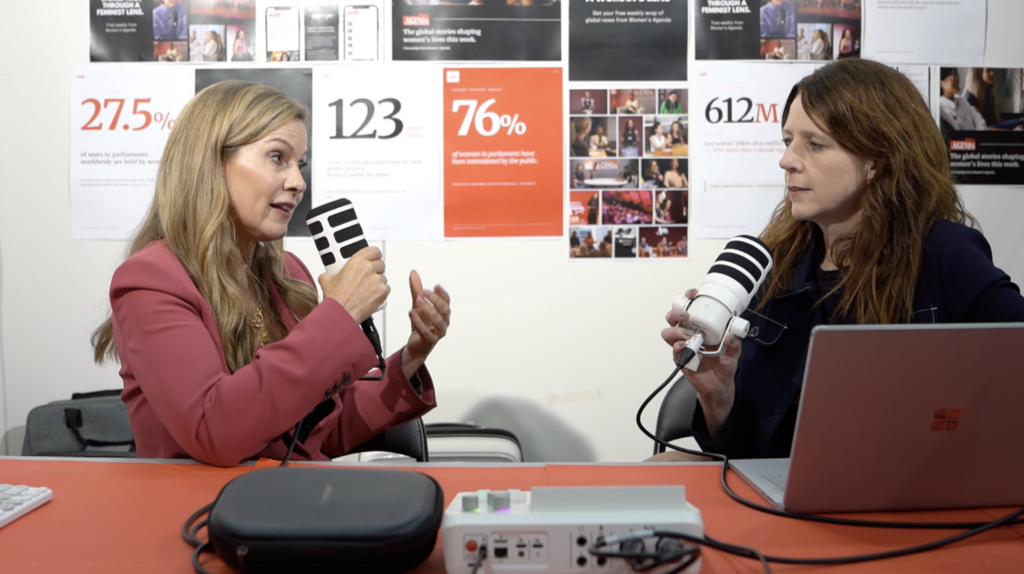
I sat down with Julie on the sidelines of Women Deliver 2026 in Melbourne last month to learn more about how her office is taking on the tech giants, and what she makes of the ever-increasing power of the small number of men leading the world’s biggest companies.
While Julie has spent almost ten years in her current role, she spent the previous 22 years working inside tech, including directly with some of the biggest tech personalities.
“What really concerns me is the convergence of a range of malign forces,” she said.
“It’s not only the wealth and power that is concentrated in a few hands. Seventy per cent of the major social media and AI companies are controlled by male billionaires. The same billionaires who were front and centre at the inauguration, one who actually had a desk in the government via DOGE,” she said, referring to the Department of Government Efficiency, which swept through the United States last year under Musk’s stewardship.
“I don’t think it’s a coincidence that there are executive orders and pushing back on any kind of tech regulation, including AI regulation that a lot of the states would like to see happen,” she said.
“We see the ascension of advanced forms of technology that are more powerful than ever, but have weaker guardrails than ever. So it does make it really challenging for small regulators like us.”
It’s not only a tough fight for a regulator, but also for social media users, especially where the “outragement” that Inman Grant talks about is being harnessed as a business model.

“[Outragement] is a vicious circle,” she says. “When we’re talking about the manosphere and the influencers gradually sucking in young men with information about physical fitness, it quickly spirals. Everyone benefits. The influencer benefits. The platform benefits. The only person who doesn’t is the young person who is hopeful and is on the receiving end of this.”
Months into the social media ban and with plenty of teens still finding ways around it, I ask Inman Grant whether she believes it’s working.
She pointed to the large percentage drop in accounts owned by teens and noted that it was always going to be a long game.
“Whether it was water safety or sun safety or seat belts, this will take years for normative changes to feel everyday. I still think we can do better. But up against these is so much power.”
Another impact is that more people are seeing the negative impacts of social media, and this world-first move by the Australian Government offers clarity on what people are feeling and more opportunities for parents to push back.
“I think people have seen the toxicity of platforms change; they don’t feel protected,” Julie said.
“They’re seeing the coarseness of online discussion getting worse, and so some people are voting with their feet, but then others are probably driven by what they’re seeing is happening to their kids, whether they’re being cyber bullied, whether they have unrealistic body expectations that have led to eating disorders or self-harm of some sort. We feel like society is changing, and the structure is changing, and I do think social media and AI now have a big part to do with that.
“Whether it’s snap streaks or endless scroll [features] …These are powerful forces that are unseen, that are difficult for us as adults. So what chance do our kids have if we don’t build in a delay and focus on critical reasoning and digital resilience? When they’re 11, 12, 13, 14, 15, this is when they’re building their identities.”
The chance to build an identity is why Julie prefers the word “delay” over “ban”, and notes the needs of marginalised kids with the latter, something her office has sought to address.
“The idea of the delay was that we just wanted to give them a reprieve from these harmful and deceptive design features that are there to entrench them and to enthral them.”
The next test is whether an Australian regulator with a modest budget can take on combined forces worth trillions. The world is watching.
You can hear more from Julie Inman Grant on the Women’s Agenda Podcast.