
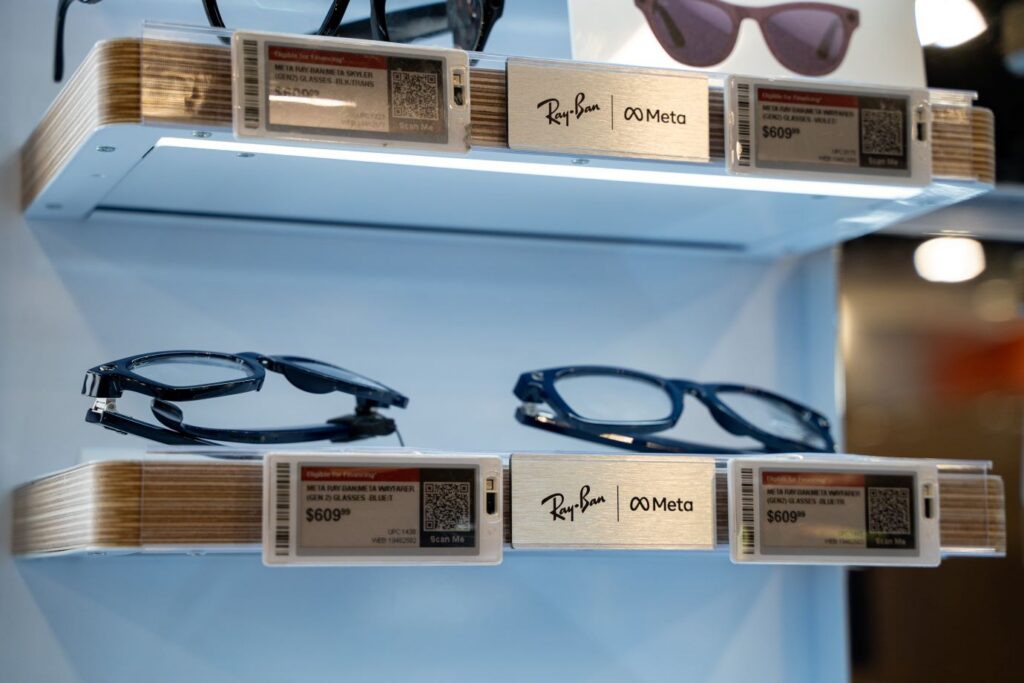
Researchers are warning that women face new harassment and safety risks from smart glasses which are being used by men to secretly record women and share the footage online.
Smart glasses often look the same as regular glasses but they can record video, audio and location data in real time, and are enabling new forms of harassment and gender-based harms, according to an emergy new global study.
The University of Sydney study has analysed hundreds of social media videos linked to pick-up artist communities, finding that men wearing smart glasses approach women with the aim of getting their phone number or Instagram handle. They then share that online, often generating high audience engagement.
Women were filmed by these men in everyday places like work, retail spaces, the gym or at the beach in swimwear. Women often refused to be filmed, or showed discomfort, but the men continued to film them.
Around 60 per cent of covert Instagram videos analysed showed behaviour that is classified as potential harassment, the study found. In 43 percent of videos, women were exposed to derogatory commentary, and some were identified and doxxed.
Smart glasses can now be purchased in Australia at places like Kmart for less than $100.
“Tech is running at breakneck speed and regulators, a pace behind, cannot regulate harms once they’ve already manifested in the wild,” said Dr Milica Stilinovic, a researcher in the Governing Immersive Technologies team at the University of Sydney.“It’s time for Big Tech to come to the table and slow down the release of more smart glasses so that regulation gets a better scope of what they’re dealing with.”
“Manosphere identity Andrew Tate often tells his army of pickup artists to ask for a social media handle because it appears less pushy. But unlike your phone number, a handle is global.
“You may block someone on your phone, but if they’ve shared footage starring you, someone in the comments might be able to sleuth and find out your handle, name, and location,” she said.
“You’ve basically handed your GPS tracker to the world.”
The research, which is still in the emerging phase, looked at 350 videos that were publicly available on Instagram over the past three years.
Researchers highlighted that smart glasses often provide no clear signal that recording is taking place. This means consenting or opting out like you may do with someone filming on a smartphone, is difficult.

“Smart glasses adoption has accelerated significantly over the past two years, and new products are entering the market all the time,” said Dr Joanne Gray, Chief Investigator of the ARC Discovery Project Governing Immersive Technologies.
Researchers identified a “second layer of harm” that occurs for women because smart glasses allow users to upload, or even livestream, the content they record. It means in-person interactions can be widely distributed online, and in some instances, women are then exposed to abusive comments or social media users revealing their personal details.
“Smart glasses have given pickup artists a new tool to further exploit women,” Dr Stilinovic said.
“We call it ‘ambient capture’ because it is a state of play in which men might seem disarming. They will stalk and harass you in places of work, the stairwell of your apartment building, on the street, in the gym, and at the beach – places where you’d assume some sort of right to privacy.”
“You don’t know if you’re being filmed; that footage is then uploaded, exposing you to a wider web of harassment.”’
Privacy and consent laws urgently needed
Chanel Contos, CEO and Founder of Teach Us Consent, said addressing the privacy issues associated with smart glasses is urgent.
“We all deserve privacy, even in public spaces – it’s not just a right forfeited every time we leave the house,” Contos said.
“At best, smart glasses normalise filming and sharing people without their consent, feeding algorithms designed to reward voyeuristic, rage-baiting content. At worst, they are used as a tool for the sexual exploitation of children, women and other vulnerable groups.
“Young people are asking the obvious question: ‘how are these glasses even legal?’ Right now, there is no existing legal framework in Australia that holds Big Tech to account for profiting from these technologies proven to cause harm.”
Researchers say there is a big gap between the new type of harassment occurring and the efficacy of current laws.
“We already know the kinds of harms these technologies can enable – and so do the companies developing them,” Dr Gray said. “That means governments have a critical opportunity to act early, before these risks become normalised and widespread.”
One key problem is that the content captured by smart glasses often comes across as a regular social interaction on the surface even if there has been no consent.
“As a result, this material frequently falls into a borderline category that is unlikely to trigger enforcement, despite producing real-world harm,” Dr Stilinovic said.