

“The aeroplane changed the way we looked at the world. The washing machine changed the world.”
I was reminded of this quote last week at a roundtable I attended on Australia’s unpaid labour crisis. Often attributed to Margaret Thatcher, it captures something we don’t always acknowledge when we talk about innovation: the technologies that fundamentally reshape our lives aren’t necessarily the ones we expect.
The aeroplane changed the way we move through the world. It globalised us, accelerated business and transformed our understanding of distance. But the washing machine changed something much more intimate and arguably important. It reduced the time and labour required to run a household and freed up hours of unpaid work that had historically fallen to women.
Australia’s unpaid labour crisis is unlikely to be fixed by technology alone, but technology does have a role to play in addressing the trillion-dollar black hole it represents.
The trick is to remember that the most powerful technologies aren’t necessarily the ones that take more from us, but those that give something back.
For much of the past few decades, technology has been designed around optimisation. We’ve been encouraged to become faster, more efficient and more productive, with every new device, app and platform promising to help us manage the competing demands of modern life.
We were given tools that allowed us to answer emails from anywhere, organise our calendars, track our health, monitor our productivity and stay connected in foreign ways.
Some of that was genuinely liberating. Flexible work, instant access to information and automation have created opportunities that previous generations simply didn’t have.
But then a lot of this technology started taking over our lives.
I don’t know a single woman who thinks her 4000 WhatsApp channels are streamlining anything. Instead, they’ve added more noise and more pressure. I’ve archived at least six of mine (sorry, Kindy Group 2026).
In many ways, technology became another way of asking us to stretch further.
Generative AI has started to shift that conversation. Rather than simply being another tool for increasing output, AI has introduced the possibility of technology acting as an assistant. It can summarise meetings, draft documents, organise information and take away some of the repetitive admin that routinely bogs us down. The sophistication of this will only get better.
And increasingly, that same thinking is moving into our homes.
The most interesting consumer technology emerging today isn’t necessarily the technology with the most impressive specifications. It’s the technology that quietly removes some of the everyday drag that takes up our time and, perhaps more importantly, our mental space.
As a working, solo mum, I feel this in my bones.
My days are shaped by hundreds of small decisions and responsibilities that are individually manageable but collectively create a constant background process of planning and remembering.
It’s ordering groceries before the lunchbox supplies run out, booking appointments, signing school forms, organising birthday presents, remembering what needs replacing around the house, and noticing that the lawn needs mowing before friends arrive for the weekend.
None of these tasks is particularly difficult, but the challenge is in noticing them, remembering them and making sure they happen.
For years, Women’s Agenda has covered the invisible work that continues to disproportionately fall to women. The mental load is difficult to measure because it isn’t one enormous task, it’s the accumulation of hundreds of small responsibilities sitting quietly in the background of someone’s mind.
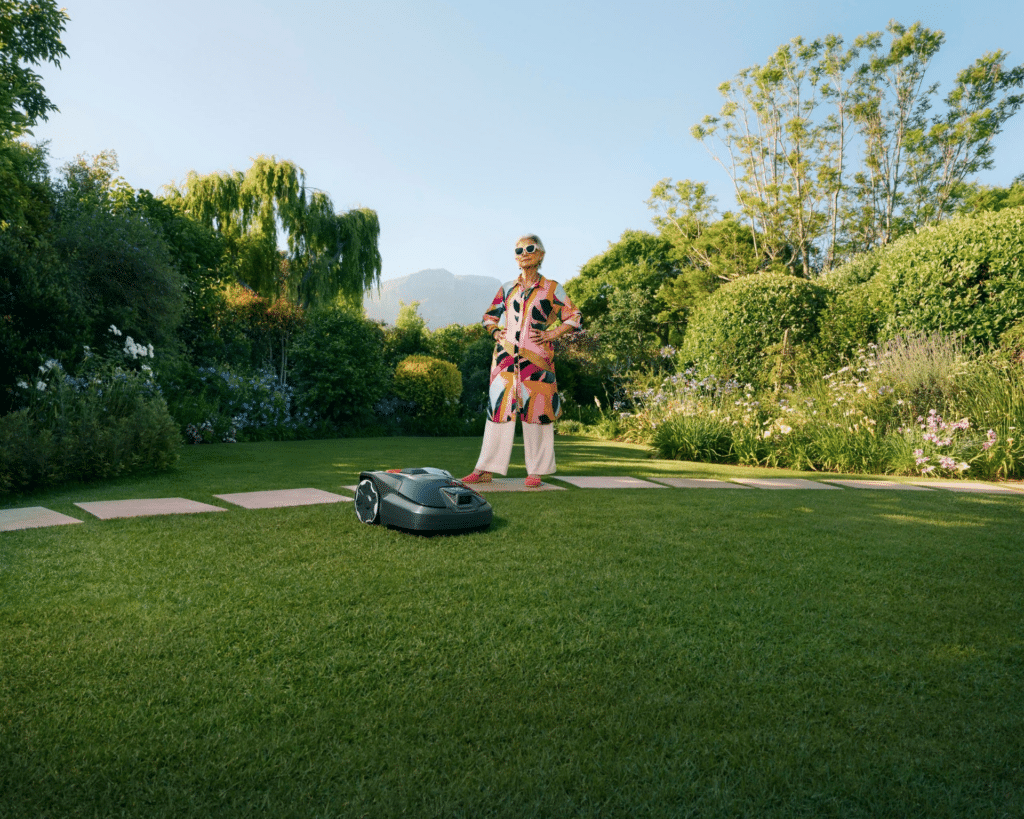
Technology won’t solve that inequality, but smarter tools can reduce some of the unnecessary cognitive burden that so many people (largely women) carry. That’s why I’ve become increasingly interested in what I’ve come to think of as “headspace technology” that quietly removes something from our list, and why I enthusiastically took up the opportunity to recently test out Husqvarna’s Automower® 308V robotic lawn mower.
Lawn equipment has traditionally been marketed around power and performance. Products have been designed around the person using them rather than the responsibility they might remove from someone’s life.
But after living with the Automower® 308V for several weeks, I am ridiculously grateful that this quiet automation has genuinely removed a monotonous and unavoidable household responsibility.
Husqvarna has been perfecting robotic lawn care for decades with the express objective of removing household burden. Swedish-designed, there are now four million robot lawn mowers quietly alleviating the load for families worldwide.
Using intelligent navigation technology, the mower maintains the lawn with minimal involvement. Through the connected app, I can monitor it, adjust settings and manage it remotely, whether I’m working, travelling or away on holidays.
The lawn simply became something that no longer required my attention.
And that’s the sweet spot for new technology.
Every responsibility that quietly takes care of itself creates a little more room for work, family, rest, or simply a moment when your brain isn’t running through the next thing that needs to happen.
And that’s why we need to keep asking the simple question: Does this technology make life easier?
Does it reduce the number of decisions we need to make? Does it give us back a little bit of capacity?
Because buying back even a fraction of time in a hectic life, might be the smartest innovation of all.
You can learn more about Husqvarna’s robotic range, here. Or book a free lawn assessment today.
Disclosure: Women’s Agenda’s editor was able to trial the Husqvarna Automower® 308V. Views in this piece are her own.