
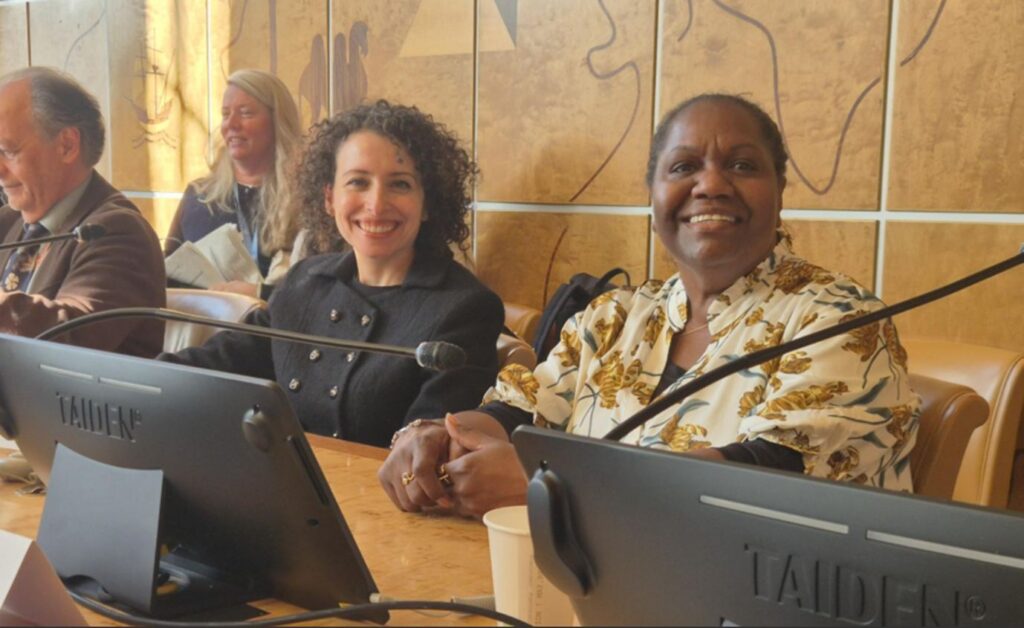
The fight to clean up Wittenoom’s asbestos has reached the United Nations, after a Banjima Traditional Owner and Australian documentary filmmaker travelled to Geneva to bring attention to the legal case.
Johnnell Parker, a Banjima Traditional Owner, and Yaara Bou Melhem, the director and producer of Yurlu | Country, spoke at an official UN event last week, calling for the remediation of the the Wittenoom contamination on Banjima Country in Western Australia’s Pilbara region.
Wittenoom is the largest contaminated site in the Southern Hemisphere. The area was contaminated by decades of asbestos mining, leaving Aboriginal people in Western Australia with the highest rate of mesothelioma deaths in the world. It is linked to more than 4,000 deaths, according to the Asbestos Diseases Society of Australia.
Last month, the traditional owners of an area launched a $1.5 billion legal claim against the Western Australian government over the asbestos contamination and its ongoing impacts on First Nations people. Wittenoom is located about 1,400 kilometres north-east of Perth.
Bou Melhem and Parker took part in an official UN Side Event at the 61st Regular Session of the Human Rights Council, speaking about the injustices of the contamination.
“Despite the legal efforts of the community over years, and despite the apparent successes in the legal processes regarding Native Title and the ban of asbestos, at the end of the day, the reality of toxic contamination of the land and of the people are appalling and heartbreaking,” said Marcos Orellana, the UN Special Rapporteur on toxics and human rights.
“It’s a predictable, inevitable result of a system that has made a choice time and time again to prioritize industry over Indigenous lives. And this is what we call environmental violence,” said Ghazali Ohorella, Legal Consultant of International Indian Treaty Council.
While in Geneva, Bou Melhem’s documentary Yurlu | Country won the Vision for Human Rights Award at the International Film Festival and Forum on Human Rights. This is one of the world’s leading human rights film prizes.
“Yurlu | Country shows clearly how human and environmental rights violations compound and intersect through corporate impunity and government complicity in abnegation of human rights obligations. In the face of a new rush to exploitation, extraction and encroachment everywhere, its urgency is undeniable,” the jury statement for the FIFDH Vision for Human Rights Award said.
Feature image: Director & Producer Yaara Bou Melhem & Banjima Traditional Owner Johnnell Parker at the UN Human Rights Council, Geneva, Switzerland.