
Women with late-diagnosed ADHD are used to being gaslit or dismissed. Which is why watching Attention Deficit was such a distressing experience for many women with ADHD in Australia, myself included.
Attention Deficit, which aired on April 20, was hosted by respected public health commentator, Dr Norman Swan. Since then, I’ve received many messages from women saying how gaslit they felt and how damaging it was, just as they were beginning to feel better understood.
While it’s great to see ADHD receiving attention in high-profile spaces, it’s critical that research findings and their meaning are presented responsibly. Sadly, this program failed on both fronts. It took a selective approach that only served to reinforce stigma in an already highly stigmatised disorder. This risks shaping public understanding in ways that have damaging, or even dangerous, real-world consequences for women.
It casts suspicion on women finally accessing care in meaningful numbers, completely ignoring research findings that clearly explain the rise in diagnoses in women.
It got the direction of the misdiagnosis wrong
Attention Deficit proposed that ADHD is overdiagnosed in many places, and implied that the significant increase in women aged 25-44 in particular, is due to ‘social contagion’.
In the linked promotional clip from ABC News above, Swan states that for “hipsters” in certain suburbs “…there’s also probably what’s called social contagion going on. You talk about it more, you hear about it more, you’re watching the same TikTok videos, which misleads you into thinking that you might have ADHD when you could have something else”.
What’s missing from that framing is the simplest explanation—and the irony: for huge numbers of women, this isn’t a wave of “misdiagnosis” of ADHD. It’s a correction of often devastating misdiagnoses they’ve been subjected to, often for decades, while the underlying ADHD went unrecognised.
Research consistently shows women are more likely to be missed or misdiagnosed, often being treated for anxiety, depression, and even personality and mood disorders, while the underlying ADHD remains unrecognised. This expert consensus statement on ADHD in females outlines these patterns clearly.
I spent more than 30 years seeing mental health professionals who told me I had anxiety and depression, until I was finally diagnosed in 2020 at age 49. This diagnosis changed my life. Decades of being told I’m a terrible listener felt the same as being told I’m a horrible, selfish person over and over. The impact on my self-worth was devastating.
Finally, I could see I didn’t have a flawed character. I had a neurological condition.
But I got off lightly. Countless people were prescribed medication for misdiagnosed psychotic disorders. Not surprisingly, their mental health didn’t improve; it got worse. In some cases, they lost years of their lives they can’t get back.
It used a benchmark that didn’t include women
The issue isn’t that the data was wrong. It’s how it was presented. The episode used research findings about rates of ADHD in adults as evidence of overdiagnosis. However, these numbers (2.5-3%) don’t paint the full picture.
Experts now see ADHD as usually lifelong—and research shows childhood rates of 5–7%. It’s not surprising that these numbers don’t add up, given that ADHD has historically been diagnosed based on what it looks like in young boys. In other words, experts believe that women have largely been left out of those numbers.
It honed in on visual data that was misleading
To understand what’s actually happening with rates of any condition, you need to look at the full picture—over time.
This chart shows ADHD medication prescriptions by sex in Australia for a longer time frame than was shared in Attention Deficit. When you extend the time-frame, the rise in prescriptions for women looks a lot less like a random explosion of diagnoses. By showing only the numbers from 2019 onwards, Attention Deficit painted a very different picture. [Source]
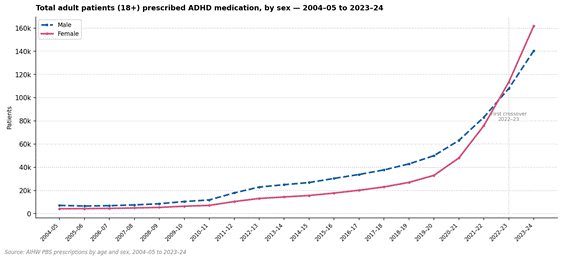
In fact, in 2024, fewer than 2% of adult Australian women were prescribed ADHD medication—less than even the conservative numbers used (2.5–3%)—suggesting a huge number of women with ADHD are still undiagnosed.
It ignored what life with ADHD looks like for women
One of the biggest omissions that likely explains why more women are getting diagnosed than men is what life with ADHD is like for late-diagnosed women.
Women aged 25 and older are juggling the lion’s share of childcare and the household mental load alongside careers, while hormonal shifts over the menstrual cycle, pregancy and childbirth and into perimenopause significantly worsen ADHD symptoms.
Research also shows that women with ADHD often experience more psychological distress and day-to-day impairment than men.
I see this all day, every day, with almost every woman I work with bursting into tears during their first coaching session. When I ask what was most helpful at the end of each session, the most common answer—by a mile—is simply being validated, which only demonstrates how invalidated they usually feel.
Add the simple fact that women use health services more than men overall, these factors make it perplexing that “social contagion” was treated as the main explanation for the rise in diagnoses in women when so many other research-backed explanations exist.
Reducing stigma is everyone’s responsibility
Presenting only part of the picture in public health reporting can reinforce stigma in an already highly stigmatised disorder like ADHD. It shapes public understanding in ways that have real-world consequences. Family members, employers, and even doctors can feel justified in being sceptical about the impact of ADHD on women, or even its existence.
When reporting carries this level of standing, it’s essential to interpret research findings and the bigger picture more carefully. Sadly, it’s not surprising that many late-diagnosed women in Australia now feel less well understood than ever.
If you’re a late-diagnosed woman with ADHD and you have family or friends who watched Attention Deficit, you might consider sending them this article to help them understand another side of the story. And I’d love to know: How did Attention Deficit land for you?