
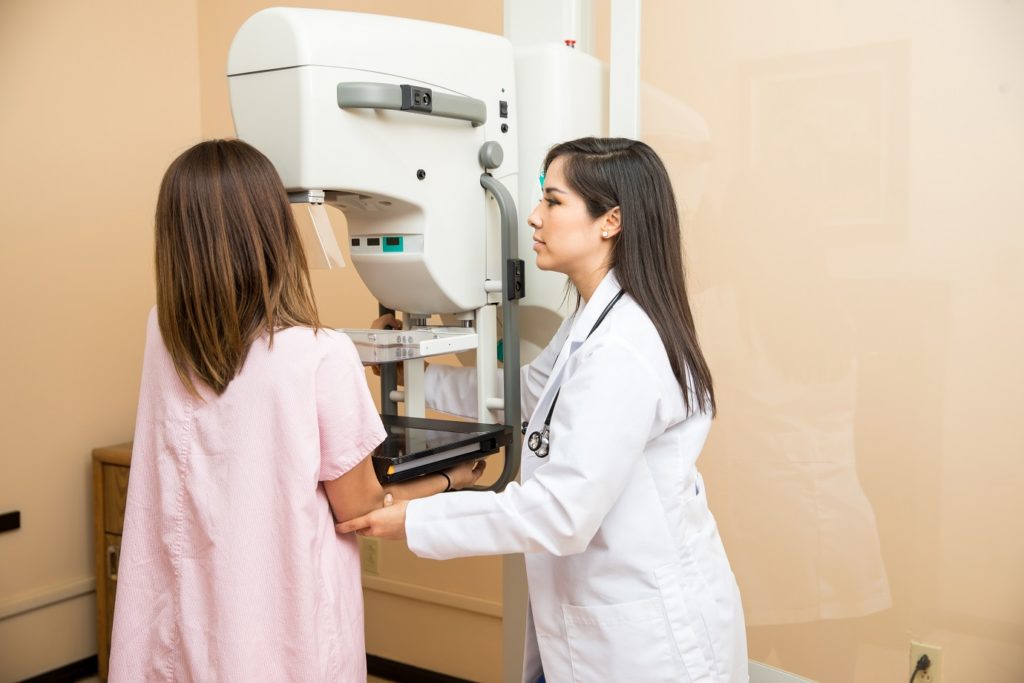
A routine mammogram could one day do more than screen women for breast cancer, with new research suggesting artificial intelligence may be able to use the scans to identify signs of cardiovascular disease.
Researchers in Israel analysed 97,364 mammograms from 29,921 women, using medical records to identify those who had been diagnosed with coronary heart disease or high blood pressure, or who had experienced a stroke.
They then trained a machine-learning model to identify patterns in the mammograms associated with those conditions.
The findings, presented this week at the European Society of Cardiology’s annual congress in Munich, showed the AI model was able to distinguish women who had experienced a stroke with 86 per cent accuracy. It achieved 79 per cent accuracy for high blood pressure and 78 per cent for coronary heart disease.
The results were consistent regardless of a woman’s age or whether she had also been diagnosed with cancer, according to the researchers.
Dr Viana Copeland from Tel Aviv University, who presented the findings, said the potential of using an existing screening tool to identify cardiovascular risks could be significant for women.
“Despite being the leading cause of death in women worldwide, CVD is consistently underdiagnosed and undertreated,” she said.
“One common finding in our medical centre, and around the world, is that when women do seek medical help, their CVD is already advanced. On the other hand, many women do attend routine breast cancer screening, even when they haven’t sought care for cardiovascular symptoms.”
Copeland said analysing mammograms for information about cardiovascular health could offer “a scalable approach without requiring an additional imaging examination”.
“Mammography also reaches many women in midlife, an important period for recognising and addressing cardiovascular risk,” she said.
A new use for an existing test
The research adds to a growing body of work examining whether mammograms could provide important information beyond breast cancer.
Mammograms can show calcification in the arteries of breast tissue, known as breast arterial calcification. While these calcium deposits are not themselves a diagnosis of heart disease, research has linked them with an increased risk of cardiovascular problems.

Earlier research published in the European Heart Journal this year found AI analysis of breast arterial calcification on mammograms could help identify women at greater risk of cardiovascular disease and death, even when traditional risk assessments were taken into account.
That possibility is particularly significant given the longstanding gaps in how cardiovascular disease is recognised and treated in women.
Heart disease is often still viewed as a predominantly male health issue, despite cardiovascular disease being a leading cause of death among women. Women can also experience different symptoms and may face delays in diagnosis or treatment.
Dr Sonya Babu-Narayan, clinical director of the British Heart Foundation, said the research highlighted the potential for technology to help address some of those gaps.
“Heart disease is the world’s biggest killer of not only men, but also women,” she said.
“Despite this, the myth persists that it’s only a ‘man’s disease’, meaning that when it comes to the heart, women are disproportionally unaware, unheard, underdiagnosed, undertreated and typically underrepresented in clinical research.”
She said it was “exciting to think” that, if the findings were further validated, AI could help identify cardiovascular disease earlier and support prevention.
“AI could one day allow breast cancer screening programmes to become dual-purpose, helping to flag women with the highest risk of dangerous cardiovascular disease, as well as spotting breast cancer early,” she said.
More research needed before clinical use
The findings are not yet a sign that mammograms can replace existing cardiovascular screening or that women should rely on their breast screening results to assess their heart health.
Researchers are continuing to improve the AI model, including working to reduce false results and expand the range of cardiovascular conditions it may be able to detect.
Elena Arbelo, an expert member of the European Society of Cardiology’s communications committee, described the findings as “compelling”, but said further work would be needed before the technology could be widely introduced into clinical practice.
“A mammogram may one day do more than look for breast cancer — it may also offer a window on to cardiovascular health,” she said.
“The challenge now is to establish accuracy and reliability — to move from experimentation to clinical implementation.”
For now, the research offers another glimpse of how women’s health screening could evolve — and how a test millions of women already undergo could potentially provide a broader picture of their health.
If validated and adopted in clinical settings, a mammogram could one day offer women information not just about breast cancer, but about another major health risk that too often goes undetected until it is already advanced.