

The real differentiator for women building a successful and sustainable business isn’t confidence. It’s a willingness to act despite lacking confidence and regardless of the uncertainty. Sarah MacDonald shares the process, 12 years since starting Canine Comprehension.
One of the biggest misconceptions about entrepreneurship is that successful founders are naturally confident people. After more than a decade running a business, I don’t think that’s true. In fact, one of the most surprising things I’ve learned is how often business owners make important decisions while feeling uncertain, unqualified or completely out of their depth.
When I started Canine Comprehension, I certainly didn’t feel brave. I was a teacher with a passion for helping young people and a belief that dogs could play a meaningful role in supporting wellbeing and learning. What I didn’t have was a business degree, investors, a strategic plan or a detailed understanding of how to build an organisation. Looking back, it’s easy to craft a tidy narrative in which one thing neatly led to another. The reality was far messier. Like most founders, I was making decisions with limited information and learning as I went.
Over time, that small idea grew into Canine Comprehension, an organisation delivering animal-assisted education and mentoring programs in schools and community settings across Victoria.
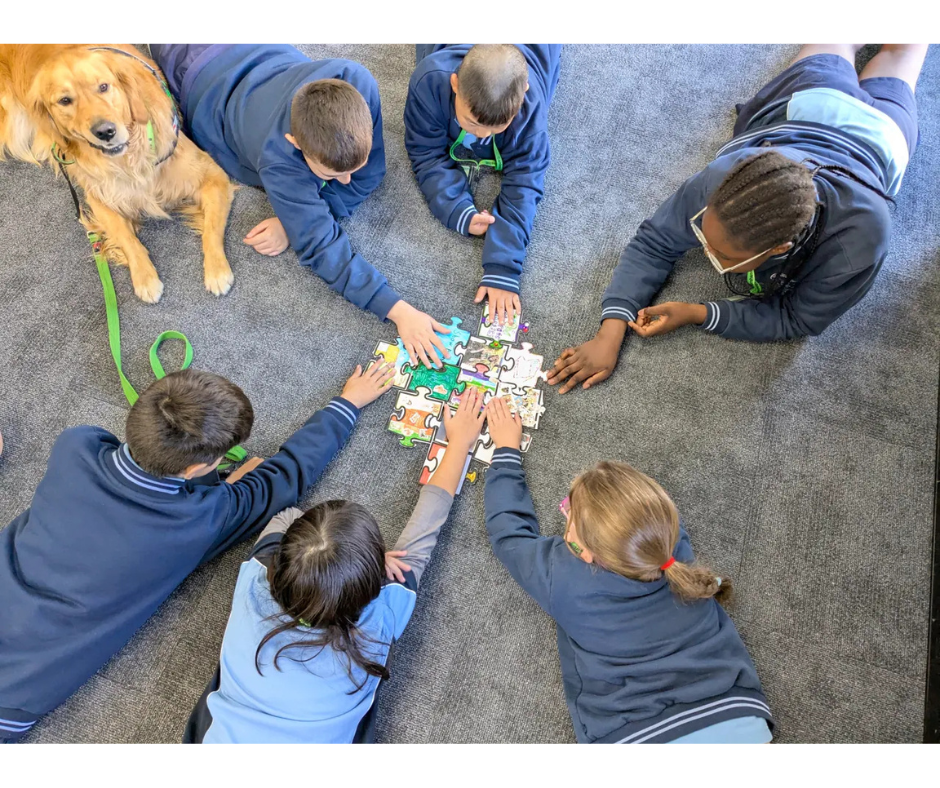
On any given day, our mentor-and-therapy-dog teams might be working in a primary school, a wellbeing space or a community setting. A typical session involves a small group of young people gathering in a calm room where a therapy dog is already settled on a mat. Sometimes students play problem-solving games with the dog, making learning feel less intimidating. Sometimes the focus is on wellbeing, communication or social skills, with the dog acting as a calming presence and a natural bridge for connection and conversation.
While the dog often attracts the attention, there’s a great deal happening behind the scenes. Mentors are constantly reading the room, adjusting activities, supporting individual needs and ensuring the dog’s welfare remains front and centre. Beyond the sessions themselves are the less visible parts of the work: planning, scheduling, preparing resources, measuring outcomes and working closely with schools to support young people who haven’t always found success through traditional approaches.
Over the years, building a team of mentors and watching them work with young people has challenged many of my assumptions about confidence. We often think confidence comes first and action follows. But I’ve watched both my staff and students try something difficult before they believed they could do it. More often than not, confidence appeared afterwards, built through small successes and repeated practice.
Looking back, I realised I had been learning the same lesson in business. People sometimes assume that building a business requires a particular personality type: confident, charismatic, fearless. Yet the longer I’ve spent around entrepreneurs (especially women), the less convinced I am that confidence is what separates those who succeed from those who don’t.
What I see instead is a willingness to act despite uncertainty.
Most of the significant decisions I’ve made in business have involved some level of doubt. Hiring staff, expanding services, investing in new opportunities, navigating challenges and making difficult leadership decisions rarely come with complete certainty. There is almost always information missing, risks that can’t be fully assessed and outcomes that can’t be predicted.
Yet many aspiring founders spend years waiting to feel ready. Particularly for women, confidence can feel like a prerequisite. We tell ourselves we’ll apply for the opportunity once we have more experience, launch the business once we’ve done more research, raise our prices once we’ve gained more qualifications or put ourselves forward once we’re sure we can succeed. The problem is that confidence often doesn’t work that way.
In my experience, confidence usually develops after you’ve done the thing you were afraid of. You gain confidence by having difficult conversations and discovering that you survived them. You gain confidence by making mistakes and learning that they weren’t catastrophic. You gain confidence by taking responsibility for decisions and realising that perfection was never an option anyway.

Running a business has taught me that certainty is overrated. Most founders are not operating with a secret advantage or a clearer roadmap than everyone else. They’re simply making the best decision they can with the information available and adjusting when circumstances change.
That’s not always a comfortable way to operate, but it is a realistic one.
It has also changed the way I think about leadership. Earlier in my career, I assumed leaders were people who projected confidence and always knew the answer. Now I think leadership is often about being willing to make decisions when there isn’t a perfect answer available. The founders I admire most aren’t necessarily the loudest voices in the room. They’re the people who continue moving forward despite uncertainty, remain open to learning and accept that mistakes are part of building anything worthwhile.
After twelve years in business, I still don’t feel completely confident. I still face decisions that make me uncomfortable. I question myself and I still wonder whether I’m getting things right.
The difference is that I no longer see those feelings as evidence that I shouldn’t proceed. If anything, I’ve learned they’re often part of the process.
The myth of the brave founder suggests that successful business owners possess some special reserve of confidence that others lack. My experience has been the opposite. Most founders are simply ordinary people who decide to take the next step before they feel fully prepared.
The confidence comes later.