
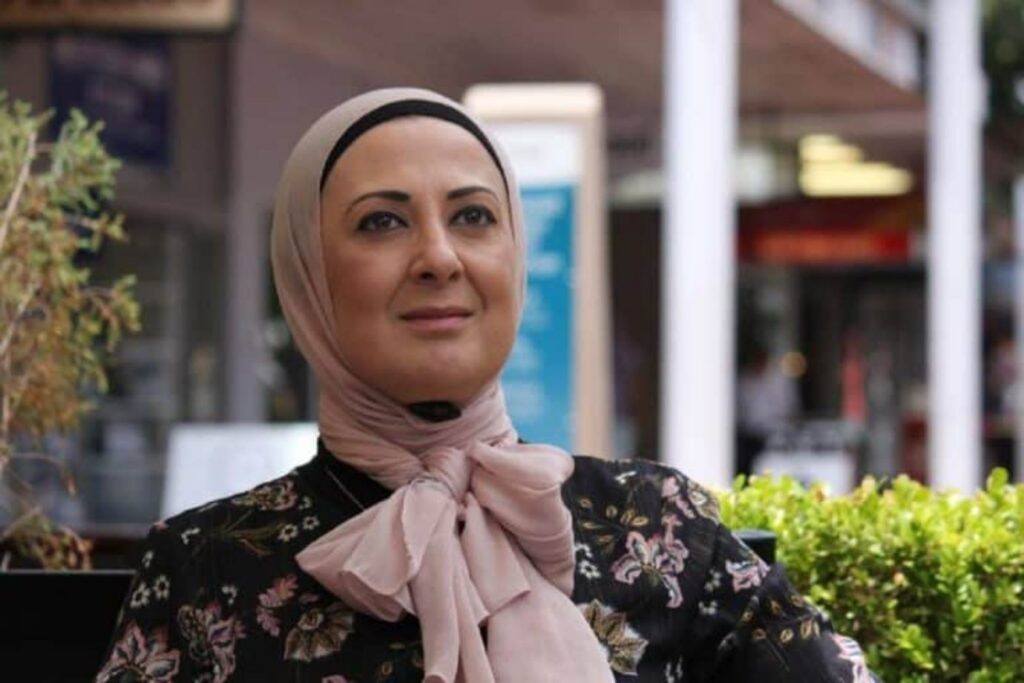
My daughter was born in Australia. Over the past six months, she has started calling in sick because she doesn’t feel safe travelling to work. She avoids Westfield Bondi Junction. She checks WhatsApp groups where young Muslim women warn each other which suburbs feel dangerous and when tensions are high.
This is not fear that spikes and recedes. It is constant.
Last week, the Australian Human Rights Commission put a name to it. Its report, The Struggle to Be Seen, the Power in Being Heard, documents hundreds of Jewish, Muslim, Palestinian, Arab and Israeli Australians describing the thing: fear that has hardened into a context. So many communities, living parallel versions of the same anxiety.
I came to Australia from Lebanon three years before September 11, a new migrant and a Muslim woman at a time when suspicion towards people like me became reflexive. I have spent 25 years since working in refugee and migrant resettlement. Back then Islamophobia felt like an overreaction to extraordinary events. It had not yet hardened into the background hum of Australian life.
My daughter never knew that version of Australia. She chose to wear a hijab as a teenager. For her, suspicion has always been ambient. But what she describes now is different. It’s not just stares or comments. It’s the calculation before every ride, every shift, every outing. It is the mental map of places she once moved through freely but now avoids.
The Commission’s language matches what she describes: racism that “homogenises, diminishes and silences communities”, while “dehumanising and isolating individuals.” The rise in racist incidents are not anomalies. It is an escalating pattern.
This is what the stealthy normalisation of xenophobia looks like. It’s not always loud. It’s anticipatory. It shapes where people go, what they wear, whether they show up to work.
But each time an act of violence is carried out by someone claiming affiliation with Islam, scrutiny expands beyond the perpetrator. It settles over an entire community.
Consider the asymmetry. After the Christchurch mosque shootings, perpetrated by a white Australian, no one demanded that white Australians apologise or prove their loyalty. When women are killed in domestic violence incidents — a national crisis — we hold individuals accountable. We do not condemn “Australian culture” or ask Australians as a whole to answer for those crimes.
Why, then, does collective blame attach so readily to Muslims?
After the Lindt Cafe siege, Muslim Australians braced ourselves for backlash. A close friend of mine — Australian-born, as were her children — was verbally abused on a train and told to “go back where you came from”. Her children turned to her in tears and asked, “But where did we come from?”
Race Discrimination Commissioner Giridharan Sivaramans word’s stay with me: “the sting of every racist slur, every hateful sign, is a reminder that the structures meant to safeguard us are standing still, allowing harm to flourish.”
Here is what makes the current moment harder to bear. The Commission delivered its National Anti-Racism Framework 18 months ago. It contains 63 recommendations that lay our protections for communities living exactly through the reality this new report documents. The federal government is yet to commit to a single one.
Language matters.
Pauline Hanson has claimed there is no such thing as a “good Muslim”. Barnaby Joyce has argued that multiculturalism should give way to “Australian culture” — a phrase that remains conveniently undefined. Bob Katter has repeatedly called for “no migration without assimilation”.
When suspicion is framed as common sense, when politicians describe multiculturalism as a problem to be solved rather than a strength to be defended, exclusion starts to feel reasonable. And overtime, it becomes the default.
This did not arrive from elsewhere. It was built here – in our media, in our politics, and in the slow drift of what has become acceptable to say about your neighbours.
Belonging cannot flourish where suspicion is ambient and citizenship feels conditional.
I keep thinking about my friend’s children on that train, bewildered and in tears. Their question echoes more loudly now, for my daughter and for many Muslim Australians born here who have never known another home.
If we are told to go back, again and again, the question becomes unavoidable: in the country we were born into, where exactly are we supposed to go?