

There’s no shortage of world-class research or ambitious ideas in Australia, so why aren’t we building more global companies? The challenge now is to translate this ambition into action, building the systems, investment pathways and culture needed to build thriving companies and economic resilience.
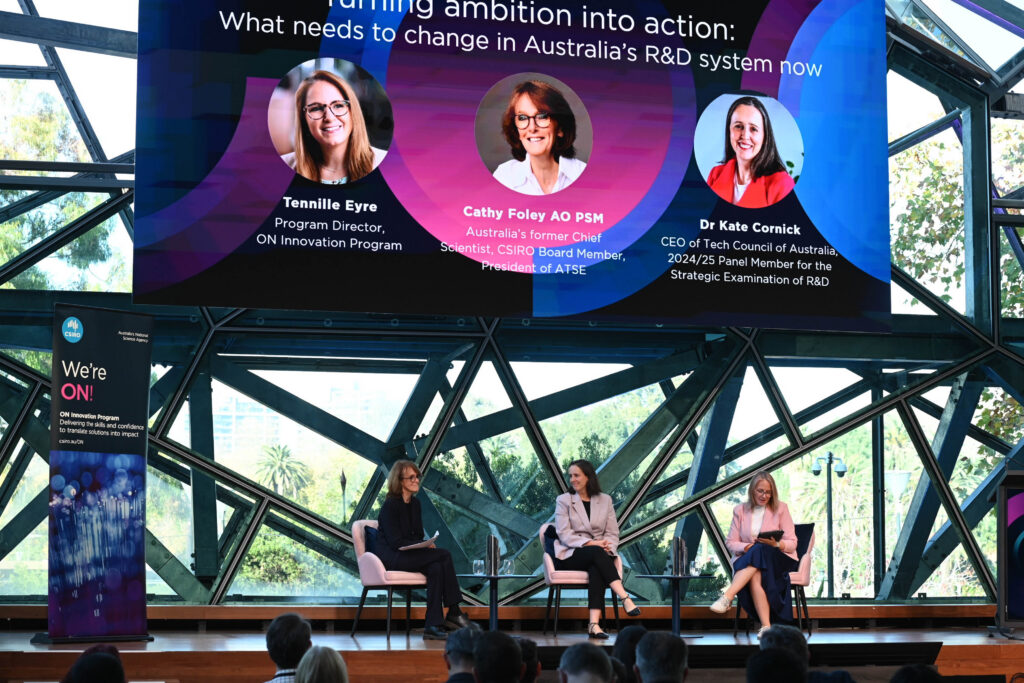
This was the focus of a fireside conversation between former Chief Scientist Dr Cathy Foley and Tech Council Australia CEO Dr Kate Cornick at CSIRO’s 2026 ON Translate event, where they joined Program Director of the ON Innovation Program, Tennille Eyre, to discuss what needs to change across industry and government to help Australia move into the next phase of growth.
According to Dr Foley and Dr Cornick, Australia’s next chapter of innovation will depend on building a united focus across sectors and developing a greater willingness to take considered risks.
Building the innovation “flywheel”
Dr Cornick, who contributed to the Strategic Examination of Research & Development (SERD) report Australia’s Science and Research Priorities: Ambitious Australia, said Australia’s innovation system needs to operate more effectively as a connected ecosystem.
The report identified a need for a stronger “flywheel”, where foundational research creates knowledge, that knowledge supports the creation of new companies, those companies grow and create jobs, and then both the private sector and government can reinvest into research.
“It sounds quite straightforward, but it’s fair to say that flywheel has never really worked [as] effectively in Australia as it could,” Dr Cornick said.
Dr Cornick pointed out the complexity of Australia’s current system, with hundreds of programs spread across multiple government portfolios.
“There is actually an awful lot of money that flows around the R&D system in Australia, but it’s spread across over 150 programs,” she said. “If we’re going to focus that money in a better way, then we will end up better for it.”

Backing our strengths
For Dr Cathy Foley, one of the challenges facing innovation is a tendency to spread resources too thinly, rather than narrowing its focus to one area where the country can lead globally.
“One of the things we’re not good at doing in Australia is focusing on where our strengths are,” Foley said. “We tend to do a little bit of everything instead of saying ‘where can we have a lot of strengths?’”
Dr Foley pointed to the recent example of quantum technology to explain that Australia can successfully build entirely new industries when research, government and industry align with a clear focus.
After decades of investment in research, the quantum sector has grown from a small research community into a growing industry with more than 50 quantum companies.
“We now can say Australia has a new industry that came out of the research sector, and we need to do that more in other areas,” Foley said.
A key part of the sector’s success was not waiting for the government to create change, according to Foley.
“Governments have a lot on their plate,” Foley explained. “But we also have a lot that we can empower ourselves to do, and that is to organise ourselves and be coordinated, not be fighting over the crumbs.”
The scale-up gap
The ability for innovators and entrepreneurs to scale up is one of the biggest barriers Australia faces. Dr Foley said Australia has become much better at supporting early-stage ideas, but the transition from a promising research project to a globally competitive company remains difficult.
“Especially in the deep tech area, you have to get to a certain point to be able to attract the investment,” Dr Foley said. “There’s a real sort of gap there. You might call it a valley of death.”
“That translation stage of small to medium and then to growth is we’re still working out how to do that.”
Both Dr Foley and Dr Cornick warned against duplicated efforts that are happening across different states, instead encouraging a coordinated focus to allow companies to reach their next stage of growth.
Changing our risk-averse culture
Australia’s innovation challenge is also cultural, according to Dr Cornick, who explained that Australia’s appetite for risk is quite low compared to similar OECD nations.
“I grew up in the UK, and my impression of Australian culture was really risk-taking. It was the snowboarder, the skydiver, the guy jumping into the ocean, chasing sharks,” Dr Cornick said.
But actually, Australia has an extraordinarily risk-averse culture, especially when it comes to business and investment, she said.
“I know from my own experience, when I ran a startup for over a decade, it was much easier selling to the UK than selling into Australia,” Dr Cornick said.
“In Australia, they did not want to take the risk of working with a young company, and we still hear startups that are having these problems today.”
Activating private investment
Another key challenge is unlocking private investment into deep tech and innovation. Dr Cornick said Australia needed to look beyond government funding and build a stronger investment ecosystem.
“Government can’t afford to invest [alone]. We have to activate the private sector,” she said.
“We really need to be thinking: How are we activating our angel communities? A big part of that is actually education, and it’s taking angels who have bought software and saying, actually, there’s really exciting opportunities here in quantum, in biotechnologies, in ag tech, in med tech, and how do we help those investors get more confident investing in deep tech?”
She said Australia needed to build greater confidence among angel investors and venture capital funds to invest in areas such as quantum, biotechnology and advanced manufacturing.
“We need many more [venture funds] in this space,” she said.
It’s time to think big and global
Dr Foley’s key advice for researchers and innovators considering commercialisation is simple: don’t be afraid to take a chance and ask for help along the way.
“Don’t be afraid to have pride in what you’re doing,” Dr Foley said. “It can be such an uplifting experience to be able to commercialise something and see it make an impact.”
She encouraged researchers to think globally rather than comparing themselves with local competitors.
“We’ve got to stop fighting. We’ve actually got to be globally competitive and think in those ways,” she said.
Foley said commercialising research was an opportunity for individuals, but also essential for Australia’s future prosperity.
“Australia has to, between now and 2050, move about $300 billion of our exports away from fossil fuels,” she said. “If we’re going to be a successful, prosperous country, developing new industries is absolutely urgent.”
For Cornick, the key reason for optimism comes down to the people working in innovation.
“I actually think it’s our people,” she said.
“We have phenomenal people. We have phenomenal research ideas. We’ve just got to unlock them and provide the right support.”
Turning potential into momentum
The message from ON Translate was clear: Australia has the research capability, talent and ambition to build more globally competitive companies.
The next step is turning that potential into momentum through stronger pathways to commercialisation, more coordinated support across the ecosystem and a greater willingness to back innovation at scale.
Read more from ON Translate 2026 here.