
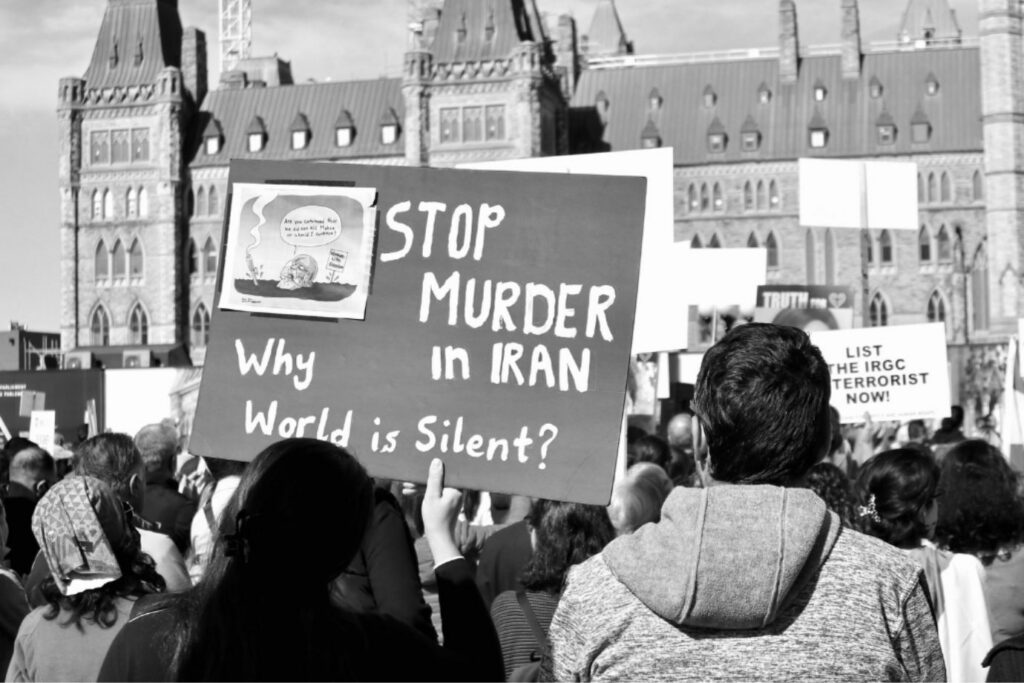
Sofia Stidham speaks to two Iranian women artists who left Iran within the past year, witnessing civilian casualties from afar while fearing for the lives of their families under the country’s internet blackout. Below, she explores why listening to the art and emotions of Iranian women is urgent at a moment when direct political action feels impossible.
“Politics, as an Iranian person, is part of my life. I cannot separate it from my personal life,” an artist told me over the phone. “It can affect any part of my life, and also it affects my art vision.”
An American anti-war pop art exhibition at Tehran’s Museum of Contemporary Art in May 2026 underscored this sentiment, highlighting how creative expression provides a site for Iranians to grapple with political violence.
Indeed, coinciding with the exhibition’s opening, the first half of 2026 was marked by ceaseless violence against Iranian civilians, both at the hands of their own governments and external actors. Iranian surgeon Dr. Amir Parasta’s analysis conveyed that 30,304 people were killed during anti-government protests in a 48-hour time period from Jan. 8 to 9, 2026.
The Human Rights Activists News Agency reported Iran’s death toll increased by 3,597 from the U.S. and Israel’s strikes until April. Even following the war, Amnesty International announced that Iranian authorities are continuing to execute civilians for political reasons.
This mass-scale of bereavement, however, cannot occur without the exponentiation of grief, and every slight numerical increase to Iran’s casualties conceals these emotions.
Two interviews I conducted with Iranian women artists abroad reveal the difficulty of processing recent political brutality. Both women are given pseudonyms to protect their safety.
Women have often borne the burden of Iran’s gender-targeted state policies, such as the hijab laws that led to the murder of Mahsa Amini by police in September 2022. Thus, they stand at the epicentre of the country’s political sufferings.
Anahita, an artist born in southeast Iran, likened her art to a language of pain. “I am autistic, although nobody outside my family knows that” she noted. “I spent an unbelievable amount of energy trying to control that storm inside me.”
“Masking and controlling myself was one of the hardest and maybe even saddest things I’ve had to do,” Anahita expanded. “Art was the only language I knew for speaking to the world.”
“It was surprising to see how deeply recent events entered my work,” she said. “It feels like my head is being held underwater while I watch one tragedy after another.”
“For months, I felt emotionally frozen,” Anahita expressed. “Then one night, after finishing the final sculpture in the series, I turned off the studio lights and sat for hours looking at this thin, fragile body under the moonlight.”
“Suddenly, after four months, I started crying uncontrollably in the middle of the night,” she described. “It was as if the sculpture itself finally told me what I had been carrying inside.”
Anahita, however, resisted victimisation of herself and other Iranians. “Whenever there is an earthquake or flood in Iran, it is the people — inside and outside the country — who come together to help each other, not the government,” she said. “Iran has survived because of its people.”
Sara, another artist who lived in Iran until last year, demonstrated the constant torment of living away from family and friends in warzones. “It’s like you’re missing a beloved person that you cannot join the funeral to mourn for,” she said.
Sara created an art installation as a substitute space for mourning. “It was like a funeral,” she stated.
Sara placed a Persian garden over red ink, asking exhibition visitors to spray water on it to reveal her self-portrait beneath. According to Sara, the red ink symbolised “the crime against normal people” in Iran. “The purpose of this installation was to show that it’s maybe impossible to wash out all the red ink,” she clarified.
Similarly to Anahita, Sara felt that the recent surge of brutality toward Iranian civilians altered the trajectory of her art. “My hand is too short to be helpful, so I try to make my voice louder in my works,” she asserted.
In January, Sara started painting candles, referencing the 88-day-long government-imposed internet blackouts in its social media captions.
“Fire can make everything brighter, but at the same time, it can burn everything,” she explained. “Sometimes it can be related to anger and violence we experience these days. It is more than a simple flame that can bring hope for broken hearts.”
Anahita foregrounded a similar co-existence of optimism and devastation. “I hope one day we can speak about things completely different from all of this — simpler, calmer, and sweeter things,” she concluded her interview.
In spite of all her grief, Sara knows that it will not last. “My studio, my home, is still there, waiting for me to go back and finish my works,” she asserted. Both Anahita and Sara’s art reveal what casualty figures cannot. It does not erase devastation but rather becomes the light they carry through it.