

Guided by generations of strong Aboriginal leadership, entrepreneur Mundanara Bayles has built a career dedicated to empowering First Nations people. Through her ventures BlackCard and BlakCast Productions, she uses strength-based narratives to create spaces where culture, community and self-determination can thrive.
Mundanara Bayles is a powerhouse. As a proud Aboriginal woman connected to Wonnarua, Bundjalung, Birri-Gubba, and Gangulu peoples, every big idea she brings to life centres around one thing: black excellence.
“Using strength-based language and having a strength-based narrative with everything I do is so important,” Mundanara tells Women’s Agenda.
“Not to speak from a deficit and not to speak from a victim mentality.
“Black fellas ran an entire country not that long ago.
“So we’re owners and runners of country and that’s how we should assert ourselves, even though we’re not treated like that.”
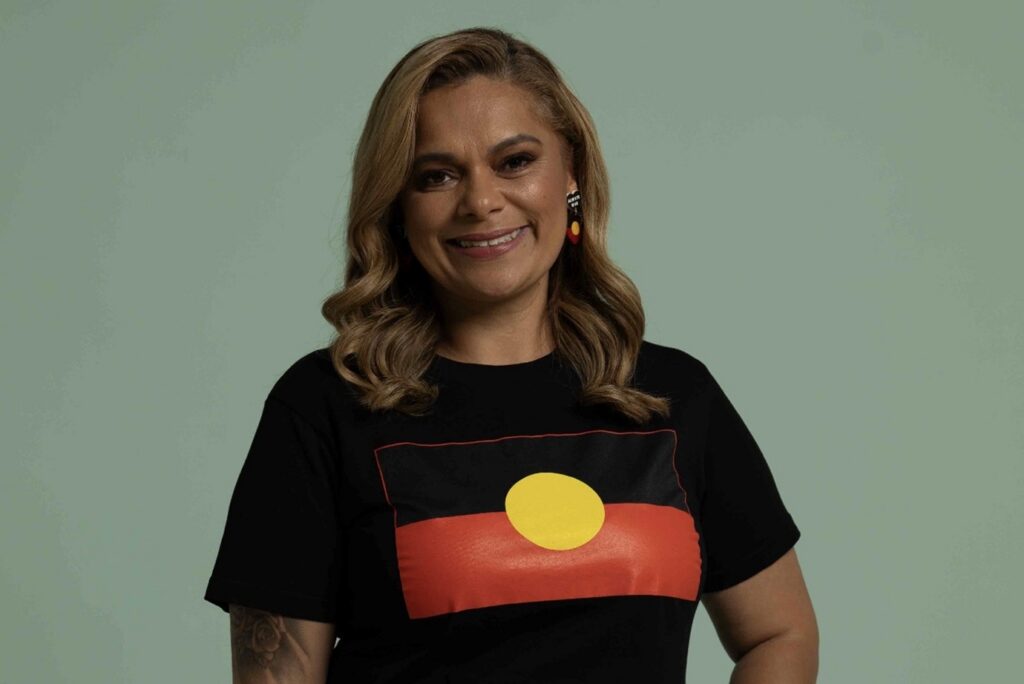
With this fire in her heart, the Sydney-born entrepreneur has been building an empire with cultural training and consultancy BlackCard and First Nations-led media company BlakCast Productions among the ventures she runs.
BlakCast’s productions include Bros and Cons and Mundanara also hosts Black Magic Woman, iHeart network’s first Indigenous podcast, as well as leadership series Culture Capital.
“95% of the business that we’ve acquired over 13 years at BlackCard has come from relationship building, not from tenders, no procurement, no competing,” she says.
“So another black fella said to me, ‘How did you become successful when there’s so much competition?’
“I say: walk into a room without selling something, don’t sell anything. Walk into that room and operate on Aboriginal terms, build a relationship.”

Building on Maureen Watson’s legacy
Mundanara’s success and drive draws back to a woman who spent her entire life inspiring black excellence in her family and Australia more broadly.
Her late grandmother Maureen Watson was a renowned activist and storyteller who set up Aboriginal station Radio Redfern in Sydney with Mundanara’s father Tiga Bayles. The station became like a second home to Mundanara.
“[My gran] used to do screen printing, poetry, she was an actress, she had sold-out one-woman shows all around the world,” says Mundanara.
“She used to screen print T-shirts saying, ‘black is beautiful’.
“She used to write poetry and nursery rhymes, and she changed the white nursery rhymes to Aboriginal nursery rhymes and she’d make up these songs and have us sing them.
“So from a very early age, my grandmother was instilling pride, Aboriginal pride, within her grandchildren in a pretty racist country.”
During the 1988 bicentennial year marking 200 years since the arrival of the first fleet, the National Film and Sound Archive (NFSA) says Radio Redfern became the main source of information for people wanting to join protests.
The NFSA says more than 40,000 people attended the Sydney March making it the largest protest in the city at the time since the Vietnam moratorium.
“I remember the protest, my gran with a microphone talking to ABC and talking to media,” says Mundanara.
“There was a massive protest in Redfern Park, massive. I still remember that day. I was five years’ old.
“Most people talk about my dad, but my grandmother influenced my father.
“She had this just beautiful, really diplomatic approach in how she spoke to people. She spoke to people with so much respect and I think that’s what shaped me and how I show up in the world today.
“She would tell us to kill with kindness, to smile in the face of adversity. In moments that we’ve been insulted, the best thing we can do is to respond with kindness.
“Do you know how hard that is?”
Watson’s legacy left such a mark in history that she was celebrated in a Google Doodle.

‘Self-determination in action’
When asked if she ever feels nervous or uncomfortable in a meeting or boardroom, Mundanara says it happens every time. But by focusing her energy on showing up authentically and articulating her message, she manages to leave a profound impression.
“I’m uncomfortable every time I walk in,” she says.
“It’s the most nerve-wrecking thing to do, to walk into a room knowing you’re going to probably be the only Aboriginal person in that room. And thinking if what might come out of my mouth, to whatever someone says around that table, might offend somebody
“Because I’ve grown up in Redfern, I’ve socialised with Aboriginal people and been brought up in my Aboriginal culture since birth. I come from a family of activists as well who have never been afraid to speak their mind and to stand in their truth.
“Now this is self-determination in action – but a lot of our mob don’t even know what Aboriginal terms of reference are, they don’t even know how to articulate our culture.
“And it’s not any fault of their own. It’s only in recent times that we’ve been forced into a position to describe ourselves to the rest of the world so it’s a new thing for Aboriginal people to describe our culture.
“But a lot of us don’t have elders like I do, elders who are academics and could articulate our culture.
“And now I’m out there doing their work.
“I believe that my elders, if they could back in their days, they would have walked into rooms and operated on Aboriginal terms but they could never do that – they weren’t even invited.
“Now we’re walking into rooms and taking over conversations, but in a very respectful, diplomatic way where there’s a knowledge exchange. We’re building relationships. We’re laying the foundations for long-term positive outcomes.”
To young Indigenous women building their own path to success, Mundanara encourages them to stay connected to culture, embrace authenticity and lead with black excellence.
“Reach out to local elders, go to those local events and build relationships and sit with people, hear their stories, make time for them, take them to lunch,” she says.
“Educating ourselves within our own cultural knowledge, that’s where the strength [comes from and why] I feel so strong within my Aboriginal identity to walk into these rooms.
“I don’t feel threatened anymore by people’s titles.”
Thanks to our partner CommBank. CommBank supports women in business and the community across all industries and sectors through its Women in Focus team. For more information head to WomeninFocus.com.au.
This article represents opinions and views of the interviewees’ personal experiences only. It does not have regard to the situation or needs of any reader and must not be relied upon as advice. It is not intended to imply any recommendation or opinion about a financial product or service. Before acting on this information, consider its appropriateness to your circumstances.