
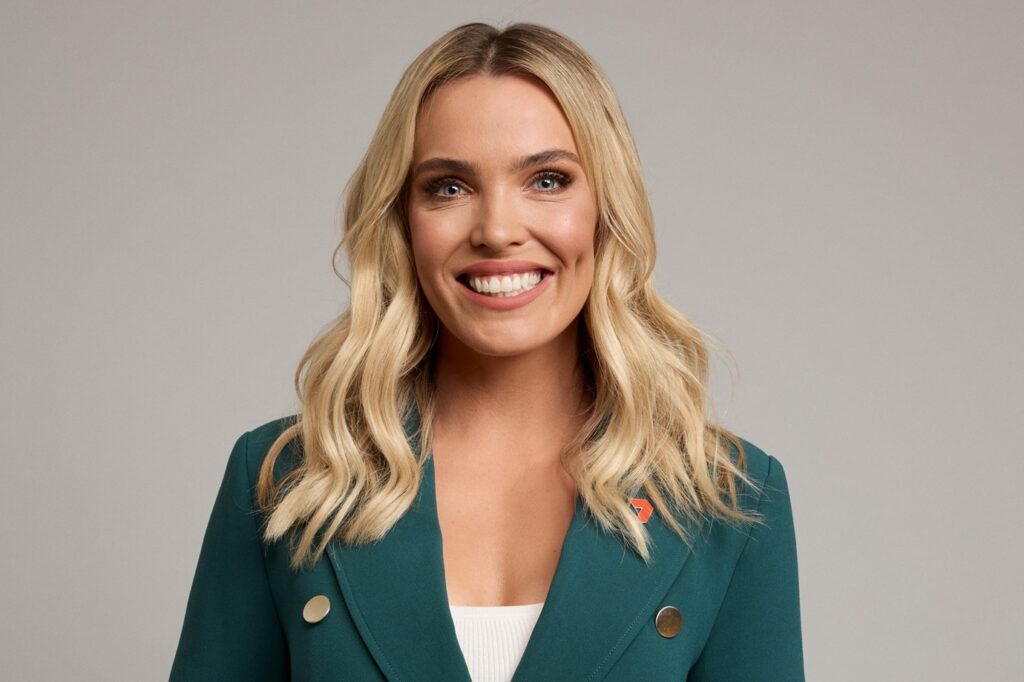
As Abbey Holmes approaches her son’s first birthday, she describes the past 11 months as the greatest time of her life.
The joy the former AFLW player turned sports broadcaster has felt in motherhood has been profound. But it’s also been accompanied by some periods of uncertainty and vulnerability.
“I had a very unique hospital experience, where my husband ended up in emergency at a different hospital straight after cutting the cord,” Holmes shares with Women’s Agenda.
“Those early days and weeks in particular were probably the most challenging, because I spent that entire first few days in hospital on my own.”
Having a brand new baby in her arms, not knowing what she was doing, was really challenging and even isolating, Holmes says.
When her husband needed to return to work quite quickly after leaving the hospital, this was where a new kind of challenge set in. Holmes was still recovering from the physical aspects of birth and suddenly faced the prospect of long days at home alone with her newborn son.
“When [my husband] went back, that was where I felt a sense of loneliness. For me, it was more around being a new parent, and what happens if something goes wrong?” Holmes explains.
Holmes is far from alone in her experiences. According to Women’s Agenda’s new report on motherhood connection, produced in partnership with Medibank, loneliness is the norm rather than the exception for mums in Australia.
Seventy-three per cent of mums reported feeling lonely at least a few times a month, 29 per cent said they feel lonely every week and 8 per cent every day.
Only 38 per cent of women said they felt like they were part of a “village”.
Rebuilding connection as a mum
For Holmes, social connection didn’t come automatically in the weeks and months of early postpartum, it was something she had to actively rebuild. Getting to the point of leaving the house took some time.
“You’ve gone from being able to put your shoes on, pick up your handbag and leave, to being at the mercy of a little baby,” she says.
It was taking some small, achievable steps that ultimately made a difference for Holmes. Daily walks up and down her street become a key part of her wellbeing routine.
“Movement is a big thing for me… it’s not necessarily for anything physical, it’s more the mental,” she said.
She also pushed herself to attend her parents’ group, something she had been a little apprehensive about at first.
“I was a bit hesitant, but I’m so grateful I did because I met some amazing people,” she says.
“We’ve got a WhatsApp group, and we catch up quite regularly. [I found] the other mums were going through the same thing. I think that was really important for me.”
This year’s Motherhood Connection survey showed 28 per cent of mums made genuine, trust-based friendships through formal mothers groups.
Navigating identity and work
Holmes’ decision to return to work seven weeks after becoming a mum made national headlines. She faced a wave of “unwarranted, unwanted” commentary, and a “pile-on” that played out across the media.
“You already have those inner thoughts going, is this right? Is he okay?” she says. “And then the pile-on… was really tough.”
Holmes says returning to work was a personal decision that suited her and her family.
“I’ve always been very career focused, very driven,” Holmes shares. “I went back after seven weeks with the amazing support of my workplace, and throughout my entire journey, they just said we will do whatever you need.”
Returning to work was also a way to build back some social connection that helped Holmes and her son thrive in the weeks that followed.
“For me, my journey was going back to work and having that social connection, and how important that was for me and the way that I operate on a daily basis,” Holmes says.
“Nobody should ever be able to comment on other people’s situation and circumstances, because you don’t know it at all.”
Holmes is quick to acknowledge the role her workplace played in that experience, describing support from the Seven Network and the AFL as “over and above what I ever expected”.
But she also says broader change is still needed for women across all aspects of motherhood.
“We’re still seeing situations where women are being removed from spaces for breastfeeding,” she says. “That’s not okay.”
For Holmes, being supported as a mum is about feeling a sense of belonging.
“You need to be able to feel safe and feel a sense of belonging while still being able to travel and work and live out your dreams.”
In an era of constant commentary and social media comparison, she says other mums should tune out the noise the best they can.
“Your situation and circumstances are different to everybody else’s… what’s right for you isn’t necessarily right for the next person, and that’s fine.”
Find the full Motherhood Connection report here.