
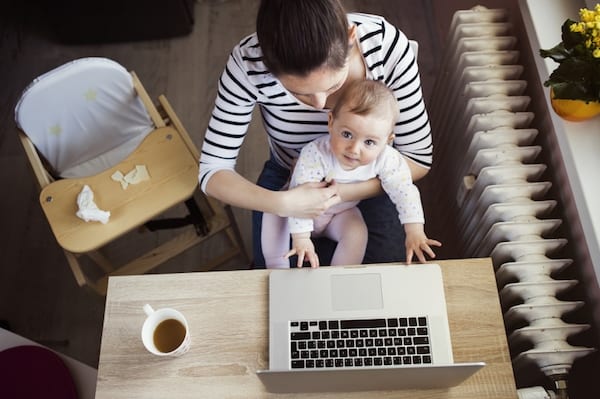

I’m going to use the term mumpreneur, just for a moment.
It’s a word that officially entered the English dictionary in 2011, and has long been used to celebrate the rise of women with small children running businesses from home.
There are some excellent businesses that have been launched and grown this way, and countless profiles and articles regarding the lifestyle benefits of this form of working. Indeed, former small business minister Bruce Billson once declared ‘mumpreneurs’ were driving small business growth in Australia.
But is the rising number of ‘mumpreneurs’ actually a symptom of something happening in corporate Australia?
New research from the University of Sydney points to a bigger problem that’s often ignored, or overlooked regarding the increasing number of self-employed women with dependent children (the study does not use the term ‘mumpreneur’, and I too will stop using it now). Being self employed while raising children can often be considered a lifestyle choice, but actually it’s often a last resort.
Former New York Times journalist and University of Sydney academic Dr Meraiah Foley interviewed 60 self employed mothers and found most establish new businesses at the kitchen table because of unsupportive work environments and the cost of childcare.
She found the major push factors for two-thirds of the women surveyed were inflexible work schedules, poor quality part-time jobs, and discriminatory attitudes towards flexible workers. “More than half of them tried to stay, and only left after really prolonged struggles, and some cases legal struggles,” Foley told me from her home in Singapore this morning.
Six of the women surveyed had been made redundant while pregnant or on maternity leave, reflecting widespread pregnancy discrimination across the workforce.
These are problems we know exist and are significant but don’t always connect when celebrating this growing movement of business owners.
Our system of working is broken, and it’s leaving some women with no choice but to go and create their own such system.
When asked why she decided to pursue this research, Foley said she’s personally been self-employed while raising children and grappled with the “pros and cons of it”. She was surprised to discover there was no research on the impact of motherhood around self employment and approached Professor Marian Baird and Dr Rae Cooper at the University of Sydney to explore why women were making the transition.
So what more can be done to provide more inclusive working environments for mothers?
It starts with flexibility, Foley told me, and ensuring that part time and flexible roles are still interesting, challenging and hold promotion potential.
“This is particularly the case for women who’re more senior in their careers,” she said. “They want interesting work, but they don’t want to have to give up their entire lives with their children to get it.
“Also what really came out in the study was that there’s an obligation for care that goes beyond the practical necessity of it, it’s in that sense or wanting and needing to be there. What I found is that some women will trade off their financial security in order to fulfill that role. They know they’re worse off, but will do it again if forced to choose between workforces that are inflexible and caring for their children.”
One woman quoted in her research said she felt she had to choose between either “using her brain” or accessing the flexibility she needed to be there for her children.
Foley said around 35 of the 60 women surveyed felt “pushed out” by their employers, another chunk saw other women go through it and decided to jump out before they too were pushed. “This is not a good news story at all,” she said.
Meanwhile, Foley added there needs to be more support for self-employed mothers, particularly around superannuation. She found two thirds of the women surveyed were not making superannuation contributions, and most were not building scalable businesses that could provide the kind of wealth they’d need to sustain them through retirement.
Kylie Ostle is one woman who was made redundant while on maternity leave, and has since founded her own business – supporting and connecting other career-minded mums through the Mum Society.
In response to Foley’s research, she said she believes employers and mothers can better work together to ensure both parties can “have it all”.
“Not every new mother needs to rack her brain and turn herself inside out to become a mumpreneur, because she thinks it’s the only way to make an income with Rugrats at her ankles,” she said.
It’s fantastic to see mothers starting great new successful businesses, but we also need to consider if and why they felt excluded from a salaried position in the first place.